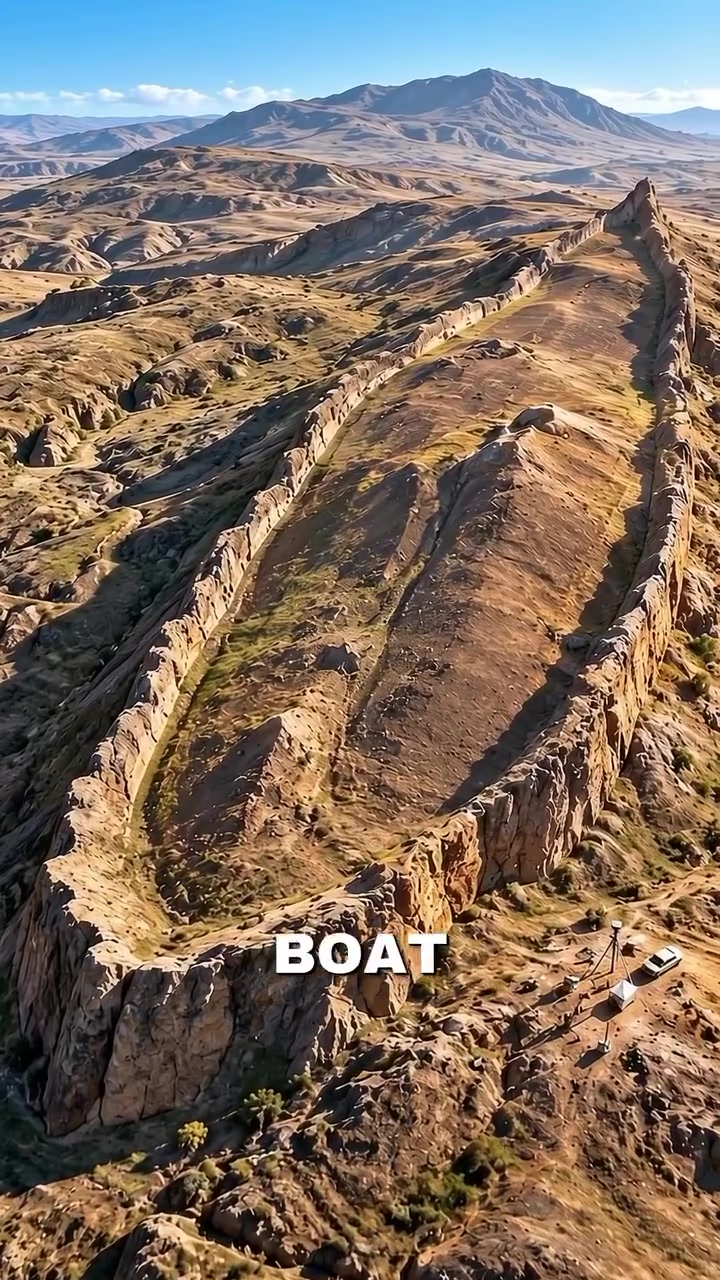
There's a mysterious geological formation in Eastern Turkey that has sparked international intrigue. This massive boat-shaped formation in the Agri Dağ region, Turkey, has some researchers speculating it could be the remains of Noah's Ark. Radar scans of the site have captured the public's imagination by revealing straight lines, right-angle intersections, and corridor-like spaces underground. Followers of the Bible’s account of the Great Flood have pointed out that the shape of the formation in Turkey matches the dimensions described in Genesis—its length is more than 500 feet, and its width is 145 to 165 feet. Why is this distant canyon landscape projected into global headlines? How does modern science investigate such mythic claims?
The Enigmatic Peak of Eastern Turkey
The ship-shaped geological formation, nestled in the Agri Dağ region, is a mountain range and has been dubbed “the Durupınar site” by modern researchers.
The Formation Itself
Around the Durupınar site, researchers have found several straight lines. Radar scans have also picked up right-angle intersections beneath the surface. These features have led some to wonder, and speculate: could this be the actual Noah’s Ark? What lies beneath the surface of this peculiar formation? Could this site be the world's oldest verbally-transmitted story, originating from this area?
Radar Explorations
The most compelling aspect of the Turkey formation is what lies beneath it. The actual radar scans, not radar drones, produce an image of a structure on the plains. Many believe the recent, officially recorded radar scans are the best indication that wherever this site is, it is clearly man-made. However, geologists suggest natural events may have eroded the site into its current boat shape. The radar scans have found clear, man-made artifacts that lie beneath the site. Researchers have found that the site contains much higher levels of organic material inside than outside. Are these artifacts proof of a once-living structure? The radar scans have also discovered that these artifacts exist less than 20 feet below the earth's surface in some places. Perhaps seismic activity over the years has destroyed some of the evidence. The radar has also discovered a tunnel running from the North end of the site which leads deeper under the earth. Perhaps the tunnel leads to more artifacts and hidden secrets.
The Modern Search for a Myth
The existence of Noah’s Ark has been a tantalizing mystery for millennia, but its modern exploration has gained new momentum. As theological debates continue, geological innovations are shedding light on the solid facts of the matter.
The Biblical Narrative
The story of Noah's Ark is a cornerstone of biblical myth. The Ark, as described in Genesis 7:18, is said to have been built of gopher wood and was 300 cubits long, 50 cubits wide, and 30 cubits high. According to the Bible, it was built to save animals and humans from the Great Flood, which lasted 40 days and 40 nights. Noah's Ark is believed to have landed on Mount Ararat, a peak in modern-day Turkey. However, only the Bible describes the Deluge and subsequent landing of Noah's Ark on Mount Ararat, which is relatively close by. The Old Testament is silent, however, about the Durupınar site in the Agri Dağ region, Turkey.
Geological Science and Its Instruments
What does modern science say about the Great Flood and Noah’s Ark? The durability of the gopher wood has always been debated. Perhaps the Ark would have rotted long ago, although some estimates suggest the Ark would last 6,000 years. Today, planes, boats, larger ships, and even drones are used to survey the sites, and these new technologies may find what was forgotten long ago.
The Nature of Scientific Evidence
Whether Noah's Ark has been found or not, the discussion has propelled several new research methodologies. Geological science and Biblical beliefs have found a way to come to a consensus on what might have happened.
Complex Investigative Techniques
The tools of geological investigation have transformed drastically. Researchers have moved away from the pickup trucks and shovels of yesteryear and are now aware of new technologies. Today, planes, boats, and drones are used to survey the sites. These methods provide a safer, more accurate way to investigate the formation.
Uncanny Discoveries on the site
The high levels of organic compounds found on the site help scientists understand that something was once alive on the site. However, these compounds can be from any number of causes. Seismic activity, men and women who have died on the site, or even other creatures who may have inhabited the area centuries ago.
The Mysterious Buried Tunnel
Under the site, a mysterious tunnel exists. The tunnel is 100 feet long and runs from the north side of the site. Perhaps beneath the earth, the tunnel leads to discoveries that could change man's understanding of the Earth, and the Old Testament. However, we do not know. This requires much more research.
The Geological Pragmatism
The mountain range that houses this mysterious formation is a place of mystical beauty. Researchers now expect to uncover more artifacts and heretofore unknown species. This is the soil of the next discussions on Noah and his ship.
Myth-Exploration for the Adventurer
While the archeological expedition to the Turkey site is happening, several other excavations are happening around the world. This may not be the final resting place of Noah’s Ark, but there is a lot to uncover about this place and others like it. Perhaps it can't be traveled to, but it can be experienced in the most unexpected ways.
- Witness the controversial site: Visit the area in person and see the Agri Dağ region, Turkey, with your own eyes. The landscape is a breathtaking wonder in its own right.
- Join the conversation: Engage with the comments and discussions online to see what other people make of the mystery.
Watch the Reel
Questions readers ask
What exactly is the Durupınar site and why is it significant?
The Durupınar site is a boat-shaped geological formation located in the Agri Dağ region of Eastern Turkey. It has garnered significant attention because some researchers and believers suggest it could be the remains of Noah's Ark, as described in the Bible. The site's unique shape and dimensions have sparked both scientific curiosity and religious fervor.
How do the dimensions of the Durupınar site compare to the biblical description of Noah's Ark?
The Durupınar site measures over 500 feet in length and 145 to 165 feet in width, which is somewhat consistent with the dimensions described in the Book of Genesis. The biblical account specifies that the Ark was 300 cubits long, 50 cubits wide, and 30 cubits high, with a cubit being approximately 18 inches. This would make the Ark roughly 450 feet long, 75 feet wide, and 45 feet high, so the formation's size is reasonably close to the biblical description.
What do the radar scans reveal about the Durupınar site, and what do scientists make of these findings?
Radar scans have detected straight lines, right-angle intersections, and corridor-like spaces beneath the surface of the Durupınar site, suggesting a man-made structure. However, geologists propose that these features could also be the result of natural erosion processes, which have shaped the site into its current boat-like form. The high levels of organic material found inside the site compared to outside also raise questions about its origins.
Are there any other sites in the region that have been explored in connection with Noah's Ark?
While the Durupınar site is one of the most prominent, there are other sites in the region, particularly around Mount Ararat, that have been explored in connection with Noah's Ark. Mount Ararat, mentioned in the Bible as the landing site of the Ark, has seen numerous expeditions over the years, although no definitive evidence has been found to support the existence of the Ark. These explorations often involve a mix of religious belief and scientific investigation, much like the Durupınar site.
What challenges do researchers face when investigating the Durupınar site, and how do they address them?
Researchers face several challenges, including the remote location of the Durupınar site, which makes access and exploration difficult. Additionally, the site's geological features can be ambiguous, making it hard to determine whether they are natural formations or man-made structures. Researchers use advanced technologies like radar scans to gather data, but interpreting this data requires a delicate balance between scientific rigor and the potential influence of religious beliefs.
What is the significance of the tunnel discovered by radar scans, and what might it lead to?
The tunnel discovered by radar scans at the Durupınar site is intriguing because it suggests the possibility of hidden artifacts or structures beneath the surface. This could provide more concrete evidence to support the theory that the site is man-made and potentially related to Noah's Ark. However, the tunnel's true nature and contents remain unknown, and further exploration is needed to uncover its secrets.
How does the geology of the Agri Dağ region contribute to the mystery of the Durupınar site, and why is this important?
The geology of the Agri Dağ region plays a crucial role in the mystery of the Durupınar site because the geological processes that shaped the area could also have influenced the formation of the boat-shaped structure. Understanding these processes helps researchers determine whether the site is a natural phenomenon or a man-made structure. This distinction is important for both scientific and religious interpretations of the site.
Related deep dives
Similar reads based on topic and creator.
Recent articles
Fresh deep dives from the latest Reels we unpacked.




Comments
Be the first to comment.