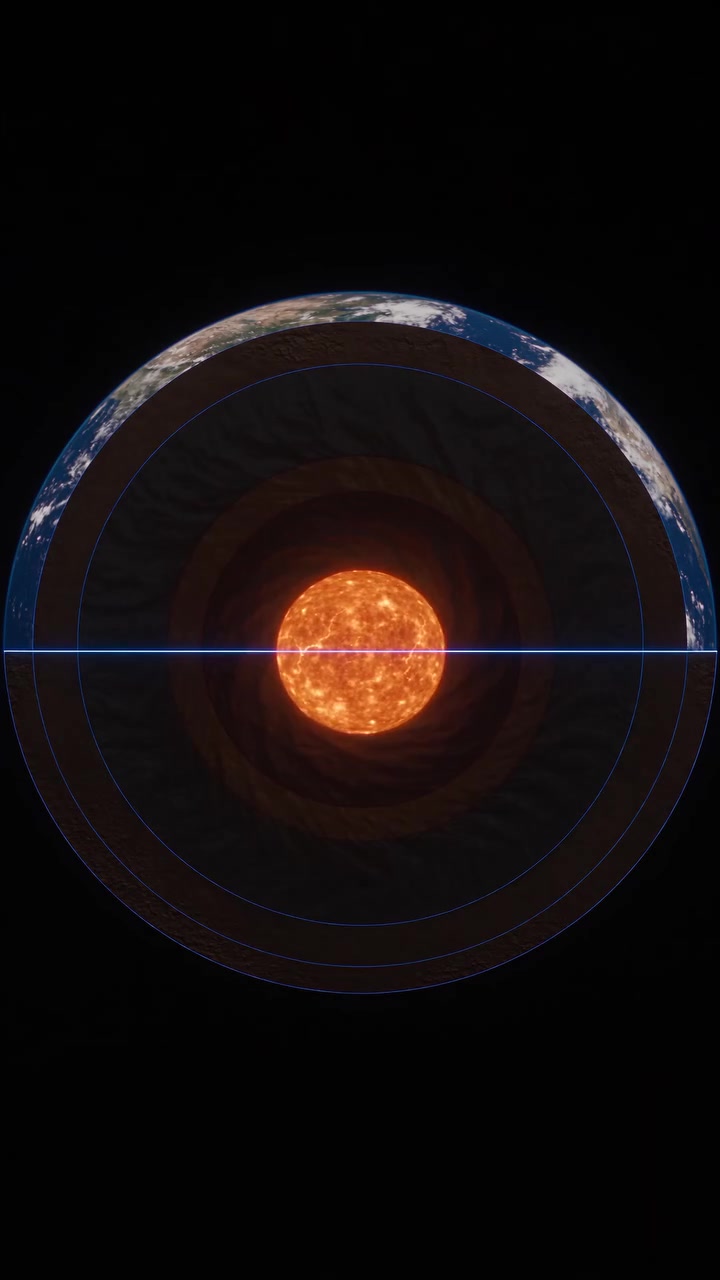
The solid iron ball at the heart of Earth, spanning nearly 4,000 miles and almost matching the size of the moon, has abruptly shifted its rhythm. Around 2010, this core transitioned from a steady beat to an irregular pattern, altering the planet’s internal dynamics in ways that scientists are still trying to comprehend.
Monitoring the Pulse of the World
The movement and behaviour of the Earth's core are a masterclass in turbulence. Its rhythm, measured as a frequency or rotation rate, dictates iron flow and generates electromagnetic changes above the surface. Now, according to the video, this core has recently entered a phase of instability, raising questions about how this inner strength will manifest in the planet’s future. This kind of core activity is part of the larger narrative of Earth’s inner workings, a story of movement and change that affects the planet as a whole. Scientists monitor this activity to look for anomalies, trends, and new phenomena that could have significance in their field.
The Earth’s restlessness
The Earth’s layers are all in motion, with the lava in between this solid iron core and the crust also potentially being in motion.
The heart of Earth
The solid iron core, 4,000 miles beneath the Earth’s surface, spins in sync with the planet. Around 2010, it changed its rhythm, altering the flow of the Earth's magnetic field. According to information from the reel, “not stopped, not broken,” the core continues to spin and behave in unexpected ways. This inner shift is a reminder that Earth’s activity isn’t solely determined by what transpires on the surface.
Earth’s satellite tag-teaming
A second mysterious moon, Kamoʻoalewa, follows the Earth from a distance, orbiting its gravitational pull. The satellite is rock-like, with a football-field-sized width that has circled our planet for centuries. Maybe a chip off the primary moon, this asteroid moon, which has been unrecognized, is a familiar reminder of Earth’s celestial companions, with its association to the moon a bit of a tag-teaming.
Ironic Moon
The visually prominent Moon leaves Earth by four centimeters every year. This increasing distance lengthens the Earth’s rotation, which causes days to expand. The gravitational pull of this satellite influences tides, which are the result of watery mass, each time the moon cycles orbit.
Mauna Kea: Earth’s hidden giant
Mauna Kea, an inactive volcanic mountain in Hawaii, rises more than ten kilometers from the seafloor, making it the planet’s tallest mountain when measured from its base. Many haven’t seen the top of this giant. It’s an observatory to astronomers and geologists alike, with its peak being home to multiple telescopes—an incredible natural resource.
Chasing the unknown
Tremendous changes happening to the Earth’s core and its satellites hint at a greater unknown that makes investigators think of the planet’s future. Monitoring Earth's moving parts, whether they’re spinning iron balls or distant moons, offers a tangible way of understanding the planet’s evolution and behaviour.
Earth's exploration
With every new detail of these hidden corners, our understanding of Earth evolves. So an exploration of these parts is a dynamic of how we know the planet. How much effort we put in can define what great mysteries are unveiled. ** Picking a mission**: Earth's exploration is like a treasure hunt, requiring tools, strategies, and determination. For each part, equipment and resources vary — filling a backpack with gear and getting accustomed to the right terrain. You might try deep-sea diving, mountain climbing, or space travel depending on where you decide to explore. Maverick technology is crucial for studying Earth’s layers and interior. What to wear when exploring Earth: For exploration within the Earth's boundaries, prep with protective clothing, sturdy shoes, and protective equipment. Remember to pack adequate water supplies. How to navigate the Earth’s realm: Research the terrain before you start, and plot your journey. Using mobile apps, compasses, or GPS devices can save you time and prevent you from getting lost. The Earth’s dynamics are delicate, fragile, and often unpredictable, reminding us of the importance of preserving this planet, which is the only one we have.
Watch the Reel
Questions readers ask
What exactly caused the Earth’s core to change its rhythm around 2010?
Scientists are still trying to figure out the exact cause of this shift. The article mentions that the core's behavior has become unpredictable, but it doesn't specify a single cause. It could be due to complex interactions within the Earth's layers or other internal dynamics.
How do scientists monitor the Earth’s core, and what tools do they use?
Scientists use various methods to monitor the Earth's core, focusing on its frequency or rotation rate and the resulting electromagnetic changes. They look for anomalies and trends to understand the core's activity and its potential impacts on the planet's surface.
How does the changing rhythm of the Earth’s core affect the planet’s magnetic field?
The core's rhythm dictates the flow of iron and generates electromagnetic changes. The shift in rhythm around 2010 has altered the flow of the Earth's magnetic field, which could have implications for the planet's overall dynamics and potentially influence surface phenomena.
Can the changes in the Earth’s core be linked to any surface phenomena or natural disasters?
The article doesn't directly link the core's changes to specific surface phenomena or natural disasters, but it suggests that the core's activity could have broader implications for the planet. Scientists are still exploring how these internal changes might manifest on the surface.
What is Kamoʻoalewa, and how does it relate to Earth?
Kamoʻoalewa is a small, rock-like satellite, also known as a quasi-satellite, that orbits the Earth. It's about the size of a football field and has been circling the planet for centuries. It is believed to be a chip off the primary moon, and its orbit is influenced by Earth's gravitational pull, making it a celestial companion to our planet.
How does the Moon’s increasing distance from Earth affect our planet?
The Moon is slowly moving away from Earth, causing the planet's rotation to slow down and days to lengthen. Additionally, the Moon's gravitational pull has a significant effect on the tides, influencing the movement of water masses on Earth.
What makes Mauna Kea significant for scientists?
Mauna Kea is significant because it is the tallest mountain on Earth when measured from its base on the seafloor. Its peak is home to multiple telescopes, making it an important observatory for astronomers and geologists. The mountain provides a unique vantage point for studying the Earth and the cosmos.
Related deep dives
Similar reads based on topic and creator.




Recent articles
Fresh deep dives from the latest Reels we unpacked.




Comments
Be the first to comment.