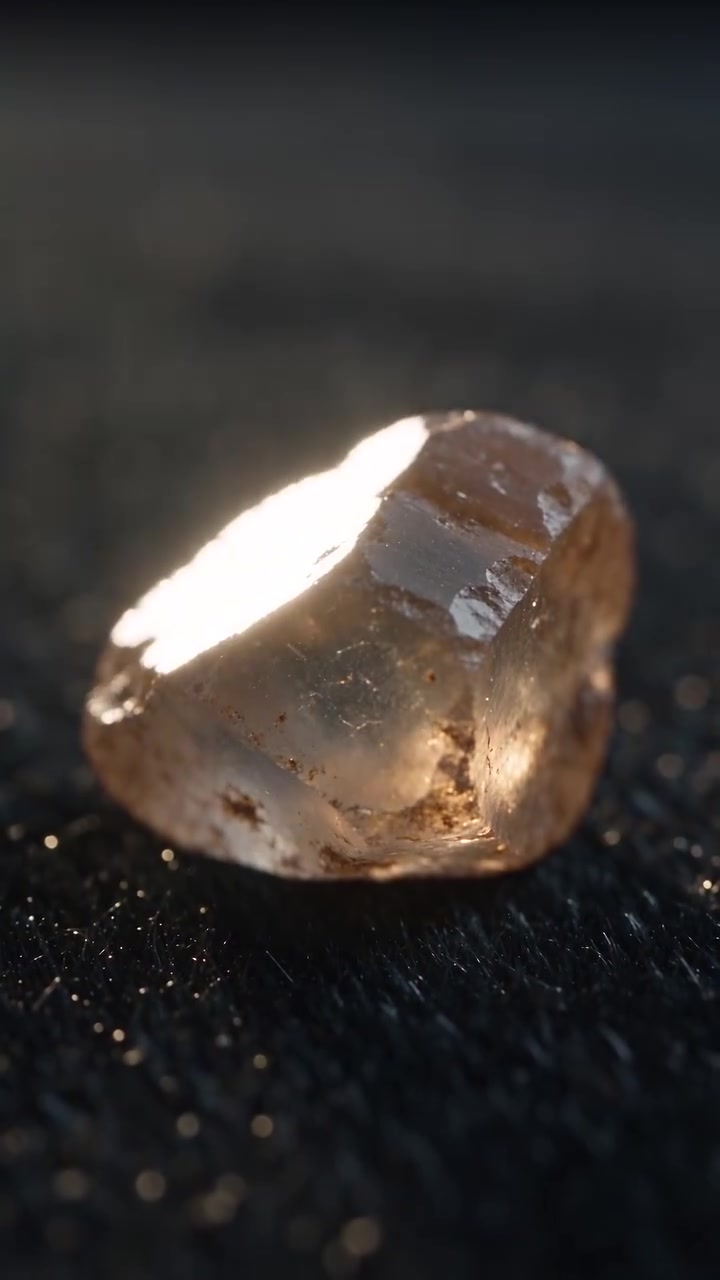
The Brazilian diamond sold for a mere $20, yet it housed an uncommon discovery. Hidden within was a tiny treasure, a blue mineral called "ringwoodite", which only forms 400 miles underground. This mineral appears to hold 1.5% water locked in its crystal matrix, and could be the root of the world's oceans.
How the $20 Diamond Unlocks Earth’s Secrets
The diamond itself was a rough piece, pushed to the Earth’s surface by a volcano in Brazil. Inside was a treasure nobody could have imagined. A diamond weighing 1.5% water, found 400 miles deep. The ringwoodite comes from Earth’s mantle, and the mantle wraps the entire planetary core: making it potentially one of the largest repositories of water in the earth. Nearly three times more water than all the oceans on the Earth's surface combined. This water is not in liquid form but embedded in the rocks. This discovery did not start with a big bang. A few billion years ago, when Earth was still forming, the planet was too hot for the water to be liquid. The existing water mentioned above was forming within the rocks of the mantle. Over time, as the planet cooled down, water was released from the rocks, creating the seas and oceans that exist currently. This breakthrough helps in understanding the origin and journey of water on the Earth. As portions of the Earth’s interior were revealed, this mineral provided the proof of everything that had been intangible for years. Both scientists and historians can study geochemical composition within Earth and see how the planet could dynamically change in the present and future.
How it Raises Questions About Water on Earth
The discovery of the hidden ocean is revolutionary. It helps scientists understand the immense water reserves potentially hidden in the deepest parts of the Earth. The discovery opens up several avenues. First, it reinforces the idea that water is a crucial part of the planet and everything within it formed because of it. This turns the theory of water reservoirs into a concrete law of nature. Second, it refocuses the study of the Earth’s layers, particularly, the mantle: the layer of the Earth just below the crust. Scientists will now study the composition and conditions within the mantle. The mineral ringwoodite could provide a foundation for developing theories and hypotheses about how the Earth’s crust and mantle interact. Most importantly, it could help understand more about the internal processes and the potential ability of Earth to recycle compounds. The transformation of these minerals into another state may help in understanding the evolution of the Earth as a whole.
The Diamond's Journey to the Surface
The diamond starts its journey in the Earth’s mantle. Over millenia, volcanic activity can push such rocks to the surface. From the mantle, the diamonds rise to the volcanic pipe, which acts as an elevator to carry the diamonds to the surface. The diamond travels through several states of pressure, temperature, and structure as it is uplifted. Its journey involves a risky trip through the Earth’s crust: the volatile part of the planet. After this exposure, the diamonds reach the surface, where they are sought after for various purposes. The discovery within the $20 diamond is significant for several reasons. First, it provides geological data that helps scientists understand the deep structures of the Earth. Second, it reveals the presence of water deep within the Earth.
How scientific discovery happens
The process of discovering ringwoodite involved the convergence of several branches of science. First, the discovery was made by geologists who study rocks. They had to identify ringwoodite within the diamond. The discovery was accidental; during a routine study of rocks. The diamond had been bought from Brazil. Second, the study required input from chemists, physicists, and mineralogists. These experts conducted laboratory experiments to determine the composition and structure of the mineral. The discovery was not possible without the combined effort of several branches of science.
The Journey of the ringwoodite Mineral
The next step was to determine how the diamond and the ringwoodite came to be. Finding a mineral in a diamond is the beginning of understanding the story that comes with it. From the various studies, scientists could piece together a story of the ringwoodite mineral. Scientists found out that it was formed 400 miles below the surface of the Earth. The mineral was formed under extreme pressure and temperature. The mineral was later brought to the surface by a volcanic eruption.
For those who seek to learn more, check out these tips.
- Visit Museums: Get a close-up look at gems and minerals that are significant in the geological history of Earth.
- Online Courses: Engage in online courses and modules to understand the composition and journey of Earth.
- Read Papers: Scientific papers are a comprehensive way to learn scientific theories and discoveries.
Watch the Reel
Questions readers ask
What is ringwoodite and why is it significant in this discovery?
Ringwoodite is a blue mineral that forms under incredibly high pressures, about 400 miles beneath the Earth's surface. It's significant because it contains water locked within its crystal structure, suggesting that vast amounts of water might be stored deep within the Earth. This finding challenges our understanding of where Earth's water comes from and how it's distributed.
How did a $20 diamond lead to such an important discovery?
The diamond, though inexpensive, contained a tiny piece of ringwoodite. This mineral is rare and only forms under extreme conditions deep within the Earth. Its presence in the diamond provided scientists with direct evidence of the water-rich environment in the Earth's mantle, which is normally inaccessible for study.
Can we access this hidden water?
Unfortunately, it's not feasible to access this hidden water. The water is locked within the crystal structure of minerals like ringwoodite, which are located about 400 miles beneath the Earth's surface. Current technology doesn't allow us to extract this water directly, but the discovery helps us understand the Earth's water cycle better.
How does this discovery change our understanding of Earth's oceans?
This discovery suggests that the water in Earth's oceans may have originated from deep within the planet. As the Earth cooled, water was released from minerals like ringwoodite, eventually forming the seas and oceans we know today. This shifts our perspective on the origins of Earth's water and its distribution.
What are the implications of this discovery for studying the Earth's interior?
The discovery of ringwoodite in the diamond provides a rare glimpse into the Earth's mantle, a layer that is typically inaccessible. It allows scientists to study the geochemical composition of the mantle and understand how the Earth's crust and mantle interact. This could lead to new theories about the Earth's internal processes and its ability to recycle compounds.
What happens to a diamond as it travels from the mantle to the Earth's surface?
During its journey, a diamond experiences extreme changes in pressure, temperature, and structure. It travels through the Earth's crust, a volatile part of the planet, and is pushed to the surface by volcanic activity. This journey can take millions of years, and the diamonds that make it to the surface are often sought after for their unique properties and origins.
Related deep dives
Similar reads based on topic and creator.




Recent articles
Fresh deep dives from the latest Reels we unpacked.



Comments
Be the first to comment.