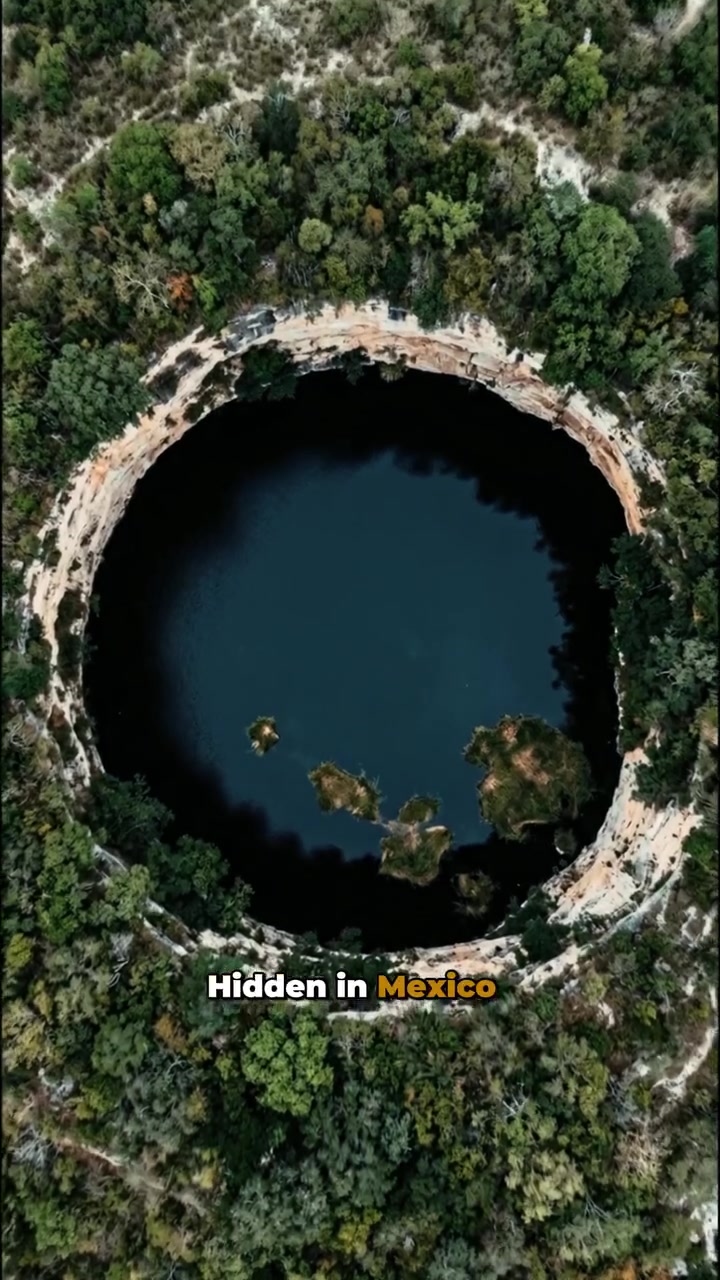
Hiding in Mexico's Yucatán Peninsula is a unique geological formation called the Zacaton cenote. With 319 meters of depth, it's officially the deepest water pit on Earth. Until it was mapped by a NASA robot in 1994, this pit remained a mystery. Its vast depth prevented human divers from reaching the bottom, and only robot technology could solve this mystery.
The Mexican Pit
Zacaton's explosive scoop- Zacaton and its geology
Cenotes in the Yucatán Peninsula originated from the collapse of limestone bedrock. Zacaton is the deepest and most mysterious of them. The sulfuric smell of the water hints at the unique ecosystem. These underground lakes are key to the Yucatán Peninsula's water reserve. The pit is exceedingly deep. The floor was initially a mystery until a robot solved it. There are regions when the grass islands drift across the surface independently. Another strange phenomenon is that the water is warm, and the smell of sulfur is apparent. According to NASA, there are factors that make this place an other worldly experience. The robot built by NASA reached 319 meters and found microbes that exist nowhere else on Earth. "This pit is practice for finding alien life on Europa, Jupiter's moon," said the voice. Some bodies are filled with water, and others are covered with vegetation. Each body has its own set of formations. The pit contains freshwater. A natural sinkhole is an opening formed in the Earth’s surface when the soft rock under the surface becomes waterlogged, and subsides. In this case, the soft rock is the limestone under the surface.
Zacaton's role in NASA training
The space agency's interest in Zacaton comes from its similarities to the environment of Jupiter's icy moon, Europa. Finding life in a challenging environment can offer clues to what life might look like. That was the point of using a robot. The robot was built to map the underwater cave, and it was successful. It reached 319 meters, and it found microbes that exist nowhere else on Earth. NASA is always looking for innovative ways to explore the unknown. They found a similar one on Europa. The agency has studied the possibility of life on Europa. But some have argued that the moon is too far away and that it would be difficult to get there with current technology. But the agency has the same problems with this pit. However, they have been working on solutions and are getting closer to a breakthrough, but they need more funds.
The deep life
Zacaton is a place with deep mystery, and it has intrigued scientists for decades. The pit has fascinated scientists for decades. They have sent probes, robots, and divers to explore it. It has been mapped and explored by robots, but few can venture into the depths. The microbes found can only be found in this pit. There are no known examples of life in the extreme environment of the pit. In 1994, a famous diver tried to reach the bottom of the pit and failed. He did not return. But divers have been able to access the higher depths. This pitches that can be dangerous places to dive. The pit is deep enough to swallow entire buildings, and it can be terrifying to look into. The depth of the pit is not the only thing that makes it terrifying. A cave is a dark place with no light. It is a place where you can't see what is around you. You can't see the walls, the floor, or the ceiling. It is a place where you can't see what is around you. The pit has a sulfur smell. You can't see the bottom, and you can't see the sides. The water is warm, and the smell of sulfur is strong. The lake is warm, and the smell of sulfur is strong, but it is not strong enough to deter you. The smell of sulfur is so enticing that it makes you feel like you are in another world.
What we are learning from exploration
The technical aspects
Examining how the robot was utilized to study Zacaton involved some ingenuity. The robot was designed to withstand the tough conditions. This robot was made with a camera, a sonar system, and a computer. The sonar system was used to map the bottom of the cave. The computer was used to control the robot and to collect data. The robot could withstand the conditions of the pit. The robot could swim in the water and could withstand the sulfur smell. The robot could withstand the conditions of the pit. The robot could swim in the warm water and could withstand the sulfur smell. The robot had to be able to move in the water and could withstand the sulfur. The engineers had to use materials that could withstand the heat and the sulfur. The materials they chose were titanium and stainless steel. They had to withstand the heat and the sulfur.
The dangers
The pit is a dangerous place. One of the best divers tried and never came back. The pit, he died. It is a place where the walls are slippery, and the water is deep. The water is warm, and the smell of sulfur is strong. The walls are slippery, and the water is deep. The pit is a place where you can't see what is around you. You can't see the walls, the floor, or the ceiling. It is a place where you can't see what is around you. The danger of the pit is the fact that you can't see what is around you. It's a place where the walls are slippery, the water is deep, and the smell of sulfur is strong. The pit is a place where you can't see what is around you. You can't see the walls, the floor, or the ceiling. It is a place where you can't see what is around you.
Where to Swim
Most people aren't going to take a dive in the Zacaton. The pit is extremely dangerous. The pit is difficult to reach. At 319 meters, it is the deepest water pit on Earth. The pit is a dangerous place. One of the best divers tried and never came back. Divers have tried to reach the bottom, but they have failed. The pit is a dangerous place. The pit is a difficult place to reach. At 319 meters, it is the deepest water pit on Earth.
Watch the Reel
Questions readers ask
What exactly is a cenote, and how does Zacaton differ from others?
A cenote is a natural sinkhole resulting from the collapse of limestone bedrock, common in Mexico's Yucatán Peninsula. Zacaton is unique because it is the deepest, reaching 319 meters, and it has a distinct ecosystem with microbes found nowhere else on Earth. Its extreme depth and unique conditions make it particularly fascinating and challenging to explore.
How did NASA get involved with Zacaton, and what did they hope to achieve?
NASA became interested in Zacaton due to its similarities to the environment on Jupiter's moon, Europa. The space agency sent a robot to map the underwater cave and search for life in extreme conditions. The mission was a success, as the robot reached the bottom and discovered unique microbes, providing valuable insights for future space exploration.
What kind of challenges did NASA face while exploring Zacaton, and how did they overcome them?
The extreme depth and harsh conditions of Zacaton posed significant challenges for exploration. Human divers couldn't reach the bottom safely, so NASA developed a robot to map the underwater cave. The robot's success in navigating the depths and discovering unique microbes demonstrated the potential for similar technologies in exploring other challenging environments, like Europa.
What makes the microbes found in Zacaton so significant, and why are they important for space exploration?
The microbes found in Zacaton are significant because they exist nowhere else on Earth, thriving in the extreme conditions of the cenote. Their discovery is important for space exploration because it suggests that life could potentially exist in similarly harsh environments elsewhere in the solar system, such as on Europa, Jupiter's icy moon.
How did the exploration of Zacaton contribute to our understanding of potential life on other planets?
The exploration of Zacaton has provided valuable insights into the possibility of life in extreme environments. By discovering unique microbes that thrive in the cenote's harsh conditions, scientists have gained a better understanding of what life might look like on other planets or moons, such as Europa, where similar conditions may exist.
What precautions should be taken if someone were to attempt diving in Zacaton?
Diving in Zacaton is extremely dangerous due to its immense depth and the presence of unique, potentially harmful microbes. Diving should be done with a high level of expertise, and even then, it is risky. Prior to 1994, no human could reach the bottom, and only robot technology could solve the mystery. It is advisable to follow the guidance of experienced professionals and be aware of the potential hazards.
Related deep dives
Similar reads based on topic and creator.




Recent articles
Fresh deep dives from the latest Reels we unpacked.
Comments
Be the first to comment.