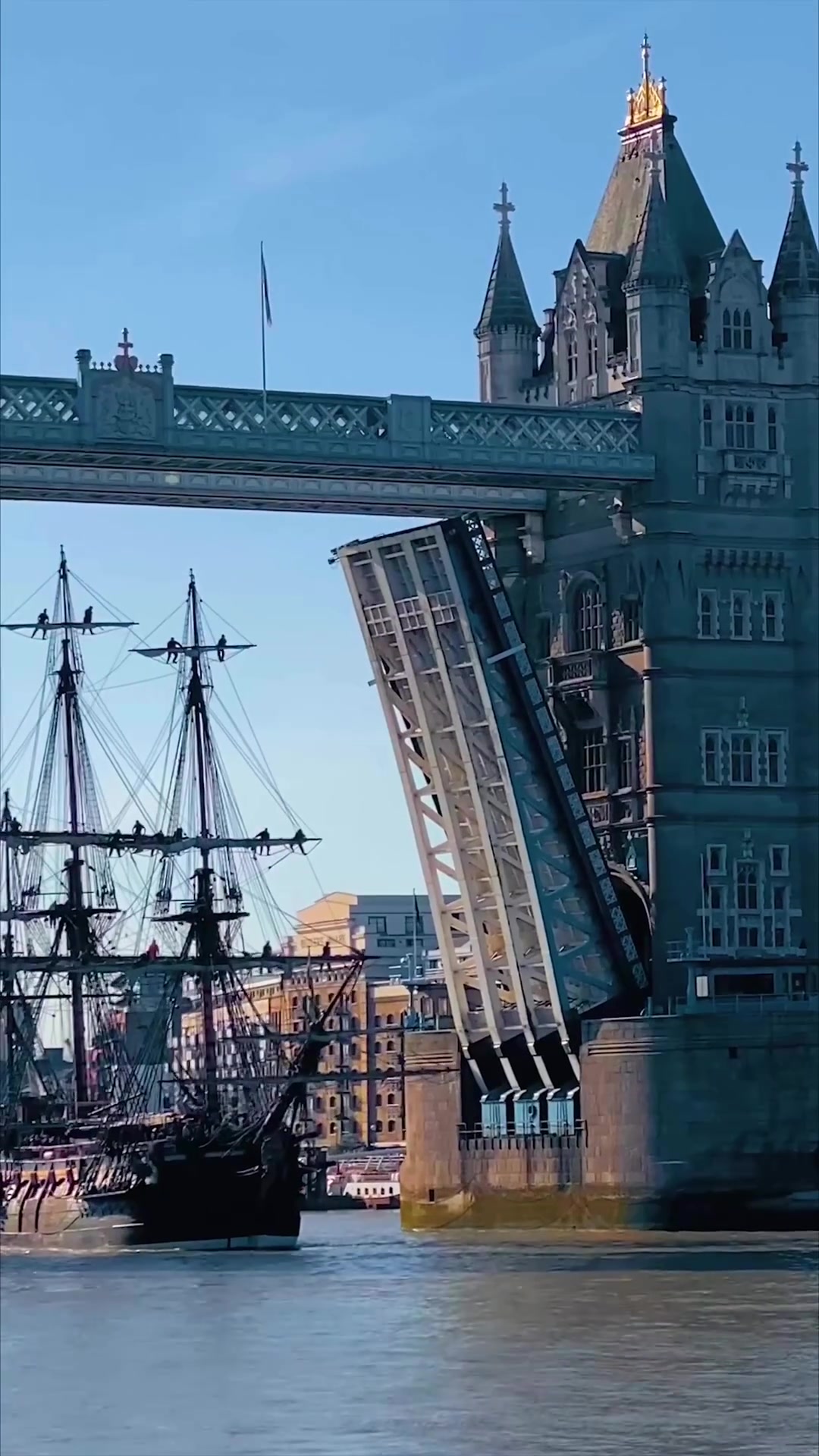
Tower Bridge spans the River Thames in London, and it is something out of a fairy tale. A sailing ship glides beneath its towering bascules. At the command of unseen operators, the bridge opens, majestically unveiling the intricate engineering feat beneath. As the bridge halves rise, the ship emerges from the perspective of the camera into the frame.
This is Tower Bridge Opening
Tower Bridge is not a single type of bridge, but a combination of a bascule and a suspension bridge. The bascule sections, the parts that lift, are counterbalanced by water tanks and weights housed in the bridge’s twin towers; as the bascules lift for small ships, or fully for tall ones, they reveal the intricate steel latticework that enables the weight distribution. This bridge type is a feat of engineering, but Tower Bridge is also a combination of bridge types. Opening these kinds of bridges allows water passage for ships that would otherwise be stuck. Motorised machinery lifts the bascule sections, which are counterbalanced by water tanks, steel girders, and weights that control the weight distribution across the span of the bridge. If you were to walk across Tower Bridge during one of its openings, the experience would be startling. You would hear the creaking of the bridge as it lifts, the hum of the motors, and the rushing of the water. When it's open, the views are unmatched. But the aesthetic impact is closely related to the bridge’s function, concerning ships, not pedestrians. Pedestrians can walk across and it is an incredible experience.
Why it occurs in 2023
Tower Bridge does not lift to allow just any boat through — the opening of the bridge is meticulously planned and scheduled. There are specific mechanisms in place to ensure that the bridge lifts at the right time for the right ships. The Bridge must lift for any vessel that cannot pass underneath the bridge, and any vessel must be scheduled through Transport for London. The last ships to be needed for Tower Bridge to lift are actually smaller ones. With sufficient planning and understanding of the height of each ship, the bridge will lift for that ship as needed. This is why, in the odd instance when Tower Bridge is open, the ship passing through is often a historical vessel, or one that is purpose-built for the occasion.
Waiting for Tall Ships
The passage of the ship is the central event to consider. The bridge must lift for any vessel that cannot pass underneath. The bridge’s operators communicate with the ships' captains, ensuring the ship is fully ready to pass through. The ship must be able to navigate with a wide margin of error. The bridge is used consistently. In most of the cases, when you see the bridge open, you will be seeing a historical vessel, often a commercial clipper ship. These are purpose-built for the occasion.
Bridges Don't Float
The scenery around Tower Bridge is full of historic sites, and it’s part of the reason the bridge continues to lift. The bridge's peak was in the 1960s, when Britain had a thriving merchant fleet, and in the 1980s, more than 20,000 ships passed annually. Today, the number of ships passing has dramatically reduced, and the bridge opening has become a tourist attraction. The bridge, like many others, has accepted its fate. But every opening is a reminder of the bridge’s purpose, which is to allow for the waterway to continue uninterrupted, before the age the internet even existed.
Steel and Water
The waters around Tower Bridge are navigable, and ships must be able to navigate with a wide margin of error. For the ships, the path is narrow and the waters are shallow, and the bridge operators make the calls. The ships must navigate carefully, as the waterway is narrow. The bridge lets ships pass that are between 50 to 100m tall, and these are often Rear Admiral sail ships. The shipping lanes of the UK carry between 1,700 and 2,000 vessels annually that must pass through the Thames. Today, Tower Bridge lifts approximately 800-1,000 times a year, to allow ships to pass. Britain has always been a key player in maritime trade, and the bridge opening is a reminder of that.
The Intriguing Structure Beneath
Engineering Works are mysteries that most people never see. The bridge is made up of two bascule sections, which combine steel lattice and suspension bracket techniques, and is one of the main bridges on the Thames. When the bridge opens, it operates on a counterweight mechanism, similar to a scale. As the ships pass, the counterbalance moves the bridge. But balancing that counterweight presents a challenge. The engineering design of the bridge and its weight must be managed to keep the bridge from falling or expanding. Without the counterweight, the bridge would be completely damaged.
How to Experience Tower Bridge
If you’re in London and you want to see the spectacle for yourself, planning is key. These openings are not scheduled days in advance, or even hours in advance. Ships often have to be moving fully ready to pass, and they need to be able to navigate with a wide margin of error. Checking the Tower Bridge website for the official times is the best place to start. Tower Bridge schedules are unpredictable—they have to allow for ships to schedule time to safely pass through.
- Scheduling: You must arrive before the scheduled opening. Plan for bad traffic; it's London, and you know bad traffic.
- Parking: Park in the city; do not be surprised if the parking is limited. Once there, it is still possible to reach the bridge on foot, despite the large number of tourists.
- Arrival Time: Check the times for yourself, the schedule is unpredictable, and the bridge lifts usually about 30-40 minutes earlier than the scheduled time.
Take a Bow
An estimated 40,000 people cross Tower Bridge daily, and over 24 million tourists visit the Tower of London annually. But not all of them see the bridge lift. Tower Bridge is not just about the ship docking, or the sound of the ships' motors, or the sheer weightlifting of the bridge. Opening the bridge is an act of bridge engineering. The tower is a striking visual — but only a small part of what makes Tower Bridge truly great.
Watch the Reel
Questions readers ask
How often does Tower Bridge actually open these days to let ships pass through?
The number of times Tower Bridge opens has significantly decreased from its peak. While it used to open over 20,000 times in the 1980s, today, the frequency has dramatically reduced, but it still opens several times a year for a mix of modern and historic ships.
Can I walk across Tower Bridge when it’s lifting for a ship?
Yes, you can walk across Tower Bridge during an opening, but it's not recommended. The experience is startling, with the creaking of the bridge, the hum of the motors, and the rushing of the water. The views are unmatched, but the primary function of the bridge opening is to allow ships through, not to accommodate pedestrians.
How does the bridge know when to open?
Tower Bridge openings are meticulously planned and scheduled. The bridge will lift for any vessel that cannot pass underneath. The process is coordinated by Transport for London, which ensures that the bridge lifts at the right time for the right ships. The bridge's operators also communicate with the ships' captains to ensure a smooth passage.
What kind of ships typically require Tower Bridge to open?
Tower Bridge lifts for a variety of ships, including freight, leisure, and emergency vessels. However, the ships that typically require the bridge to open are often historical or purpose-built vessels that are too tall to pass underneath when the bridge is closed. These can include commercial clipper ships and other notable vessels.
How does the machinery work to lift the bascule sections of Tower Bridge?
The bascule sections of Tower Bridge are lifted by motorized machinery. These sections are counterbalanced by water tanks, steel girders, and weights, which control the weight distribution across the span of the bridge. This intricate system allows the bridge to lift smoothly and safely, revealing the steel latticework beneath.
What are the views like when Tower Bridge is open?
When Tower Bridge is open, the views are spectacular. You can see the intricate steel latticework and the River Thames below. However, the primary function of the bridge opening is to allow ships to pass, so the experience is more about the engineering and the ships than the scenery for pedestrians.
What is the history of the bridge's openings?
The bridge's peak was in the 1960s, when Britain had a thriving merchant fleet. In the 1980s, more than 20,000 ships passed through annually. Today, the number of ships passing has dramatically reduced, but the bridge still lifts for a variety of vessels, including historical and purpose-built ships.
Related deep dives
Similar reads based on topic and creator.




Recent articles
Fresh deep dives from the latest Reels we unpacked.




Comments
Be the first to comment.