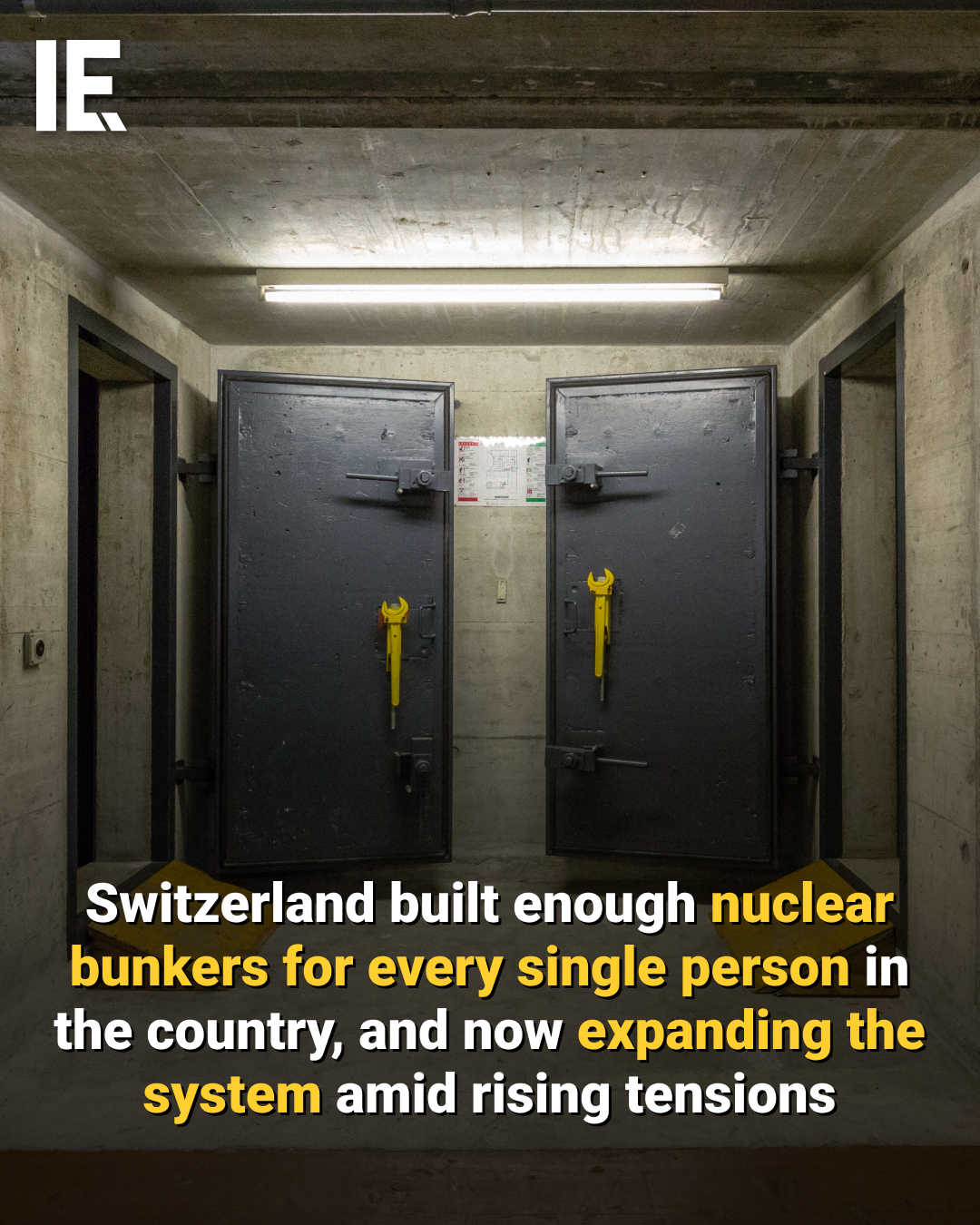
Switzerland is expanding its nuclear bunker system again, with an eye toward protecting every citizen. The European nation counts 335,000 of these shelters underground, which is enough for the entire population of 8.6 million — more than double the population.
The system that keeps a nation calm
These bunkers aren't some secret underground lair; they're government-mandated shelters equivalent to a national's designate evacuation zone before Hurricane Gustav. Swiss nuclear bunkers can be found in basements, underground garages, or even in farm buildings. The system consists of living areas such as bedrooms, a kitchen and a toilet, as well as a decontamination chamber, water storage, and a ventilation system should the air outside become toxic. Structurally, they're designed to withstand extreme heat, pressure, and must withstand a nuclear blast to protect anyone inside. About half of all buildings have their own bunker or protection space — and it’s not just big cities and small towns. Even remote hamlets have a nuclear bunker within walking distance. All Swiss citizens are guaranteed an emergency shelter — but the law does not require every house to have one. sheltered areas total 2.8 square meters per citizen, 6.7 square feet of security. Today they serve as more than just a nuclear token from the Cold War, considering earthquakes, floods, and the corona virus. Per the Civil Protection Act, the bunker infrastructure must remain operational, be accessible, and meet modern safety standards; each family must also be trained in emergency procedures.
Shelter from the storm
The most shelters were constructed during the Cold War. But in 2021, Switzerland expanded the system as global tensions rise — an action that follows the “Swiss theory” of preparedness - a response to growing geopolitical risks. The last major financial crisis was the 20th century's inflation and the two world wars. But Switzerland has a theory that people should be able to live independently with their family for a month with a “self-proclaimed crisis”. Even the EU has a 2010 mandate to hold enough emergency food stockpiles for every citizen.
An underground infrastructure
Bunkers can be very small, such as a basement, or it can be larger than one of the largest homeless shelters. Each building is designed to be built quickly, and the total number of shelters has doubled thanks to better technology. Some bunkers have a decontamination shower, space for water, food, and garbage storage. The building needs to make sure the air pressure is the same as outside the building because if it’s lower than the outside, the danger of a nuclear fallout can be more dangerous. The building must also be able to withstand extreme pressure from the outside. This means the building can withstand blasts and other catastrophes.
Building a bunker
In the mid-20th century, cement was the main building material. After World War II, prefab panels became the standard. Modern shelters are made of concrete sandwiched between two outer layers of steel, a unique material known as Profibet. The steel is designed to protect the concrete from radiation, and the outer layer can withstand extreme heat, The core of the building is a protective concrete shell that is designed to withstand blasts and the effects of nuclear fallout.
Entryways to the catacombs
Today, bunkers feature automatic doors which close from the inside. The system was introduced to allow people to shelter in their apartment fortifications. In the regions, the buildings are underground garages with exits to the streets. The type of door that was used in the Cold War was very heavy. The building still has the old door because of the security threat, and the doors have a warning sign.
Ample room for food, business, and creativity
Families are stockpiling everything needed to survive underground, including canned food and water. All buildings were built with a kitchen and a food storage room, but today, all buildings must have storage space for food and water. An average shelter has space for 250 liters of water, and it can hold water for six months, but this is not enough for Switzerland, which needs 120 litres of water per person per day. This water supply is much more than the water supply that is available in other countries, where a normal person needs 10 to 15 litres of water per day. The government's suggested stockpile is the equivalent of 500 litres of water and 100kg of food — enough to keep people healthy during a crisis, even without electricity. The Swiss Civil Protection has only 1000 reserve food containers, with enough food to feed the entire population, and the government does not have a plan for how to provide food for these bunkers.
Preparedness for any crises
For tourists who encounter an alert, the simplest procedure is to follow instructions on highway signs. During a chemical emergency, the authorities will place signs on the roads, showing tourists the nearest shelter. They should head to the nearest shelter, even if it's not the original destination. If they travel with a car, they should stay put while exiting the vehicle, and if they are within walking distance, they should find shelter in the building or basement. If the number of earthquakes increases, it might damage the shelter, but the government had built it to withstand earthquakes and blasts, and if the situation worsens, the Swiss government may issue an alert, and a sirene will warn people.
Engineers need to make the entranceways
During the Cold War, bunkers were built with heavy doors, and some of them still have them. This makes it easier for people to feel secure, The Swiss government will ask engineers to modify these doors, but they won't be able to remove them. During a natural disaster or a flood, the bunker has a warning system that will notify the police and other emergency personnel of the danger, but the policemen can't visit the place, the bunker can't be opened so people may need to stay for several days. To find a bunker, tourists can find a modern bunker in a house or apartment. The bunker is only used for self-defense, but it's now known for tourism. The bunker can be found at the entrance of large buildings, such as mountains, and it can be found in basements, and underground garages, and it’s designed to withstand earthquakes and blasts. Residents and tourists alike should not be alarmed by the warnings—Switzerland has a system to protect each citizen. That system is as robust in modern times as it was during the Cold War. If the sirens go off, follow the weather report and instructions, and then go about your business. All options are designed to keep people safe from any possible disaster.
Watch the Reel
Questions readers ask
How does Switzerland ensure that everyone has access to a nuclear bunker?
Switzerland guarantees that every citizen has access to a nuclear bunker by mandating that shelters are integrated into various buildings, including basements, underground garages, and even farm buildings. This ensures that even remote areas have shelters within walking distance, with a total of 2.8 square meters of shelter space per citizen.
What kind of infrastructure does a typical Swiss nuclear bunker have?
A typical Swiss nuclear bunker is equipped with living areas including bedrooms, a kitchen, and a toilet, as well as a decontamination chamber, water storage, and a ventilation system. These features are designed to protect occupants from extreme conditions, including nuclear blasts, and ensure they can survive independently for extended periods.
Why is Switzerland expanding its nuclear bunker system again?
Switzerland is expanding its nuclear bunker system in response to growing geopolitical risks and a theory of preparedness. This expansion follows the “Swiss theory” that people should be able to live independently with their family for a month during a crisis, ensuring the nation is ready for various emergencies, including natural disasters and pandemics.
What materials are used to build modern Swiss nuclear bunkers, and why?
Modern Swiss nuclear bunkers are typically made of concrete sandwiched between two outer layers of steel, a material known as Profibet. The steel protects the concrete from radiation, making the bunker more resilient to nuclear fallout. This design ensures that the bunker can withstand extreme pressure and other catastrophes.
Can I visit or tour a Swiss nuclear bunker?
The article doesn't specify whether public tours of Swiss nuclear bunkers are available. However, given their role in national security and emergency preparedness, it's likely that access would be restricted to authorized personnel and emergency services. It's best to check with local authorities or civil protection agencies for any public access or educational programs.
How do Swiss nuclear bunkers address air pressure and ventilation?
Swiss nuclear bunkers are designed to maintain equal air pressure between the inside and outside to prevent the danger of nuclear fallout. The ventilation systems are engineered to ensure that air quality remains safe, even if the outside environment is toxic. This design feature is crucial for protecting occupants during a nuclear emergency.
What is the Swiss theory of preparedness, and how does it influence the bunker system?
The Swiss theory of preparedness is based on the idea that people should be able to live independently with their family for a month during a crisis. This theory influences the bunker system by ensuring that shelters are equipped with essentials like food, water, and sanitation facilities, allowing citizens to withstand various emergencies, including nuclear blasts, earthquakes, and pandemics.
Related deep dives
Similar reads based on topic and creator.

Recent articles
Fresh deep dives from the latest Reels we unpacked.


Comments
Be the first to comment.