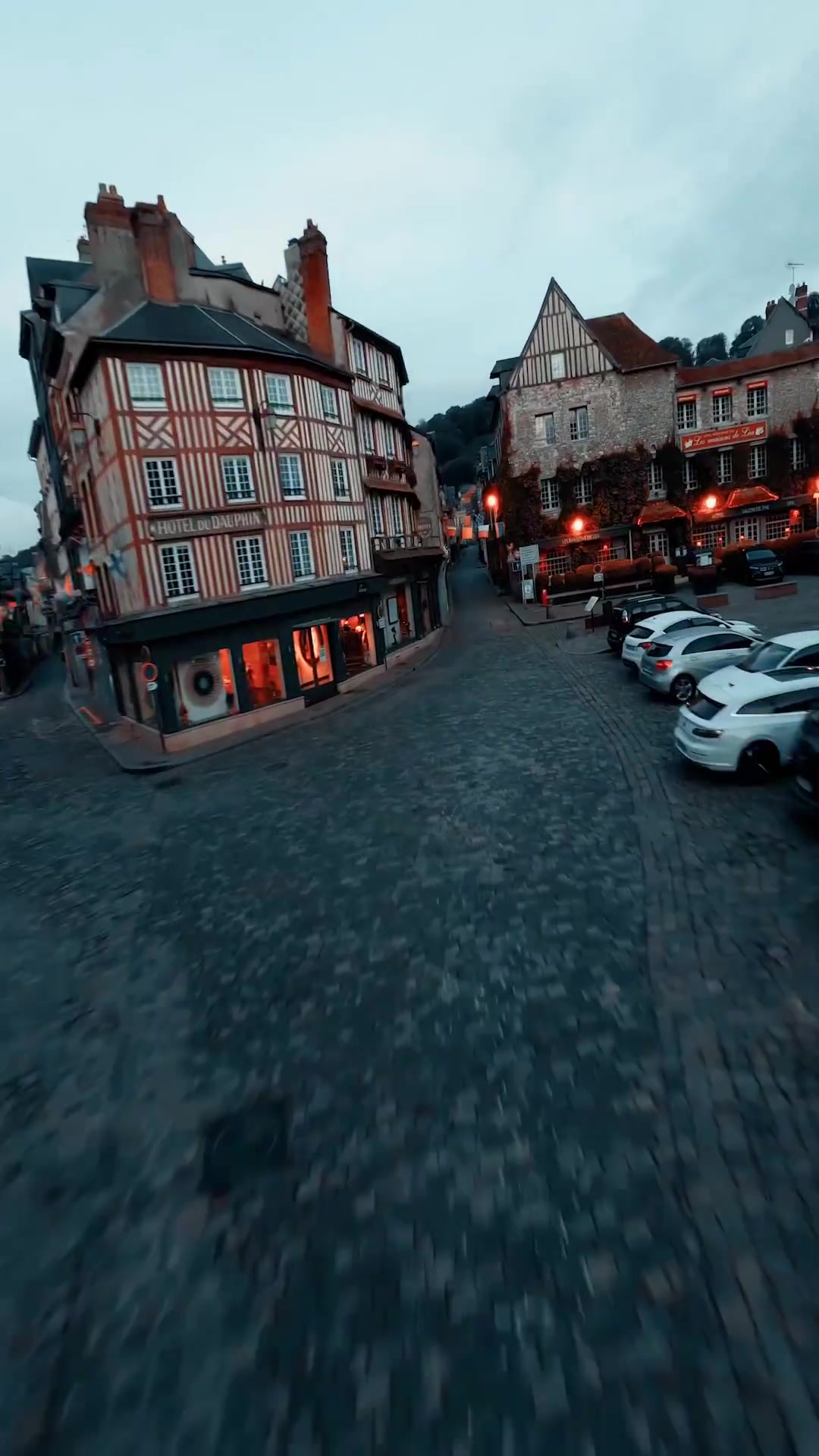
Normandy is a region in northwest France. It offers a sensory blend of medieval and 2022th-century architecture built without modern straight lines. A video shared by a traveler under the username justinfpv gives viewers a first-person perspective of Norman town streets on wet, likely rainy day.
Normandy Towns — timeless, tangible history
Normandy is known for its picturesque towns, medieval and 20th-century history, and beautiful landscapes. The region’s architecture is distinctively rural, featuring asymmetrical designs with windows and doorways often surrounded by wood framing. This provides a warm, earthy aesthetic different from the stone or brick found in other European countries. These timber-framed buildings give Normandy’s towns a cozy, intimate feel. Imagine a day of exploring the streets of Normandy — winding alleys, cobblestone roads, and solid, centuries-old timber-framed buildings. The heavy roofs and ornate lines of the Norman houses, shops, and churches are eye catching.
Normandy's timeless architecture is an anchor to Europe's past
The distinctive architecture of Normandy helps shape a strong national identity that merges its medieval, Napoleonic, and aspects of its World War 2 history. The timbers and frames are often visible outside — contrasting the white plaster and chinking on the walls. Many of these structures still stand with heavy beams and carved wood details that were the norm at the time. These are rare in Britain in particular, as wood wood was generally painted over and covered in plaster. The country's famous half-timbered houses are a hallmark of the buildings in Normandy. The timber frame construction allowed for easy renovation and additions, as the frame itself could be entirely reconfigured. Even in older houses, you can still see the original timber framing of the house. The beams were visible inside homes, adding to a feeling of being in a historic country. Normandy's towns have evolved since their medieval origins, but the steady, stately build remains the focal point. Buildings were often built to withstand wars — with thick, sturdy walls. The region's architecture has survived centuries of invasion, occupation, and political upheaval. Normandy is a region that has weathered the test of time by constantly staying true to its agricultural and maritime heritage.
The city weaves old and new
On the road: movement and presence
The video showcases a first-person perspective of driving through a historic European town, highlighting the moving vehicle. The experience of relying on a handheld camera allows viewers visual control over timing and movement. But it also gives the feeling of being there. The street is familiar yet exciting. You can see the raindrops on the windows and the metal on the roof, the rain soaking into the ground.
Landscape and architecture
Timber-framed buildings line the cobblestone streets, with wood surrounding windows and doors. The buildings evoke rustic charm, largely unchanged for centuries. The first-person vision brings in blurred lime-green and gray sidewalks as the vehicle moves through a town square. The camera rushes past the medieval buildings. One of them is the timber-framed building of the Friends of the Bibliotheque Patriem. The most striking aspect of the building is not its age, but the sense that there is something behind the subtle colors. The buildings are heavily textured, a fitting backdrop as a way to convey a sense of place. The video has a moving, if sensory, quality — the noise, including the rumors, the sound of the rain, the general noise of the streets.
The town's identity
The region's tourism relies on showcasing its medieval and 20th-century history and beautiful landscapes as a way to appeal to people. Audiences enjoy traveling through Normandy. Its architecture features a rural style with asymmetrical features. The timber-framed buildings and traditional stonework give the region an intimate feel, and a person could feel at home there.
Evasive landmarks; don't look away
Normandy’s towns offer a blend of timeliness and timelessness that makes finding one’s way feel unhurried, even when the camera is moving swiftly. When you visit Normandy, you can embrace a simple, timeless holiday while consistently being steeped in a sense of history. Buildings are often built around green spaces and waterways, which keep the towns beautiful and functional. To explore a truly timeless walking tour, consider visiting the following places:
- Tapisserie de Bayeux: Bayeux Cathedral is a 17th-century cathedral that showcases many astonishing works of French art. The famous Bayeux Tapestry, which depicts the story of the Norman conquest of England in the 11th century, is a must-see. It's a go-to spot for fans of all things medieval.
- D-Day beaches: The Normandy American Cemetery and Memorial in Colleville-sur-Mer, Normandy, France. It’s a must-visit for history buffs and respects the lives of the American soldiers who gave their lives defending liberty and democracy.
Watch the Reel
Questions readers ask
What makes Normandy's architecture so unique compared to other regions in France?
Normandy's architecture is distinct due to its use of timber framing, which creates an asymmetrical design with windows and doorways often surrounded by wood. This gives the buildings a warm, earthy aesthetic, different from the stone or brick commonly found in other European countries. Additionally, the visible timber frames and heavy beams add to the cozy, intimate feel of the region.
How has Normandy's architecture evolved over time?
Normandy's architecture has evolved from its medieval origins but has maintained its timber-framed structures. These buildings were often built to withstand wars and political upheaval, with thick, sturdy walls. Over time, the region has stayed true to its agricultural and maritime heritage, preserving its historic charm while adapting to modern needs.
Are there any notable differences between Normandy's architecture and that of other European countries?
Yes, Normandy's timber-framed architecture is particularly unique. In Britain, for example, timber framing was often covered with plaster, making it less visible. In Normandy, the timber frames are often left exposed, both inside and outside the buildings, providing a distinct aesthetic.
What can visitors expect to see when exploring Normandy's towns?
Visitors can expect to see winding alleys, cobblestone roads, and solid, centuries-old timber-framed buildings. The heavy roofs and ornate lines of the Norman houses, shops, and churches are eye-catching, and the overall feel is one of cozy, intimate charm with a rich historical context.
How does the first-person perspective in the video enhance the viewing experience?
The first-person perspective of the video, shot from a moving vehicle, gives viewers a sense of being there. It allows for visual control over timing and movement, highlighting the raindrops on windows, the metal on the roof, and the rain-soaked streets. This immersive experience brings the viewer closer to the historic charm of Normandy's towns.
Is there a way to visually identify a building as Normandy architecture?
Yes, Normandy's architecture can be identified by its distinctive timber-framed buildings. The timber frames are often visible both inside and outside, contrasting with the white plaster and chinking on the walls. The heavy beams and carved wood details are also characteristic of Norman architecture. These features create a unique, rustic charm that sets Normandy apart from other regions.
Related deep dives
Similar reads based on topic and creator.



Recent articles
Fresh deep dives from the latest Reels we unpacked.


Comments
Be the first to comment.