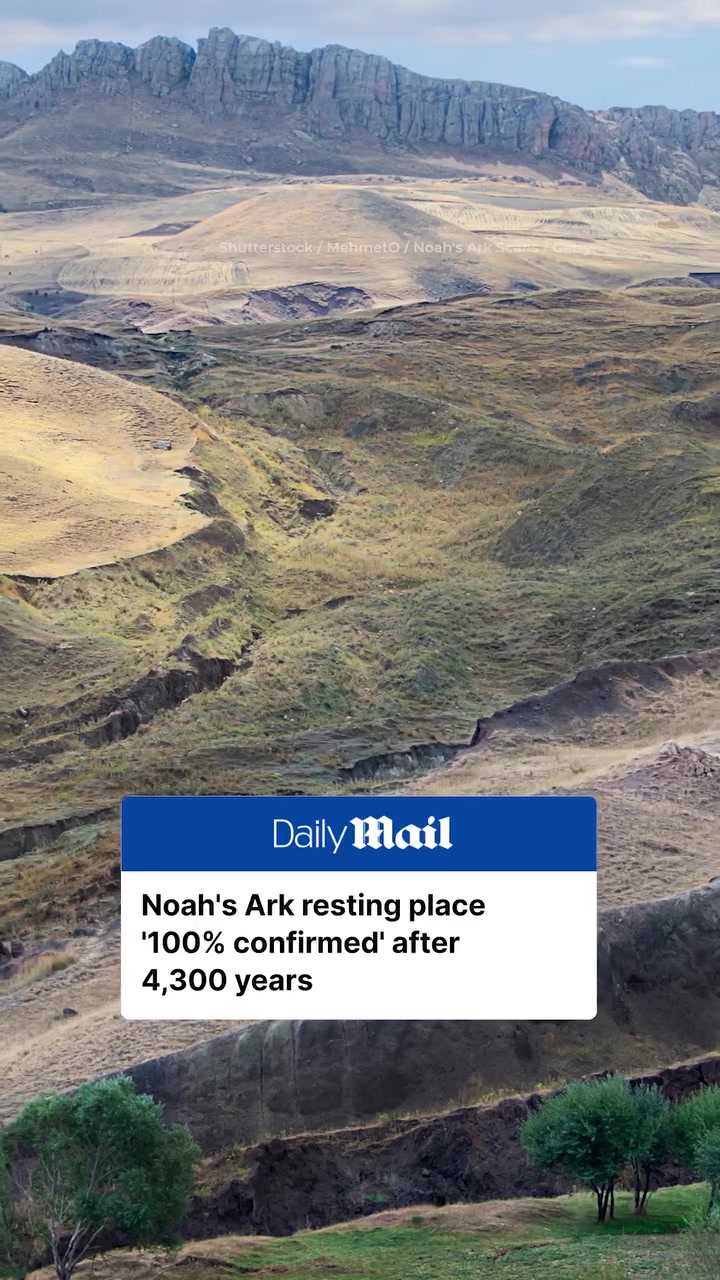
In the arid expanses of Mount Ararat, a drilling operation has ignited a tempest of disbelief, hope and skepticism. Local media outlets have reported uncovering the fossilized remains of enormous, ancient wooden beams at 13,000 feet. To the Daily Mail, this is "100% confirmation" of the final resting place of Noah's Ark.
An Ancient Claim on a Mountain
Noah's Ark is a vessel of Judeo-Christian lore: a ship built to withstand a global deluge that the Book of Genesis says The Creator sent as punishment for humanity. The Ark is said to have carried Noah, his family, and pairs of animals for surviving life on Earth. Modern researchers have long attempted to make this ancient legend into a concrete fact. Many theories have been proposed, but none has been universally agreed upon. The great size and antiquity of the alleged Ark, its possible location, and the lack of physical evidence have contributed to this lack of agreement. Mount Ararat, located in the northeast of modern-day Turkey, is where the Bible says the Ark eventually came to rest. Despite being dubbed as the resting place of Noah's Ark, Mount Ararat has a long history of explorations, with no conclusive results. A team of researchers claims the 2023 drilling operation at 13,000 feet on Mount Ararat did not turn up any hard evidence of man-made structure, althouh many say that the mud and debris at the site contain fragments of ancient wood that have the smallest residue of ancient wooden beams. Others claim the wood has pronged cracks running through them — a telltale sign of ancient wood, which archaeologists say rotates when impacted. The Drilling team claims that the wood fragments' extremely high altitude — and therefore extreme age — corroborate the notion that they come from Noah's Ark.
The Challenge of Historical Precedent
The possible discovery of Noah's Ark raises a mythic convergence of history, religion, and scientific exploration. Believers are often seeking unexplained phenomena to validate religious beliefs. The Daily Mail claims that the discovery of a 4,000 year old wooden beams is such a discovery. Skeptics, however, say that the 2023 dig never reached bedrock and that the precise location of the Artificial snow and ice has not been determined. The existence of Noah's Ark has been a hotly debated topic for centuries, with many people claiming to have found it. While some of these alleged discoveries may be based on misinterpretation of natural formations, others may be outright hoaxes. This has not stopped people from continuing to search for the legendary vessel, however.
What The Wood Cracks Reveal
What the Ancient Wood Means For the believers, the discovery of ancient wood fragments is a glimpse into a world 4,000 years ago. The Daily Mail report claims that the wood fragments have pronged cracks running through them — a telltale sign of ancient wood, which archaeologists say rotates when impacted. But missions to Noah's Ark have been doomed to become full of rain and mud as soon as the public discovers them. The scientific claims have drawn skepticism on social media, where some users have launched their own research into the potential discovery. These ancient wood fragments were found amidst the geological layers confirming ancient catastrophic events. Dr. J. Whitcomb, a Geologist, claims that when Noah’s Ark came to rest, it was surrounded by water and mud, and as it sank, the wood would have cracked and decomposed. The Debate Over Finding Noah's Ark Despite the potential archaeological significance of the discovery, some scientists and skeptics have raised questions about the authenticity of the fragments, claiming that the drilling operation didn't reach bedrock which is why no conclusive evidence was found. Nor did it determine the precise location of the alleged artificial snow and ice in the area. The reported discovery has sparked a debate among scientists, theologians, and historians, some of whom believe that the fragments could be part of a previous structure predating the Ark. How Ancient Wood and Cracks Corroborate Claims The Daily Mail quoted experts in the field of wood technology who claim that the wood found in 2023 has pronged cracks that only occur in wood older than 4,000 years. They claim that the evidence of Noah's Ark is corroborated by the ancient wood and cracks found in the area. The ancient wood fragments are distinct from the contemporary wood found in the area, which suggests they may have been used to construct a structure thousands of years ago. However, some scientists argue that the presence of such cracks or even artificial snow and ice does not necessarily prove that the wood belongs to the biblical Ark. They then point out that these formations could have been created by some other natural processes or structures, rather than the debris of Noah's Ark.
The Future of the Quest for Noah's Ark
Why It Matters The quest for Noah's Ark has captured the imagination of people for centuries, sparking numerous expeditions and discoveries, and often resulting in controversy and debate. Noah's Ark is said to have carried Noah and his family to safety during a great flood, as recounted in the biblical book of Genesis. The site of these discoveries appears to have been inspired by the biblical account of the Ark and the flood. Still, some researchers doubt that the fragments are from the legendary vessel. The Legacy of Past Attempts Previous expeditions to Mount Ararat have yielded inconclusive results. However, the religious and historical significance of Noah's Ark is immense and the search continues. Mount Ararat, though often associated with Noah's Ark, has been the subject of numerous explorations and investigations over. However, the site of the 2023 finds remains unknown. Many expeditions have been conducted on Mount Ararat, but none of them have yielded conclusive results. Why It Matters The site of these latest discoveries is shrouded in mystery, as researchers are tight-lipped about its exact location. The Daily Mail believes in its significance, reporting that wood fragments with pronged cracks may validate the existence of Noah's Ark. Yet for believers and many explorers, the quest is far from over.
Watch the Reel
Questions readers ask
What exactly was found on Mount Ararat that has people talking about Noah's Ark?
The drilling expedition on Mount Ararat uncovered ancient wooden fragments at an extremely high altitude of 13,000 feet. These fragments have been interpreted by some as potential evidence of Noah's Ark, although this claim is highly debated.
How do the wooden fragments support the idea that they are from Noah's Ark?
The fragments are said to have pronged cracks, which some archaeologists believe is a sign of ancient wood. Additionally, their extremely high altitude suggests they are very old, which aligns with the timeline of the biblical flood story, but this is not definitive proof.
Why is there so much skepticism surrounding this discovery?
Skeptics argue that the drilling operation did not reach bedrock, and the precise location of the artificial snow and ice has not been determined. Additionally, the lack of conclusive evidence of a man-made structure and the history of hoaxes and misinterpretations in previous searches for the Ark contribute to the doubt.
What makes Mount Ararat a significant location for this discovery?
Mount Ararat is mentioned in the Bible as the final resting place of Noah's Ark. Its significance lies in its historical and religious context, making any find at this location highly notable, despite the lack of conclusive evidence.
How do believers interpret these findings differently from skeptics?
Believers see the discovery of ancient wood fragments as a validation of their religious beliefs, suggesting that the Ark may have been found. Skeptics, however, question the scientific rigor of the findings and point out the lack of definitive proof, such as reaching bedrock or finding clear man-made structures.
What challenges do researchers face in verifying the authenticity of these findings?
The main challenges include the extreme altitude and harsh conditions of the site, the lack of conclusive evidence, and the history of misinterpretations and hoaxes. Additionally, the public's interest and media coverage can complicate the scientific process and add pressure to the researchers.
Related deep dives
Similar reads based on topic and creator.

Recent articles
Fresh deep dives from the latest Reels we unpacked.

Comments
Be the first to comment.