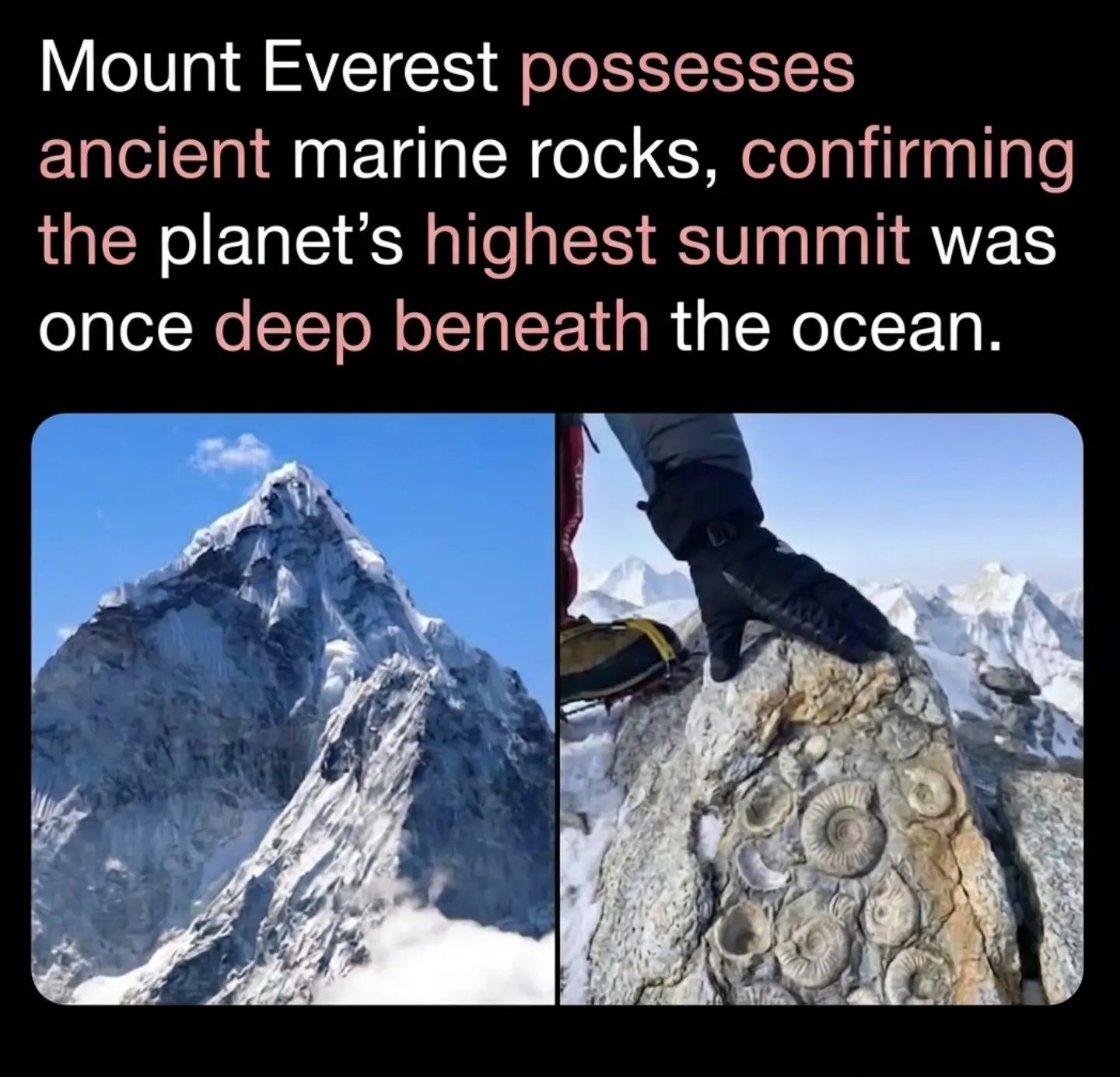
Mount Everest's Fascinating Geological History
Mount Everest, the world's highest peak, is renowned for its majestic beauty and challenging climbing routes. Beyond its allure as an adventurer's dream, the mountain holds profound geological secrets. The summit's ancient marine rocks reveal a staggering history of geological transformation, offering a glimpse into the Earth's dynamic past.
The Geology of the Highest Peak
Mount Everest stands at over 8,848.86 meters (29,031.7 feet) above sea level, making it the pinnacle of the Earth's surface. This towering summit is composed of layered sedimentary rocks, primarily limestone and shale, that are rich with marine fossils. These rocks were formed in a shallow sea environment over 400 million years ago.
The presence of these ancient marine rocks indicates that the region where Mount Everest now stands was once part of an ancient ocean. The geological shifts and tectonic movements that have occurred over millions of years have pushed these marine sediments to their current elevation, far from their original underwater setting.
The Himalayan Formation
The Himalayan mountain range, of which Everest is the highest peak, began to form around 50 million years ago. This process was driven by the collision of the Indian tectonic plate with the Eurasian plate. The collision caused the Earth's crust to thicken and uplift, forming the towering peaks we see today. The force of this collision continues to push Everest and other Himalayan mountains upward at a rate of about 4 millimeters per year.
The Significance of Marine Rocks at the Summit
The discovery of marine rocks at the summit of Mount Everest has provided crucial evidence for understanding the Earth's geological history. These rocks suggest that the summit was once deep beneath the ocean. The transition from an underwater environment to the highest peak on Earth highlights the immense geological changes that have occurred over millions of years.
The Geological Composition of Mount Everest
Mount Everest is composed of several distinct types of rocks, each with its own story to tell. The summit comprises primarily limestone and shale, which are sedimentary rocks formed from the accumulation of marine organisms and sediments. These rocks are interleaved with layers of metamorphic rocks, such as gneiss and schist, which were formed through intense heat and pressure deep within the Earth's crust.
In addition to limestone and shale, Mount Everest is home to a variety of minerals, including quartz, feldspar, and mica. These minerals are remnants of the ancient marine environment and provide further evidence of the mountain's underwater origins.
The Role of Tectonic Activity
Tectonic activity has played a pivotal role in shaping Mount Everest and the Himalayan range. The collision of tectonic plates has not only uplifted the mountains but also caused significant deformation and metamorphism of the rocks. This tectonic activity has resulted in the complex geological structure of Mount Everest, with its layers of sedimentary and metamorphic rocks.
The Formation of the Himalayan Range
The Himalayan range is a result of the ongoing collision between the Indian and Eurasian plates. This collision began around 50 million years ago and continues today, causing the Earth's crust to thicken and uplift. The Himalayas are part of a larger orogenic belt, a significant zone of deformation and mountain-building activity, that stretches from the Mediterranean to Southeast Asia.
Practical Tips for Understanding Mount Everest's Geology
For those interested in understanding the geological history of Mount Everest, several practical tips can enhance your appreciation of the mountain:
-
Read Geological Literature: Dive into scientific papers and books that explore the geological history of the Himalayas. These resources provide detailed insights into the processes that shaped Mount Everest and the surrounding ranges.
-
Visit Geological Museums: Museums often have exhibits dedicated to the geology of famous mountains, including Mount Everest. These exhibits can provide visual representations and interactive models to help understand the geological processes.
-
Explore the Region: If possible, visit the Himalayan region to see the geological features firsthand. Guided tours and treks can offer a more immersive experience, allowing you to observe the rocks and landscapes up close.
Important Takeaways
Mount Everest's geological history is a testament to the Earth's dynamic and ever-changing nature. The presence of ancient marine rocks at the summit highlights the significant geological transformations that have occurred over millions of years. Understanding these processes not only enriches our appreciation of the mountain but also provides valuable insights into the Earth's history.
The collision of tectonic plates and the resulting uplift of the Himalayan range are ongoing processes that continue to shape the landscape. The geological composition of Mount Everest, with its layers of sedimentary and metamorphic rocks, offers a window into the Earth's past and the forces that have shaped it over time.
Conclusion
Mount Everest's geological history is a fascinating journey through time, revealing the Earth's dynamic processes and the forces that have shaped its surface. The presence of ancient marine rocks at the summit provides evidence of significant geological changes, from an underwater environment to the highest peak on Earth. By understanding the geological composition and the role of tectonic activity, we gain a deeper appreciation for the mountain's remarkable story and the ongoing processes that continue to shape our planet.
Watch the Reel
Questions readers ask
How did marine rocks end up at the summit of Mount Everest?
The marine rocks at the summit of Mount Everest were formed over 400 million years ago in a shallow sea environment. Due to tectonic plate collisions, these rocks were uplifted and pushed upward over millions of years, eventually forming the peak we know today.
What kinds of marine fossils can be found on Mount Everest?
The marine fossils found on Mount Everest are predominantly from creatures that lived in shallow sea environments. These include fossilized remains of marine animals like trilobites, brachiopods, and crinoids, which are indicative of the ancient sea that once covered the region.
What role did tectonic plate collisions play in Everest's formation?
Tectonic plate collisions were crucial in the formation of Mount Everest. The Indian Plate collided with the Eurasian Plate, causing the crust to thicken and uplift, which gradually pushed the marine rocks that were once beneath the sea to the summit of the world's highest peak.
How long ago was Mount Everest beneath the sea?
The rocks at the summit of Mount Everest were formed in a shallow sea environment over 400 million years ago. This means that the area that is now Mount Everest was once beneath the sea during this ancient geological period.
What does the presence of marine fossils on Everest tell us about the Earth's history?
The presence of marine fossils on Mount Everest indicates that the region has undergone significant geological changes over millions of years. It shows that the area was once a shallow sea, and the fossils serve as evidence of the Earth's dynamic geological processes, particularly tectonic activity.
What are the primary types of rocks found at the summit of Everest?
The primary types of rocks found at the summit of Mount Everest are sedimentary rocks, specifically layers of limestone and shale. These rocks were formed in a marine environment and were subsequently uplifted to their current high-altitude position due to tectonic forces.
Can the geological history of Mount Everest be traced through its rocks?
Yes, the geological history of Mount Everest can be traced through its rocks. The layers of sedimentary rocks and the marine fossils they contain provide a record of the region's past environments and the tectonic forces that shaped it over time.
Related deep dives
Similar reads based on topic and creator.
Recent articles
Fresh deep dives from the latest Reels we unpacked.




Comments
Be the first to comment.