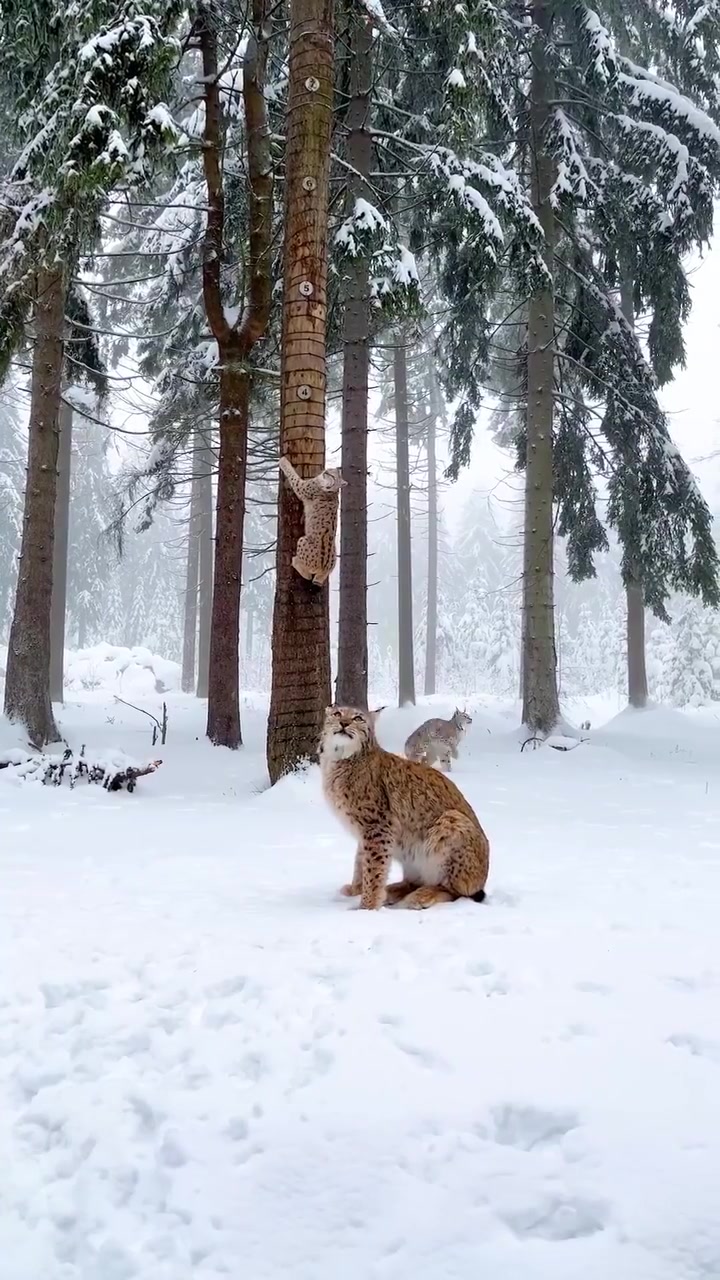
A Lynx's Ascent In a snowy forest, a lynx climbs a tree. Its sibling watches from below, camouflaged against the bark. Lynnx are known for their tree-climbing abilities and this video captures that skill in a family of catlike hunters navigating a wintery forest.
A Lynx's Alpine Dance
Lynx are a rare sit of the cat family, Felidae. They belong to the genus Lynx, which includes species like the bobcat. Lynx are known for their short tails, characteristic tufts of black hair on their ears, and their ability to climb and balance on trees at a unique angle, often seen as "dancing" up a tree. They are built to adapt to snow-covered environments. The lynx is a mid-size cat weighing about 18 to 25 pounds, and their agility is notable. These predators climb trees to observe and track prey, and sometimes use the height to escape threats. Lynx prefer to hunt in forests with dense understory to stalk prey and climb trees for a better vantage point, especially in the snowy forest. These cats stalk their prey — often a smaller woodland animal. When chasing the lynx run across the ground with great speed. If the animal escapes, the lynx will chase the animal onto a tree to capture it. Unlike true big cats, which kill by suffocation, lynx have a powerful bite and are known to kill by biting their prey in the neck or head. Lynx have been introduced to the forests of Europe and North America, where the species has thrived. Their close cousins, the bobcat, European lynx are now being re-introduced into German and Swiss forests in an effort to stabilize the ecosystem. Lynx are iconic wildlife but are threatened by the hunting of small game animals. Both the American Lynx and the Canadian Lynx are placed on the endangered species list by the Canadian government.
A Lynx is not a Bobcat
Lynx are a keystone species, and their presence can impact the entire food chain of a forest. They are known to control the population of rodents in the forests. They can also boost the population of certain birds and woodland species with their hunting patterns. Lynx are threatened by habitat fragmentation, overhunting, and habitat destruction. Their adaptations to the snowy forests are the reason for their huge success in these ecosystems. Their large paws help them to not sink into the snow, and their tufted ears and long legs help them to hunt better in the snow-covered forests. They are apex predators — at the top of the food chain. They can survive in snowy forests. They can eat rodents. They also eat some of the smaller woodland species. The lynx is a formidable predator, known for its ability to climb trees and its distinctive appearance. Their large paws, which have a unique structure and function, help them to traverse the snow-covered forest floor. Not only are these cats agile climbers, but they are also formidable predators. The lynx is a specialized hunter, adapted to its environment. Their large paws help them to navigate the snow-covered forests, and their tufted ears help them to hear better. Their long legs help them to move quickly and efficiently through the forest. They are also known for their ability to climb trees, which helps them to escape from predators and to hunt for prey. This video captures this unique combination of lynx behavior.
Snowshoeing Through the Trees
The Misty Forest
This video captures a snowy, misty forest with trees covered in snow. The forest provides a dense habitat for the lynx family. The unique forest vegetation provides a hunting ground for the lynx. The misty atmosphere is a typical feature of the forest in these snowy environments. The video depicts the family of lynx navigating through the snowy forest.
Camouflage
Lynx have thick fur that helps them to blend in with the snow-covered trees. This adaptation is essential for their survival in a snowy, misty forest where the lynx must navigate and hunt. The lynx's camouflage helps them to blend into the forest and helps them to stalk their prey more effectively. It is this ability that helps them to survive in snowy forests.
Tree Climbing
When the lynx family moves to the snowy forest, their tree-climbing skills are helpful. The video captures a lynx family climbing a tree and watching from below. They climb the trees for a better view of their prey. Lynx are known for their ability to climb trees and balance on them. Unlike cats, lynx prefer to balance on a branch at a 45° angle. This unique adaptation helps them hunt their prey better and escape from predators. Lynx are known for their ability to climb trees and balance on them. They are agile climbers and can easily navigate the branches of the trees. They climb the trees for a better view of their prey. They climb the trees to hunt. This skill is essential for their survival in a snowy, misty forest.
The Lynx’s Difficult Life
They are known to be solitary and territorial, but they hunt in pairs. It is difficult for them to survive in a winter forest. Throughout their life, they need more food and water. They are territorial and do not share their territory with other animals. They are known to be solitary and territorial, but they hunt in pairs.
How to spot a Lynx in the Forest
The most important tip for spotting a lynx in the forest is to look for their tracks. They leave distinctive tracks in the snow, which can be identified by their large paws and the unique structure of their footpads. The tracks are large and can be easily identified. They leave distinctive tracks in the snow, which can be identified by their large paws and the unique structure of their footpads. Lynx are known for their large paws, which help them to navigate the snow-covered forests. A successful lynx sighting will mean that you have spotted a family of cats often seen in this snowy misty forest. These cats can be easier to spot in the snowy, misty forest where they can easily blend into the environment. While spotting a lynx in the forest can be challenging, it is possible with the right knowledge and patience. A successful lynx sighting will mean that you have spotted a family of cats often seen in this snowy misty forest.
Watch the Reel
Questions readers ask
What makes lynx so adept at climbing trees, especially in snowy conditions?
Lynx have several adaptations that make them excellent climbers. Their large, snow-shoe-like paws help them grip the tree bark, and their long legs and tufted ears aid in balance and maneuverability. Additionally, their unique climbing style, often described as "dancing" up a tree, allows them to navigate vertical surfaces with ease, even in snowy forests.
How do lynx use their tree-climbing abilities in hunting and survival?
Lynx climb trees to gain a better vantage point for spotting and tracking prey. They often chase their prey up into the trees to capture them. This ability also helps them escape from threats, as they can quickly ascend to safety. Their preference for forests with dense understory provides ample opportunities for both stalking prey on the ground and climbing trees for a strategic advantage.
What distinguishes lynx from other cat species, like bobcats?
Lynx are larger than bobcats, with a more robust build and distinctive features like tufted ears and a shorter tail. They are also more adapted to snowy environments. Unlike bobcats, lynx are known for their tree-climbing agility and their unique hunting style, which involves climbing trees to pursue prey. Additionally, lynx are considered a keystone species, playing a crucial role in controlling rodent populations and impacting the entire food chain of a forest.
Why are lynx considered a keystone species, and what role do they play in their ecosystem?
Lynx are considered keystone species because they help control rodent populations, which in turn benefits other species in the forest. Their hunting patterns can boost the populations of certain birds and woodland species by reducing competition for resources. By keeping rodent numbers in check, lynx help maintain the balance of the ecosystem, making them a vital part of the food chain.
What threats do lynx face, and how are conservation efforts addressing these issues?
Lynx face several threats, including habitat fragmentation, overhunting, and habitat destruction. Both the American and Canadian lynx are on the endangered species list. Conservation efforts include reintroducing lynx to their native habitats, such as in the forests of Europe and North America, and protecting their habitats from further destruction. Additionally, efforts are being made to stabilize ecosystems by reintroducing lynx to areas like German and Swiss forests, where their presence can help control rodent populations and benefit other species.
How do lynx differ from true big cats in terms of hunting and killing techniques?
Unlike true big cats, which typically kill their prey by suffocation, lynx have a powerful bite and are known to kill by biting their prey in the neck or head. This hunting technique is more efficient and allows them to take down prey quickly, which is crucial in snowy forests where energy conservation is important. Their agility and tree-climbing abilities also give them a unique advantage in pursuing and capturing prey.
Related deep dives
Similar reads based on topic and creator.




Recent articles
Fresh deep dives from the latest Reels we unpacked.




Comments
Be the first to comment.