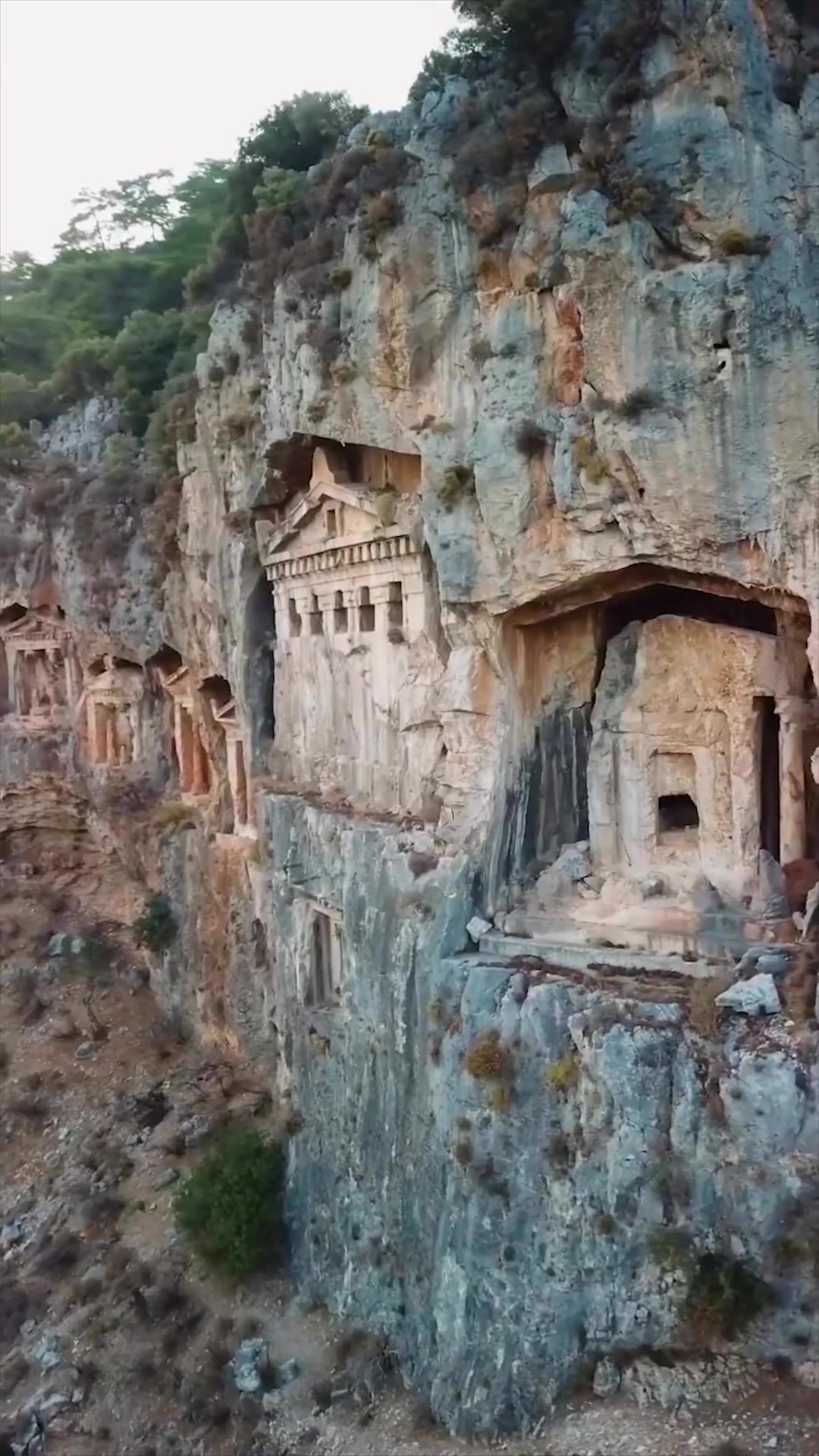
Kaunos, Turkey, is home to a series of ancient rock-cut tombs, stunning reminders of the city's 3,000-year history as a bustling metropolis through to the 1st century CE. This site in the scenic mountainous region is notable for its remains from the mid 4th century BCE, including a series of tombs carved directly into the rock face.
The Carved Legacy of Kaunos
The Tombs of Kaunos
First came the city, then come the tombs. Kaunos' story began in the 10th century BCE. In the millennia since, it developed from a metropolis on the caldera of modern-day Dalyan, Turkey, to a hub for trade and culture; many landmarks, including the rock-cut tombs, still stand for tourists to visit. The rock-cut tombs are the focal point, carved directly into the cliffside overlooking the city below. They are multi-tiered, with each tomb featuring classical architectural elements like pediments, cornices, and Doric columns, which are recognizable today. As per @gribercom, "The tombs likely served as burial sites for prominent individuals." The local stone, a honey-colored limestone, allowed for the carving of intricate details, from ornate facades to inscriptions that have largely weathered away, noting the burial of local nobles, possibly. The tombs' classical styles were built in a similar architectural style from the surrounding region. These tombs are more acropolises than single graves — a distinctive blend of Greek and Lycian design, combining ornate stonework with the more straightforward architecture of the Lycians.
The site is multi-tiered
The tombs are carved into the cliff itself, showcasing a technique used throughout the Mediterranean world. Notably, the Lycians, and arguably, the Kaunian rock-cut tombs, are carved as a physical embodiment of the myths of their day. The top tier features the most impressive tombs of all, including the largest tomb and other prominent structures. Layers of carved entrances symmetrically line each tomb, like the cells of a honeycomb. The lower tiers of rock-cut tombs include simpler tombs, some of which are still visible but mostly overgrown with vegetation.
The Legacy of Kaunos
Kaunos is currently a destination for history buffs, archaeology enthusiasts, and travelers interested in ancient Greek and Lycian culture. Local legend and lore claim the roots of Kaunos date back to your 10th century BCE, make it one of the oldest continuously inhabited sites in the world. It was a Hellenistic trading city on the Mediterranean shore, also serving as an inland port. Its legacy includes many original structures like the tombs, theater, and the its characteristic harbor structure.
A Testament to Longevity
The Tumbark
When @gribercom says the rock-cut tombs are from "the mid-4th century BC" why stop there? Much like the tombs, Kaunos' story is a testament to buildings of in the region. More than 2,500 years ago, travelers would pass through the city, and the tombs still welcome visitors today. The Tombark was carved as a grand entrance to the site. Destroyed in one form or another, visitors can still see where Kaunos stood and left its mark. Interspersed between the tombs are other carvings, including round structures, possibly symbols of wealth and status, and Lycian tombs built around the 5th century BC. The Lycian tombs faced each other for centuries, but a 7th-century earthquake damaged the city, and later, the tombs were damaged by a 6th-century earthquake, but the rock-cut tombs themselves remain. These tombs are among the most impressive examples of Lycian architecture, which is one of the first civilizations to carve tombs into cliff faces.
The Lycian Climate
Kaunos is in a lush region, with vegetation and rocky outcrops. The rock-cut tombs were carved from this limestone cliff face in an exposed location, weathering away the details on the tomb's façade. The Lycians were known for their monumental structures, and the rock-cut tombs of Kaunos are a testament to their engineering and architectural skills. The Lycians also mastered the art of the carving, evident in the tombs' intricate detail, including pediments, cornices, and other architectural elements. The region is a rich source of cultural and architectural heritage, especially if you aren't worn down by the region's often humid and arid conditions. The climate in the region is arid, with temperatures reaching 40°C in the summer. The vegetation is sparse, and the weather sometimes causes additional wear and tear on the rock-cut tombs. The tombs are exposed to the elements, and the site is not always maintained, so visitors should watch for additional conditions when exploring the complex.
The Antique Theater
Buried thousands of years ago, the Antique Theater of the city was damaged by earthquakes in the 6th and 7th centuries, but the theater's remains, including columns and a semicircular orchestra, are still there. The theater was built between the hill and the sea, offering audiences a fantastic view of the city and the harbor. The theater's remains are a testament to the city's rich cultural heritage and the Lycians' architectural skills. The Antique Theater is a reminder of the city's rich cultural heritage and the Lycians' architectural skills, and is worth exploring.
Experiencing the Tombs
- Getting There: Kaunos is in Turkey's southwest corner, near Dalyan. Taking a car is the easiest method, as buses are infrequent and local tour schedules are variable.
- Accommodation: Visit nearby Dalyan and take a ferry to Kaunos. While the town itself has few options for accommodation, plenty are available nearby in Dalyan.
- Preparation: Keep in mind that Kaunos is a series of tombs carved into a cliff face, so be prepared for uneven terrain, climbing, and sturdy footwear. Remember to bring water, as it can get very hot in the summer.
The Near Future of Kaunos
The site is located in a mountainous region, with the opportunities for a spectacular visit. The city of Kaunos is a must-visit for history enthusiasts and travelers.
Watch the Reel
Questions readers ask
What exactly are the rock-cut tombs at Kaunos and how were they constructed?
The rock-cut tombs at Kaunos are ancient burial sites carved directly into the cliffside. They were constructed by carving intricate details into the honey-colored limestone, featuring classical architectural elements like pediments, cornices, and Doric columns. These tombs are multi-tiered, with the most impressive structures at the top tier and simpler tombs at the lower levels.
Who were these tombs built for and what do the inscriptions say?
The tombs likely served as burial sites for prominent individuals, possibly local nobles. However, many of the inscriptions have weathered away over time, so the specific details about the buried individuals are largely unknown. The inscriptions that do remain are written in ancient Greek and Lycian languages.
How old are the Kaunos rock-cut tombs and why are they significant?
The rock-cut tombs are from the mid-4th century BCE, making them over 2,500 years old. They are significant because they offer a glimpse into the burial practices and architectural marvels of the ancient Mediterranean world, particularly the blend of Greek and Lycian design.
Can visitors explore the tombs today and what is the experience like?
Yes, visitors can explore the tombs today. The experience involves walking through the multi-tiered site, with the most impressive tombs at the top tier. Some of the tombs are overgrown with vegetation, but many are still visible and offer a unique glimpse into ancient burial practices.
What other historical sites can be found in Kaunos besides the rock-cut tombs?
Besides the rock-cut tombs, Kaunos is home to other historical sites such as a theater and a characteristic harbor structure. The city was a Hellenistic trading city on the Mediterranean shore, and its legacy includes many original structures that visitors can explore.
How does the architecture of the tombs reflect the cultural influences of the region?
The architecture of the tombs reflects a distinctive blend of Greek and Lycian design. The Classical Greek elements, such as Doric columns and ornate facades, are combined with the more straightforward architecture of the Lycians, showcasing the cultural influences of the region.
How do the rock-cut tombs at Kaunos compare to other ancient burial sites in the Mediterranean world?
The rock-cut tombs at Kaunos are notable for their intricate carvings and classical architectural elements, similar to other ancient burial sites in the Mediterranean world. However, their distinctive blend of Greek and Lycian design sets them apart, making them a unique example of ancient Mediterranean architecture.
Related deep dives
Similar reads based on topic and creator.



Recent articles
Fresh deep dives from the latest Reels we unpacked.




Comments
Be the first to comment.