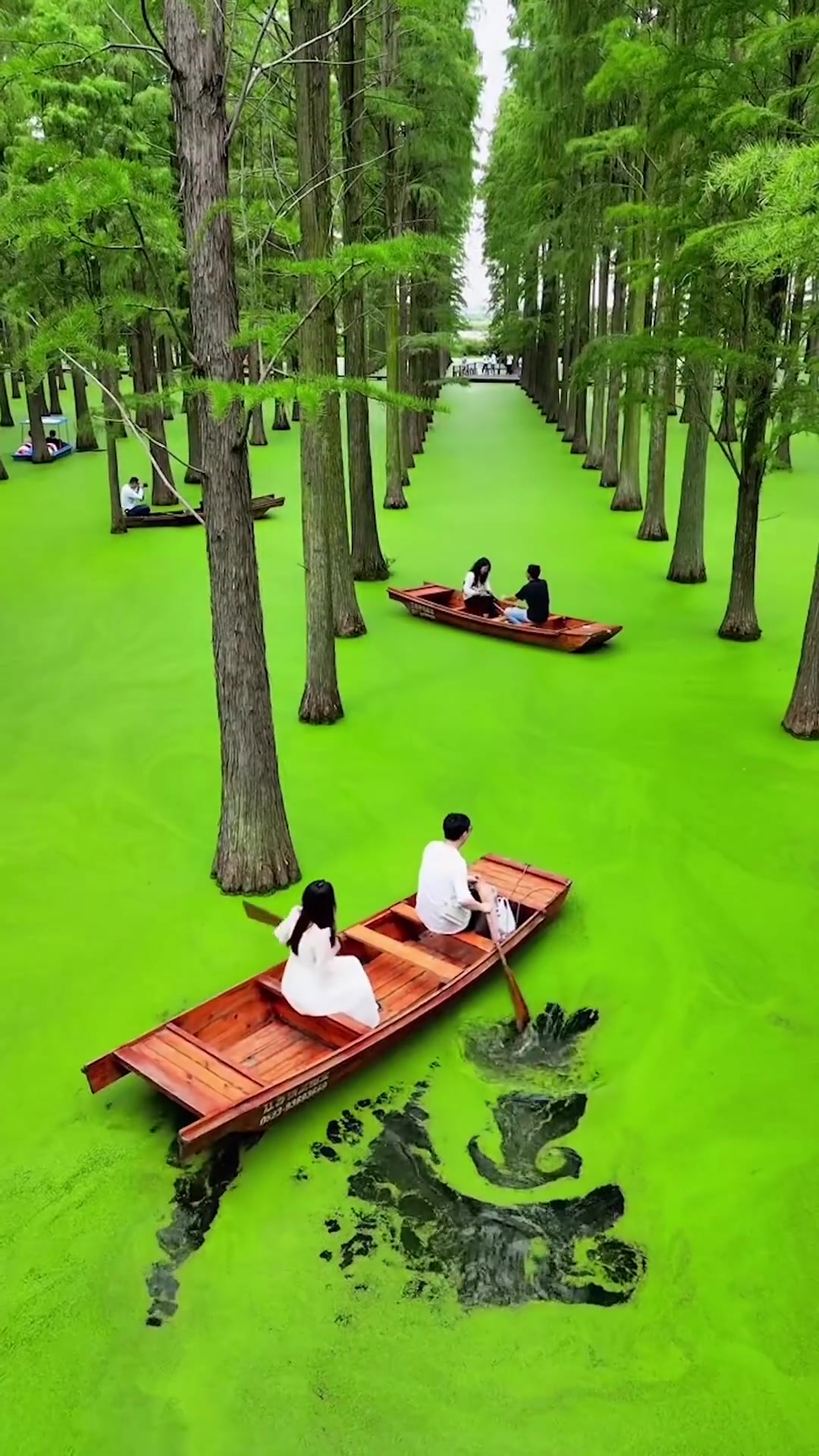
Huayang Lake Wetland Park in China's eastern region is a marvel of nature. There's something special about the way these trees stand quietly — so many of them. The main attraction is a dense forest that sprouts directly from the lake. Tall, slender trees jut from the water, as if defying the elements. Some trees stand impossibly alone, completely surrounded by water. We see small boats of people floating through this improbable forest. Rather than let the trees overwhelm the water, the two elements complement each other beautifully. The water reflects the trees’ silvery light and in turn, the trees' aerial roots divide the water into silver pathways. Water and trees do not compete, but intermingle. The overall effect is more optimally balanced than the forest just above the waterline.
Green Water Forest
The wetland at Huayang Lake covers 4000 hectares and is ranked as a national nature reserve. The most amazing thing about this park is that it is a floating forest. The concept itself is unique. Instead of the forest pushing up against the water, it is the literal water that is the basis for this forest. Trees grow into the water and then out from it. The forests stand still and rise above the water floor as it covers the entire forest floor. The trees are scattered across the waterway so you can see the water moving, but also the trees swaying. The broad leaves extend over the water itself. The trees are tall and slender, and they reflect the water similar to how a mirror would. Trees have been growing for thousands of years, yet nothing is blocking visibility to the water. It's the trees’ trunks that rise above the water, creating a semi-transparent scene while keeping the whole landscape beautifully grounded. The trees are densely packed, and the wetlands are wet enough to have a variety of trees. The distinctive thing about these trees is how they grow. They're not just planted; their roots are submerged in the water. The trees are entirely dependent on the water for their nutrients, and they grow vertically as they reach for the sun. Trees that are near the water’s edge and so on, they turn seaward, no longer consistent with the water below. Furthermore, the trees do not soak up the water. Instead, it just provides a stable source of nutrients. From the comments, it is clear that these water features are both a sight and a sound experience. People can walk on the boardwalk above the water, or walk alongside the water. If you look closer, you will see people boating along the waterway.
New Chinese Tourist Attractions
This landscape is a hidden gem in China. While people may not be very familiar with it, it shows that China is moving to appreciate and protect its natural parks. More and more beautiful destinations are being preserved, and nature parks being opened for public view. China has more than 2000 protected natural spaces (China Nature Reserve). China is building a lot more parks and improving infrastructure to ensure a more eco-friendly view or appeal. Huayang Lake Wetland Park is one of China's newest tourist destinations. The lake, and the surrounding park are being promoted as natural beauty zones, and the only way to access is by walking and boating. It's the idea of "ecotourism" and China is laying the groundwork for it. While local residents are also going there, the park is still a relatively untraveled territory. It is the wetlands themselves that add to the mystique of this floating forest.
An Eco-Landscape
There is variety in the landscape. While most of the forest is water-based, their are natural water bodies, too. You’ll find both water and tall trees on the damp land surrounding the water. The trees are present and the water is maintained by two lakes. There are two essential components: the trees and the water. The trees grow straight, tall and right out of the shallow water.
The Trees
The trees are tall and slender, growing from the floor, and their long roots cover the water. The trees are dense, stunning, and enhance the beauty of the water. Trees and boats are in balance with each other; boating is the optimal way to view the forest. The trees are slender, green, and reflect on the water. The trees are not planted in an order; they simply grow from the water's floor onto the water. The trees themselves are denser than most forests.
Explore the Water
Huayang Lake Wetland Park is easily accessible by car, bus, or train. Take a walk or enjoy a quick boat ride through calm waters. Be aware of the park’s visiting hours, which vary depending on the season.
- Best time to visit: April. Trees start to grow, and the weather is warm before people flocks out.
- Best way to experience it: By boat. To truly absorb the beauty of this landscape, explore by boat through the wetland.
- Avoid: Crowds. The park is popular, so plan your visit for the off-peak season. The trees are waterproof, so it is fine to lean against them. Look for the trees that are bent perfectly over the water.
Trees of the Future
Huayang Lake Weland Park is a marvel of nature and engineering. The trees are what makes the forest beautiful. They are in balance with the water, trees floating and growing in the wetland. Huayang Lake Wetland Park is worth seeing, and it is a good family vacation spot with multiple activities for the whole family.
Watch the Reel
Questions readers ask
What kind of trees are in the floating forest at Huayang Lake Wetland Park?
The article doesn't specify the exact species of trees, but it describes them as tall, slender, and densely packed. The trees have broad leaves that extend over the water and their trunks rise above the waterline, creating a unique, semi-transparent landscape. The trees are entirely dependent on the water for their nutrients, and they grow vertically, reaching for the sun.
How do the trees in the floating forest survive in the water?
The trees in the floating forest at Huayang Lake Wetland Park are uniquely adapted to their environment. Their roots are submerged in the water, which provides a stable source of nutrients. The trees do not soak up the water but rather use it to sustain their growth. This allows them to grow vertically and create a beautiful, balanced landscape with the water.
Can visitors interact with the floating forest at Huayang Lake Wetland Park?
Yes, visitors can enjoy the floating forest from different perspectives. They can walk on a boardwalk above the water, walk alongside the water, or even take a boat ride along the waterway. These experiences allow visitors to appreciate both the sight and sound of the unique landscape and water features.
How large is Huayang Lake Wetland Park?
Huayang Lake Wetland Park covers 4000 hectares. It is designated as a national nature reserve. The wetland is home to a floating forest, where trees grow directly from the water, creating a surreal and beautiful landscape.
Is this type of forest unique to Huayang Lake Wetland Park?
While the concept of a floating forest is quite unique, it's not clear if it is entirely exclusive to Huayang Lake Wetland Park. The article highlights the distinctive way the trees grow directly from the water and how the water provides nutrients, making it a special and rare ecosystem. However, similar natural phenomena might exist elsewhere, but this park is certainly one of the most notable examples.
Related deep dives
Similar reads based on topic and creator.




Recent articles
Fresh deep dives from the latest Reels we unpacked.




Comments
Be the first to comment.