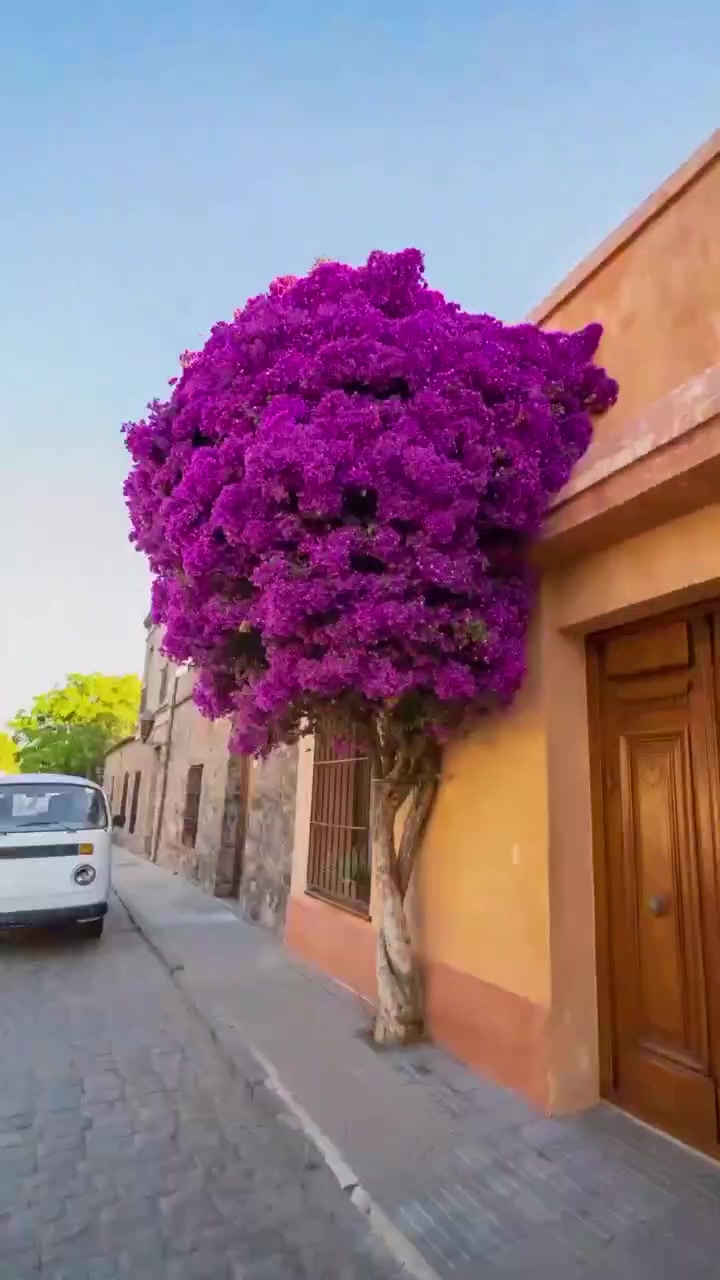
A bougainvillea tree in bloom—standing, banners of vibrant purple flowers waving in the breeze. The tree is an eye-opening sight, especially near a rooftop with white stucco walls and stone trims. Trees that bloom with as much wild abandon, energy, and color are a rare sight in the suburbs. Its lush abundance of flowers contrasts dramatically with the stark, dry look of its surroundings. This vibrant tree is gracing a tranquil, old-world location more often seen with dark green and earthy brown foliage.
The Radiant Bougainvillea
The bougainvillea is a hardy shrub that produces bright and colorful blossoms much like the showy, flamboyant, and apparent one in the video. The tree is native to South America, though it now grows all over the world. Its true flowers are small and grow in clusters, but these bloom encased in even larger, paper-like, and colorfully hue bracts. The bracts (not actual flowers) are modified leaves which stand out with colors as eye-catching as their blossoms. These brightly colored bracts are why it’s become a popular ornamental plant for gardens, patios, and other open spaces. Bougainvillea can grow into large, sprawling trees or shrubs. They are adaptable, drought-resistant, and able to thrive in various climates. The flowers change colors—pink, violet, yellow, red, or white, depending on the species. They bloom continuously in tropical climates. The species in the video is a purple variety. The tree’s unique growth process is unlike the plumeria or frangipani trees, which are more familiar in the vicinity. Bougainvillea is a great addition to any garden. It grows quickly, adapting to dry, harsh conditions. It flowers year-round in tropical climates
What makes this tree so eye-catching?
Relieving the urban monochrome
Bougainvillea trees stand out in settings saturated with a monotonous color palette, such as archipelagos, or plains. Dull-brown deserts, or places where greenery is sparse and the landscape is dominated by sandy tones. The tree's vibrant, lush, and colorful blossoms add a striking contrast. The bougainvillea tree in the video adds relief to the otherwise dry, earthy tones of the area. Here, it is contrasting with the stark backdrop of the building and landscape.
Drawing flocks of birds
Because bougainvillea trees are so full of blossoms, there is a lot of movement and activity around them. Birds are drawn to the trees and nest in their branches. While the bougainvillea does not produce fruit, the pollinators that flock to the flowers are a feast for the birds. They nest and periodically feed in the trees. The tree’s vibrant colored bracts provide a safe place for birds to nest and hide under.
Growing where others don’t
Bougainvillea flowers thrive in harsh environments. This is an immediate advantage. The tree’s resilience to drought and adaptability are why it’s suited to survive in areas where trees struggle. Its vibrant flowers tolerate harsh sun and heat. The tree’s deep roots help to hold the soil, limiting erosion and providing shade. The tree is known for growing in arid climates. Its roots are much deeper and stronger than other plants. This strength and adaptability are a major reason why bougainvillea brece is a popular choice for landscaping in many parts of the world.
You’ll want one after you see this
Despite the scarcity of water in the area, the bougainvillea flowers bloomed in full splendor. You can have a bougainvillea growing in your home or outside of it. Here’s what you need to know to grow your bougainvillea tree:
- Placement: Bougainvillea trees grow best in full sun and can also grow in partial shade. Although they can tolerate a range of soil types, well-drained soil is preferred.
- Nutrients: Apply slow-release fertilizer or organic fertilizer enriched with potassium and phosphorus, applying it every 2-3 months. An occasional supplement with a balanced fertilizer can help maintain its green leaves, especially in cooler months.
- Growth: Bougainvillea can be planted directly in the ground or in pots. Prune the tree to maintain its shape and encourage new growth, especially after it blooms. Remove dead or diseased branches as needed.
- Maintenance: Whether in the ground or a container, make sure the roots do not sit in water. This can cause root rot, which can kill the plant. To ensure that the tree blooms consistently, it requires a period of temperature drops at night to stimulate flowering. Also, deadheading any wilted flowers will encourage fresh leaves and new growth.
Watch the Reel
Questions readers ask
What exactly are the bright colors we see on a bougainvillea tree?
The bright colors are not the actual flowers but modified leaves called bracts. These bracts encase the small, true flowers and come in a variety of colors like pink, violet, yellow, red, or white, depending on the species. They are what make the bougainvillea so visually striking.
Can bougainvillea trees grow in colder climates, or are they strictly for tropical areas?
Bougainvillea trees are quite adaptable and can grow in various climates, but they do thrive best in tropical environments. They are drought-resistant and can handle harsh conditions, but extreme cold might be challenging for them. In colder regions, they might need some protection during winter.
How do bougainvillea trees help the environment, especially in arid areas?
Bougainvillea trees are excellent for preventing soil erosion due to their deep root systems. They also provide shade and shelter for birds and other wildlife. Their ability to thrive in harsh, dry conditions makes them a great choice for areas where other plants struggle to survive.
Are bougainvillea trees easy to care for, and can I grow one in my garden?
Bougainvillea trees are relatively easy to care for. They are drought-resistant and can tolerate a range of soil types. They grow quickly and adapt well to various conditions, making them a great addition to any garden, especially in areas with plenty of sunlight.
Why do birds flock to bougainvillea trees, and what do they find there?
Birds are drawn to bougainvillea trees because of the abundant flowers and the pollinators that these flowers attract. The trees provide a safe nesting place and a source of food for the birds. The vibrant colors and dense foliage offer both shelter and a place to hide.
Related deep dives
Similar reads based on topic and creator.




Recent articles
Fresh deep dives from the latest Reels we unpacked.




Comments
Be the first to comment.