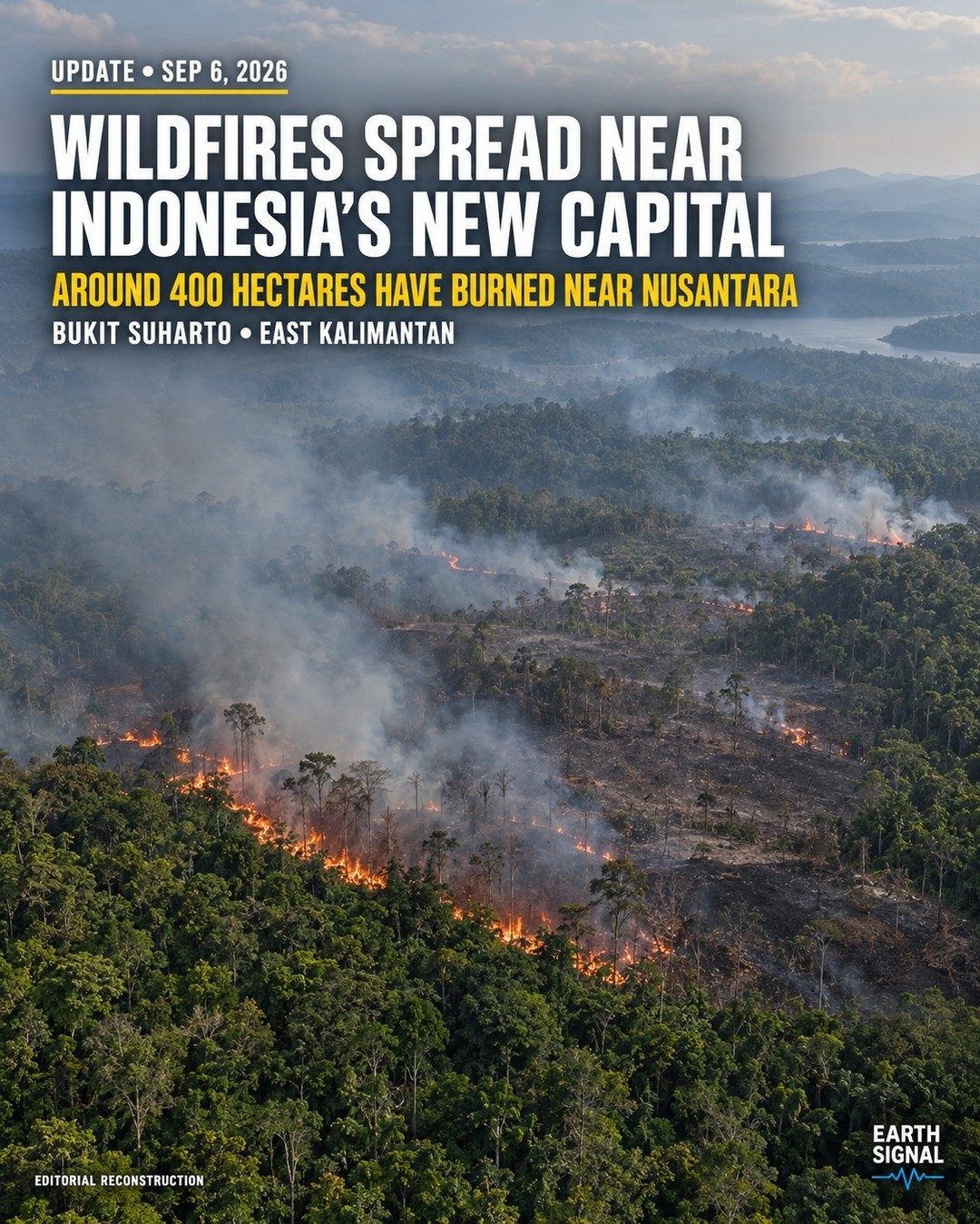
Wildfires’ Shadow Over Nusantara
Wildfires have swept near Nusantara, Indonesia, the country's freshly minted capital. Initially built to fill the need of replacing Jakarta, whose sinking rates and pollution levels had reached critical points, Nusantara now faces different pressing environmental issues. Now, a wildfire has burned through approximately 400 hectares of Bukit Suharto's forest. The thick smoke plumes rise from burning trees and vegetation shrouding the sky. On September 2023, The Guardian reported that Bukit Soeharto has experienced more than 200 fires this year. Environmentalists lack understanding on the fire's underlying cause. As the country shifts its capital, it must grapple with the complex environmental challenges that threaten its new beginning. President Joko Widodo welcomed the news of the move in August 1, 2023, but awareness of Bukit Soeharto's fires had already begun to spread. This year has seen more than 200 fires in Bukit Soeharto, Indonesia. Numerous farms and settlements have been displaced or destroyed. The Environmental and Forestry Ministry announced: "The fires have started due to the dry climate". While this may be the case, it is not the only agent responsible. There is increasing evidence suggesting that the fires were intentionally lit by individuals, with intention to clear land.
The Human Factor
Indonesia is one of the world's largest producers of palm oil. Responsible for roughly 40% of global supply, most of this is exported. Illegally setting fires to clear forest for palm oil and other plantations is a widespread problem. The fires have already burned through 400 hectares of forest, releasing massive amounts of greenhouse gases and other pollutants into the atmosphere. These fires add tremendously to the consequences of air pollution, already at critical levels due to an immense number of transportation and industrial activities. It is a direct challenge to the city's development. There was public outrage. On September 2023, The Guardian reported intense public discussion on the fires. Public accounts and organizations pointed to the destructive nature of the fires. They repeatedly emphasized the immediate need for intervention. The public was not alone in their outrage. The Environment and Forestry Ministry's involvement was quick, and the forces had already begun to combat the fires.
The War Against Climate Change
The newest front of the fight against climate change is not in a laboratory, or on a wind farm, but in the forests of Indonesia. The World Wildlife Fund stated: "It is clear that illegal palm oil plantations are driving the spread of fires in Indonesia. It's estimated that there are more than 3,000 such sites across the country, destroying millions of hectares of forest each year, threatening biodiversity and releasing vast amounts of greenhouse gases." At Nusantara, heightened security has been deployed and the city has slowed. Guards have been deployed across the front of the fires. Air support has been deployed to identify sources of fire and extinguish them. Additional support is on the way, as the Indonesian government has committed to protecting the city and halting the fires. Committed to the protection of the city, the Ministry of Environment and Forestry allotted more than 200 million dollars to fight the fires.
Watch the Reel
Related deep dives
Similar reads based on topic and creator.

Recent articles
Fresh deep dives from the latest Reels we unpacked.




Comments
Be the first to comment.