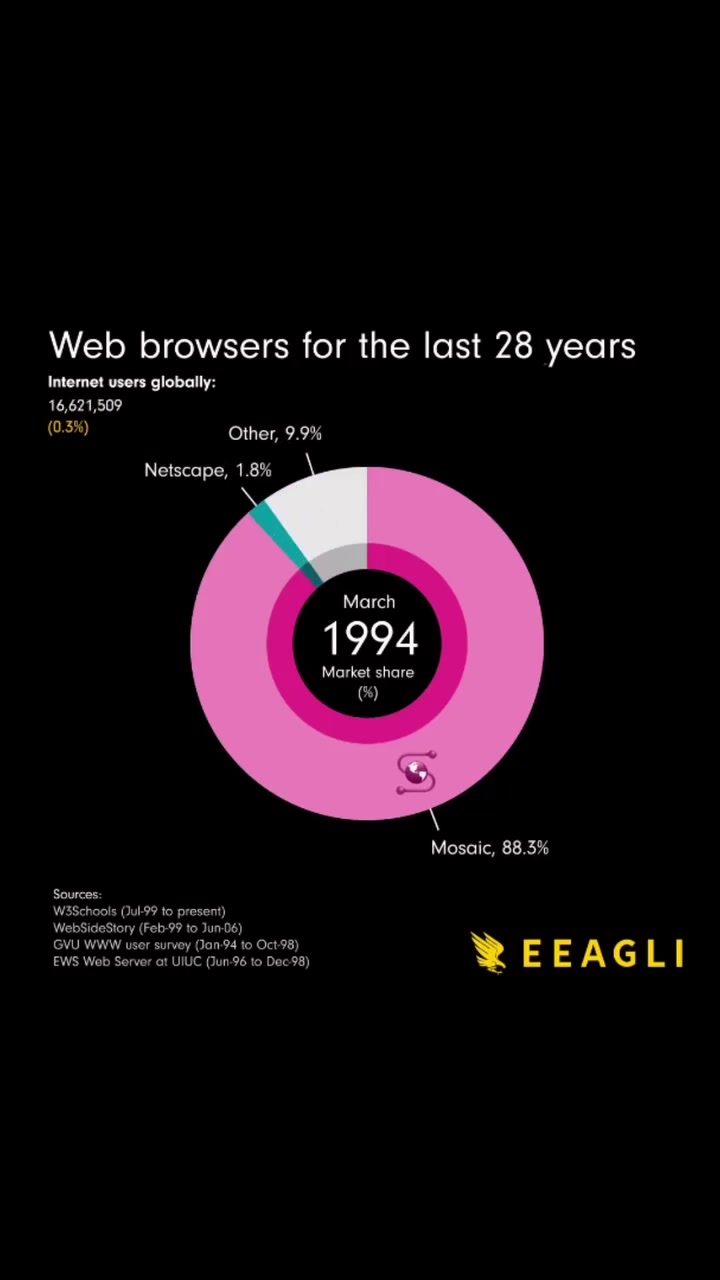
The Evolution of Web Browsers: A Journey Through Market Dominance
Web browsers have been the gateway to the internet for over three decades, evolving significantly in terms of functionality, design, and market share. Understanding the trajectory of popular web browsers since 1994 provides valuable insights into the dynamics of the digital landscape.
Why This Matters
The rise and fall of web browsers reflect broader trends in technology adoption, user preferences, and competitive strategies. From Mosaic to modern browsers like Google Chrome and Firefox, each browser has played a crucial role in shaping the internet as we know it today.
The Early Days: Mosaic and Netscape
Mosaic's Dominance in the Early 1990s
In February 1994, Mosaic was the undisputed leader in the web browser market, holding an impressive 93.0% market share. This was a time when the internet was still in its infancy, and Mosaic's user-friendly interface made it a go-to choice for early adopters. Data sources like W3Schools and the GVU WWW user survey provide a snapshot of this era, highlighting Mosaic's dominance.
The Rise of Netscape
By August 1998, the landscape had shifted significantly. Netscape and Internet Explorer were neck and neck, with Netscape holding 49.8% of the market and Internet Explorer close behind at 47.1%. This period marked the beginning of a fierce competition that would define the browser wars of the late 1990s and early 2000s.
The Internet Explorer Era
Internet Explorer's Monopoly
By December 2002, Internet Explorer had established itself as the dominant player, commanding a staggering 92.8% of the market share. This period was characterized by Internet Explorer's integration with the Windows operating system, which gave it a significant advantage over competitors. Mozilla, Netscape, and Opera lagged behind with much smaller market shares.
The Fall of Internet Explorer
Despite its dominance, Internet Explorer's reign began to wane in the mid-2000s. The rise of new browsers like Firefox and Chrome, coupled with increasing security concerns and competition, led to a gradual decline in Internet Explorer's market share. By 2012, its market share had dropped to around 30%, and it was no longer the default browser for many users.
The Modern Era: Chrome, Firefox, and Safari
Google Chrome's Ascendancy
Google Chrome, launched in 2008, quickly gained traction due to its speed, simplicity, and integration with Google services. By 2012, Chrome had surpassed Internet Explorer to become the most widely used browser globally. Its market share continued to grow, reaching over 60% by 2022.
Firefox and Safari's Contributions
Mozilla Firefox, developed by the Mozilla Foundation, has been a strong contender in the browser market. Known for its focus on privacy and open-source development, Firefox has maintained a significant user base. Safari, Apple's proprietary browser, has also gained popularity, particularly among macOS and iOS users.
Opera and Other Players
Opera, one of the earliest browsers to introduce features like tabs and speed dial, has maintained a niche market share. Other browsers, such as Microsoft Edge and Brave, have also emerged, offering unique features and catering to specific user needs.
Practical Tips for Choosing a Browser
Choosing the right browser depends on your specific needs and preferences. Here are some practical tips to consider:
- Speed and Performance: If you prioritize speed and performance, Google Chrome and Microsoft Edge are known for their fast loading times and efficient resource management.
- Privacy and Security: For users concerned about privacy, Firefox and Brave offer robust privacy features and ad-blocking capabilities.
- Integration: If you are deeply integrated into a particular ecosystem (e.g., Google services, Apple ecosystem), choosing a browser that seamlessly integrates with these services can enhance your user experience.
- Customization: Browsers like Firefox and Chrome offer extensive customization options, including themes, extensions, and add-ons, allowing users to tailor their browsing experience.
Important Takeaways
- The evolution of web browsers reflects the broader trends in technology and user preferences.
- Mosaic's dominance in the early 1990s set the stage for the browser market.
- Internet Explorer's integration with Windows led to its dominance in the late 1990s and early 2000s.
- Google Chrome's ascendancy in the 2010s marked a new era of browser competition.
- Modern browsers like Firefox, Safari, and Edge offer unique features and cater to specific user needs.
Conclusion
The journey of web browsers from Mosaic to Google Chrome highlights the dynamic nature of the digital landscape. As technology continues to evolve, so too will the browsers that shape our online experiences. Understanding the rise and fall of these browsers provides valuable context for navigating the ever-changing world of web technology.
Watch the Reel
Questions readers ask
Which web browser held the largest market share in the mid-1990s?
In the mid-1990s, Netscape Navigator was the dominant web browser, holding a significant portion of the market share. Its popularity was largely due to its user-friendly interface and innovative features, which set the standard for early web browsing.
When did Internet Explorer first become the market leader?
Internet Explorer first became the market leader in the late 1990s. Its rise to dominance was accelerated by its bundling with the Windows operating system, which gave it a significant advantage in terms of accessibility and user adoption.
What were the 'browser wars' and when did they occur?
The 'browser wars' refer to the intense competition between web browsers, primarily between Netscape Navigator and Internet Explorer, during the late 1990s to the early 2000s. This period saw rapid development and innovation in browser technology, driven by the need to gain or maintain market share.
How has Google Chrome impacted the web browser market since its launch?
Google Chrome, launched in 2008, has significantly impacted the web browser market by offering a faster, more efficient browsing experience. Its market share has grown steadily, making it one of the most widely used browsers today.
What role did the GVU browser statistics play in tracking web browser trends?
The GVU (Graphics, Visualization, and Usability Center) browser statistics were a key resource for tracking web browser trends from the mid-1990s to the early 2000s. They provided monthly updates on browser usage, helping to monitor shifts in market share and user preferences over time.
Which web browser was the first to gain widespread popularity?
The first web browser to gain widespread popularity was Mosaic, released in 1993. Its intuitive interface and graphical design made it accessible to a broad audience, paving the way for the growth of the internet.
How have user preferences influenced the evolution of web browsers over the years?
User preferences have significantly influenced the evolution of web browsers, driving the development of new features and improvements. For instance, the demand for faster browsing speeds and enhanced security measures has led to the creation of more efficient and secure browsers. Additionally, the rise of mobile devices has prompted the development of browsers optimized for smaller screens and touch interfaces.
Related deep dives
Similar reads based on topic and creator.


Recent articles
Fresh deep dives from the latest Reels we unpacked.




Comments
Be the first to comment.