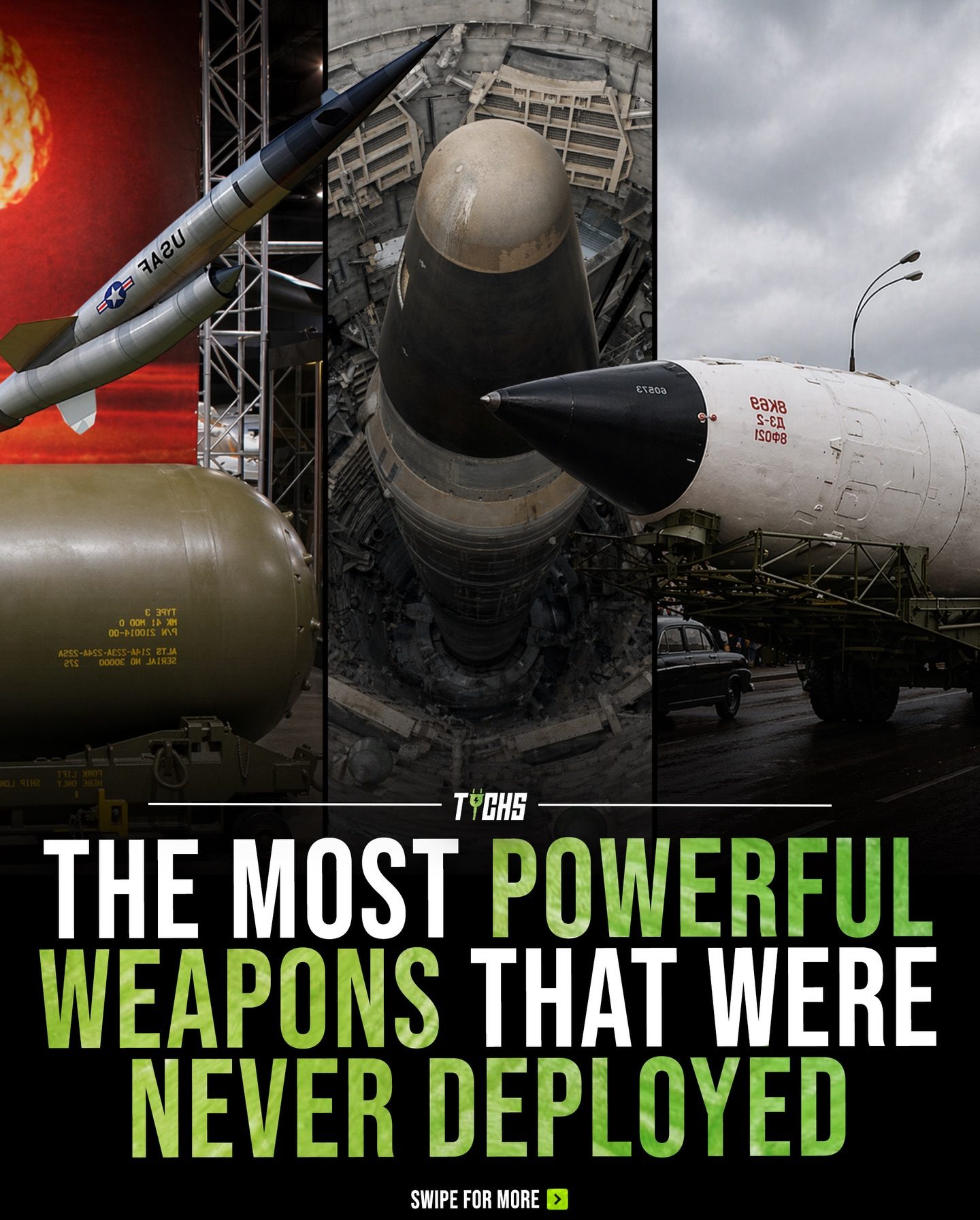
Nuclear Weapons: The Most Powerful Systems Never Deployed
Nuclear weapons stand as a stark reminder of the destructive capabilities humanity has developed. Among these, some of the most powerful weapons were created but never fully deployed. These systems, born out of the Cold War, represent a chilling chapter in global history, showcasing the frightening depths of nuclear innovation and the constant fear of unimaginable destruction.
Context: The Cold War Arms Race
The Cold War era, spanning from the late 1940s to the early 1990s, was a period of intense geopolitical tension between the United States and the Soviet Union. This rivalry extended to the development of nuclear weapons, leading to a relentless arms race. Both superpowers were driven by the desire to maintain a strategic advantage, resulting in the creation of some of the most formidable and terrifying weapons ever conceived.
The Most Powerful Weapons
The Soviet Tsar Bomba
The Soviet Tsar Bomba remains the most powerful nuclear weapon ever tested, with a yield of 50 megatons. This hydrogen bomb, also known as the RDS-37 or AN602, was detonated on October 30, 1961, over the Mityushikha Bay test site in the Arctic. The explosion was so massive that it was visible from over 1,000 kilometers away. Despite its terrifying power, the Tsar Bomba was never used in combat and remains a symbol of the extreme capability of nuclear weaponry.
The US B41 Nuclear Bomb
The US B41 nuclear bomb, featured prominently in the visuals, was another monumental development in nuclear weaponry. With a yield of 25 megatons, it was a thermonuclear weapon designed to deliver unprecedented destruction. The B41 was never used in combat and was eventually retired, reflecting the shifting priorities and the growing awareness of the catastrophic consequences of deploying such weapons.
The Cobalt Bomb
A far more sinister concept, the cobalt bomb was a theoretical weapon designed for global extinction. The idea was to use cobalt-59, which would contaminate the environment with cobalt-60, a radioactive isotope with a half-life of over five years. This weapon was never built, thankfully, but its mere conception underscores the chilling lengths to which nuclear research extended during the Cold War.
Project Pluto
Project Pluto was a United States military project to develop a nuclear-powered cruise missile, designed to fly at Mach 3 (approximately 2,300 mph). The missile was intended to use a continuous nuclear detonation to power its engines, making it a terrifying concept with the potential for unstoppable, sustained flight. Project Pluto was ultimately cancelled due to concerns about the safety and practicality of a nuclear-powered missile.
Fractional Orbit Bombardment System (FOBS)
The Fractional Orbit Bombardment System (FOBS) was a Soviet intercontinental ballistic missile (ICBM) system that could deliver nuclear warheads from a fractional orbit around the Earth. This system allowed for precise, long-range strikes and was designed to evade early warning systems. Though it reached a deployment stage, its use was limited by international treaties and the evolving strategic landscape.
Advanced Weapon Technologies
Perimeter Dead Hand
The Perimeter Dead Hand, also known as "Mertvaya Ruka" (Dead Hand), was an automated nuclear retaliation system designed to ensure a second-strike capability in the event of a decapitating first strike on the Soviet Union. This system would launch nuclear missiles automatically if it detected a nuclear explosion on Soviet territory, adding another layer of terrifying automation to the nuclear deterrent.
Practical Tips for Understanding Nuclear History
To comprehend the complexity and gravity of nuclear weaponry, it is essential to approach the subject with a blend of historical, scientific, and geopolitical perspectives:
Seek Reliable Sources
Reliable sources, such as official military documents, academic research, and expert analyses, provide a comprehensive understanding of nuclear history. Websites like the National Security Archive and Global Security offer extensive resources and documents. Additionally, books like "The Making of the Atomic Bomb" by Richard Rhodes and "Command and Control" by Eric Schlosser offer in-depth insights.
Study Key Events and Treaties
Understanding key events and treaties, such as the Cuban Missile Crisis, the Partial Nuclear Test Ban Treaty, and the Strategic Arms Limitation Talks (SALT), provides context for the development and limitation of nuclear weapons. These historical milestones highlight the diplomatic efforts to control nuclear proliferation and mitigate the risks of nuclear war.
Explore Historical Archives
Historical archives, such as the US Atomic Energy Commission and National Archives, contain primary documents, photographs, and films that offer a firsthand look at the development and impact of nuclear weapons.
Important Takeaways
The most powerful nuclear weapons, while never deployed, serve as a stark reminder of humanity's potential for self-destruction. The relentless pursuit of nuclear superiority during the Cold War led to the development of weapons with unprecedented capabilities, from the Soviet Tsar Bomba to the US B41 nuclear bomb. Concepts like the cobalt bomb and Project Pluto pushed the boundaries of nuclear technology, while systems like the Perimeter Dead Hand added automated layers to nuclear deterrence.
The Cold War arms race underscores the importance of international cooperation and strategic diplomacy in mitigating the risks of nuclear war. Treaties, such as the Nuclear Non-Proliferation Treaty and the Comprehensive Nuclear-Test-Ban Treaty, have played a crucial role in limiting the spread and testing of nuclear weapons, ensuring that humanity remains vigilant in preventing a nuclear catastrophe.
Conclusion
The most powerful nuclear weapons, though never deployed, represent a chilling chapter in global history, showcasing the extreme capabilities developed during the Cold War. From the Tsar Bomba to the B41 nuclear bomb, these systems exemplify the relentless pursuit of nuclear superiority and the constant fear of unimaginable destruction. As we continue to navigate the complexities of nuclear weaponry, it is essential to remain vigilant in promoting peace, cooperation, and strategic diplomacy to ensure a safer, more secure world.
Watch the Reel
Questions readers ask
What were some of the most powerful nuclear weapons developed during the Cold War but never deployed in combat?
During the Cold War, several extremely powerful nuclear weapons were developed but never used. These include the B41 nuclear bomb, which was the most powerful nuclear weapon ever produced by the U.S., with a yield of 25 megatons. Other notable examples include the Soviet Tsar Bomba, which, although tested, was never deployed. The U.S. also developed the W53 warhead and the W38 warhead, which were some of the most powerful nuclear warheads ever created, but they were never used in a conflict.
How did the Cold War influence the development of nuclear weapons?
The Cold War significantly accelerated the development of nuclear weapons as both the United States and the Soviet Union engaged in an aggressive arms race. This period saw rapid advancements in nuclear technology, leading to the creation of some of the most powerful and terrifying weapons in history. The constant fear of nuclear war drove both superpowers to develop more advanced and deadly nuclear systems, pushing the boundaries of destructive capabilities.
What is the significance of the B41 nuclear bomb in the history of nuclear weapons?
The B41 nuclear bomb is significant because it was the most powerful nuclear weapon ever produced by the U.S. with a yield of 25 megatons. It was designed as a strategic weapon, carried on heavy bombers, and intended to deliver large-scale destruction. The development and testing of the B41 highlighted the escalating nuclear tensions and the relentless arms race between the U.S. and the Soviet Union during the Cold War.
What was the cobalt bomb and why was it considered an extinction-level threat?
The cobalt bomb was a theoretical nuclear weapon that would have used cobalt as a component, turning the weapon into a 'doomsday device.' The cobalt would create large amounts of radioactive fallout, which could contaminate vast areas for long periods. Such a weapon was considered an extinction level threat because it could make entire regions uninhabitable, leading to widespread human and environmental devastation, and could potentially cause global catastrophe.
What are the key differences between the B41 and the Tsar Bomba?
The B41 and the Tsar Bomba are both extremely powerful nuclear weapons, but they have some key differences. The B41 was produced by the U.S. and had a yield of 25 megatons, while the Tsar Bomba, developed by the Soviet Union, had a yield of 50 megatons, making it the most powerful nuclear weapon ever tested. The Tsar Bomba was tested in 1961, while the B41 was never deployed. The B41 was designed as a strategic weapon for heavy bombers, while the Tsar Bomba was designed as a demonstration of Soviet power.
How were nuclear weapons tested during the Cold War?
During the Cold War, nuclear weapons were tested primarily through atmospheric and underground detonations. The U.S. and the Soviet Union conducted hundreds of tests, with the U.S. testing 1,054 nuclear weapons and the Soviet Union testing 715. Many tests were conducted in remote locations, such as the Nevada Test Site in the U.S. and the Semipalatinsk Test Site in Kazakhstan. The testing of these weapons played a significant role in the escalation of tensions and the development of more advanced nuclear technologies.
What role did nuclear fear play during the Cold War?
Nuclear fear was a constant and pervasive force during the Cold War. The ever-present threat of nuclear annihilation shaped geopolitical strategies and public consciousness. This fear was amplified by the potential for instant and catastrophic destruction, leading to widespread anxiety and a deep-seated dread of nuclear conflict. The relentless arms race and the constant fear of nuclear war drove both superpowers to develop more advanced and deadly nuclear systems.
Related deep dives
Similar reads based on topic and creator.



Recent articles
Fresh deep dives from the latest Reels we unpacked.




Comments
Be the first to comment.