Global Freshwater Usage
Water is a finite resource, and how countries utilize it can have significant implications for both local and global environments. Understanding global freshwater usage patterns is crucial for managing resources and addressing environmental challenges.
Context / Why this matters
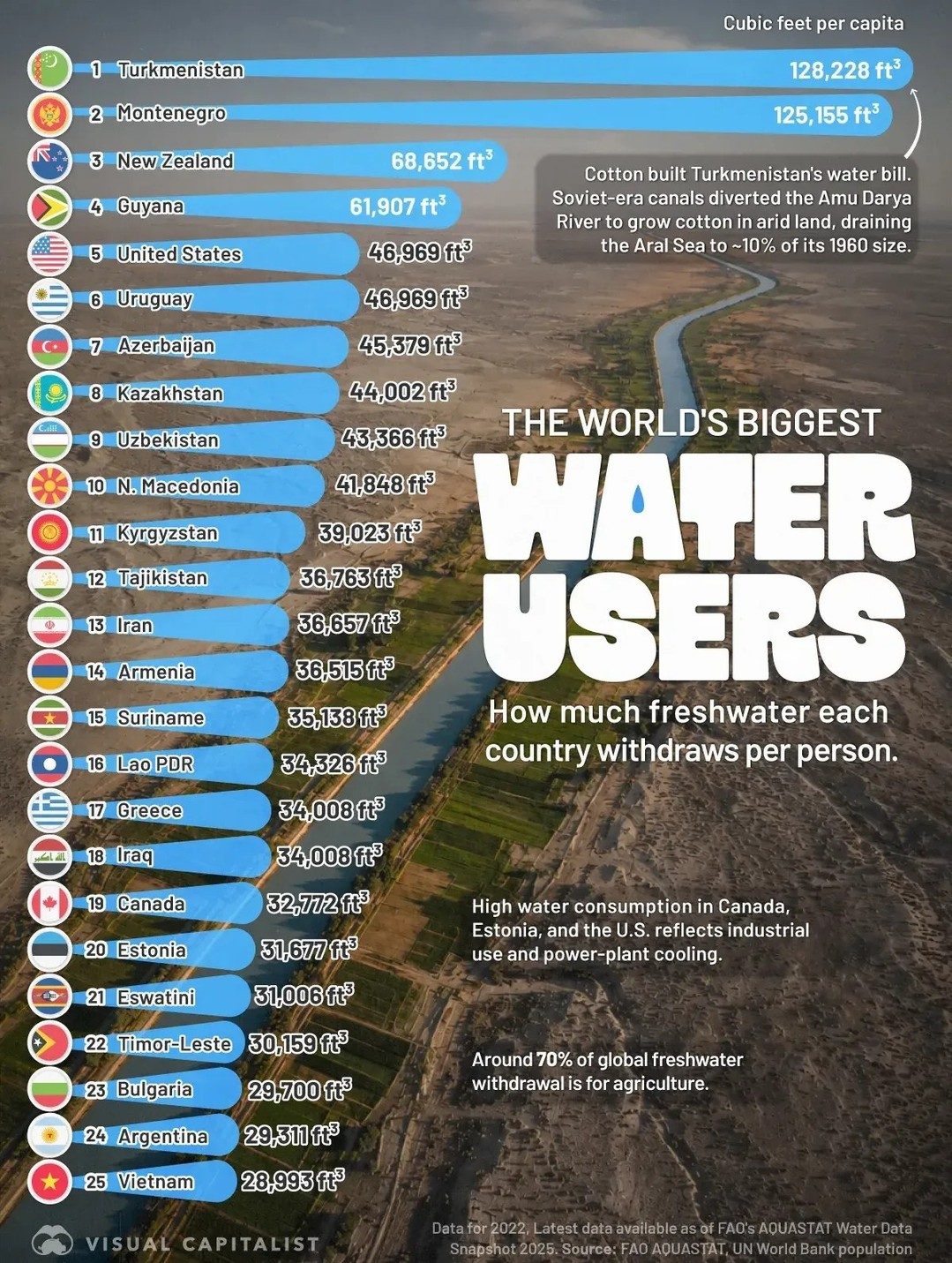
Globally, about 70% of freshwater withdrawals are dedicated to agriculture, highlighting its substantial demand on water resources. Industrial activities and power generation also contribute significantly to freshwater usage, particularly in countries like the United States, which ranks fifth overall in terms of annual freshwater withdrawals per person. This underscores the need for efficient water management practices across various sectors.
Main discussion
Global Freshwater Withdrawals
Freshwater withdrawals per capita vary widely across the globe. Turkmenistan leads the list with the highest freshwater withdrawal per person, at 128,228 cubic feet. This is followed by New Zealand at 68,652 cubic feet and Guyana at 61,907 cubic feet. The United States, with 46,969 cubic feet per person, ranks fifth. This data, sourced from FAO AQUASTAT, the UN, and the World Bank, provides a clear picture of how water is being utilized differently across various countries.
Water Usage in Agriculture
Agriculture is by far the largest consumer of freshwater resources globally. This sector accounts for approximately 70% of all freshwater withdrawals. The high demand for water in agriculture is driven by the need for irrigation, which is essential for growing crops in arid and semi-arid regions. Efficient irrigation practices and water-saving technologies are crucial for sustaining agricultural productivity while minimizing water usage.
Industrial and Power Generation
Industrial activities and power generation are the next largest consumers of freshwater. These sectors require significant amounts of water for cooling, processing, and other manufacturing processes. For instance, the United States’ high ranking in freshwater withdrawals is partly due to its substantial industrial activity and power generation needs. Effective management and recycling of water in these industries can help reduce their environmental footprint.
Freshwater Usage by Country
Countries like Turkmenistan, which have high freshwater withdrawals per capita, face unique challenges in managing their water resources. High consumption can strain local water supplies, leading to issues such as water scarcity and environmental degradation. Effectively managing water resources in these countries is essential for sustainable development.
Canada's Water Consumption
Canada, known for its abundant freshwater resources, also has high water consumption due to its industrial use and power-plant cooling. Although Canada has vast water reserves, efficient water management is still necessary to ensure long-term sustainability. This underscores the importance of water conservation practices, regardless of a country's water endowment.
Practical Tips
Efficient water management is key to sustainable development. Here are some practical tips for conserving water resources:
- Implement Efficient Irrigation Systems: Use drip irrigation and other water-saving technologies in agriculture to reduce water consumption.
- Promote Water Recycling: Industries should adopt water recycling practices to minimize freshwater withdrawals.
- Encourage Water-Saving Appliances: Households can use water-efficient appliances and fixtures to reduce daily water usage.
Important takeaways
Understanding global freshwater usage patterns is essential for sustainable resource management. Key takeaways include:
- Agriculture is the largest consumer of freshwater, accounting for about 70% of global withdrawals.
- Industrial activities and power generation also contribute significantly to freshwater usage.
- Countries like Turkmenistan and the United States have high freshwater withdrawals per capita, highlighting the need for efficient water management.
- Efficient irrigation, water recycling, and water-saving appliances are crucial for conserving water resources.
Conclusion
Global freshwater usage is a complex issue that requires a multi-faceted approach. By understanding the patterns of freshwater withdrawals and implementing sustainable practices, countries can better manage their water resources. This not only ensures the availability of water for future generations but also supports environmental sustainability.
Watch the Reel
Questions readers ask
Why does Turkmenistan have the highest freshwater usage per person?
Turkmenistan's high freshwater usage per person is primarily due to its extensive cotton industry, which requires large amounts of water. The country's agriculture, power generation, and industrial activities, combined with its arid climate, lead to significant water withdrawals. The FAO data from Aquastat shows that these factors contribute to its high water consumption. Additionally, the country has water-intensive infrastructure, such as irrigation systems and power plants, increasing its water use.
What are the biggest categories of global freshwater usage?
The biggest categories of global freshwater usage are agriculture, industrial activities, and power generation. Agriculture alone uses about 70% of all freshwater withdrawals. Industrial activities and power generation, especially in countries with high industrial output, significantly impact overall water usage. Efficient water management practices are crucial in these sectors to mitigate environmental challenges from excessive water use.
How does Vietnam's water usage compare to global averages?
Vietnam's water usage is notable but varies compared to global averages due to its significant agricultural sector and industrial activities. Vietnam is ranked 15th in the world for annual freshwater withdrawals per person, with industrial activities and power generation also contributing significantly. This highlights the need for efficient water management in the country, particularly in the agricultural sector, which is a major water user in Vietnam.
Which countries are the biggest water users globally?
The biggest water users globally, based on freshwater withdrawals per person, include countries like Turkmenistan, which tops the list, followed by Uzbekistan, Kuwait, Iran, and the United States. These countries have high water withdrawals due to extensive agriculture, industrial activities, and power generation. Efficient water management is crucial for these countries to sustain their water resources and address environmental challenges.
How can countries improve water management efficiency?
Countries can improve water management efficiency by implementing sustainable agricultural practices, investing in water-saving technologies, and promoting water recycling. Additionally, enforcing regulations on industrial water use and promoting renewable energy sources can reduce the demand for water in power generation. Regular monitoring and analysis of water usage data, such as that provided by the FAO's Aquastat, can help identify areas for improvement and track progress in water management efforts.
What role does power generation play in global water usage?
Power generation plays a significant role in global water usage, particularly in countries with high industrial output. The process of generating electricity, especially through thermoelectric power plants, requires large amounts of water for cooling. This contributes to a significant portion of total water withdrawals, making efficient water management in the power sector crucial for sustainable water use.
Related deep dives
Similar reads based on topic and creator.


Recent articles
Fresh deep dives from the latest Reels we unpacked.




Comments
Be the first to comment.