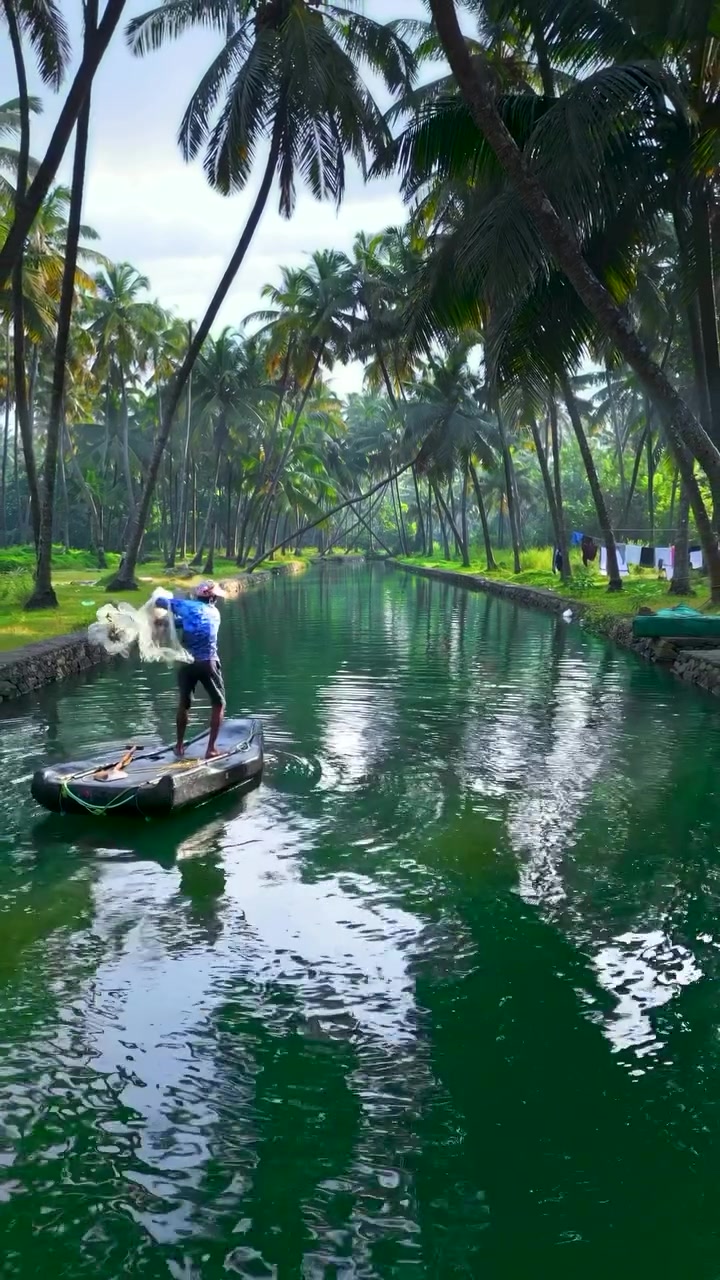
A Serene Canvas of Tradition
A fisherman sits in a small boat, casting a large net into the calm waters of a canal in Kerala, India. Palm trees line the backwaters, their reflections shimmering on the surface. This image is not a postcard — it's a snapshot of a traditional fishing scene in Kerala, captured by @ashikaseem.
The Nets that Feed a Culture
To understand the "Valam" Net Catch, as the fisherman says, must perform a delicate dance with one of Kerala's most iconic tools. This lengthy fishing net requires a carefully executed, rhythmic motion. The fisherman casts a large net across the width of the canal, and when he begins to scoop the bottom of the water surface, when he yanks the net, a small catch comes up. It's not about pulling as fast or hard as possible. Instead, it’s a dance with the water, requiring extreme concentration, precision, and strength. The Valam Net Catch is distinctive because it represents an elemental, literal engagement with the water — one that involves all the senses. There are no motorboats, no motors or other fishing gear. Fishermen in Kerala use their muscles and their will to navigate the water.
Heritage Across Waves and Generations
Fishing in Kerala traces back centuries. The state’s coastal geography and abundant rivers have made it a prime location for fishing, and subsequently, for intricate fishing practices. The ritually performed by locals. Traditional fishing still holds significance in Kerala. But as the younger generation increasingly leaves villages for urban areas, traditional occupations, including fishing, seem to be in decline. More than economic impact, a shift away from traditional fishing signifies a larger cultural shift.
Clay Pots and Copper Bowls
Kerala's fishing, while straightforward, is paired with equipment that makes it distinct in the ballet of nature. It has clay pots, wood, riveted nets, and copper bowls. It’s a performance that requires honing of skills, nurturing love for the craft, and patience. When the net is cast into the water, it forms a circle, with the help of the solid clay pots fasten at the corners. The edges remain with the help of the copper bowls. Every part of the fishing equipment has a design that helps achieve the desired balance with water. Though simple and effective, the materials are laboriously built based familial traditions passed down from generations.
The Canvas of Kerala's Culture
The green of the lush greenery, the grey of the smooth clay pots, the copper bowls, and the reflective surface of the calm backwaters weave a tapestry that is unique to the region. The images of the traditional fishing methods are evocative. The scene is also cultural, uniquely reflective of a way of life that is still, in many ways, deeply intertwined with the land and the water. The practice isn’t even seen as a job, only as a way of life.
The Art of the Cast
When you see a fisherman in Kerala performing the traditional fishing ritual in full glory, there is a series of almost practiced patterns that he rolls back and forth. The secret lies in the timing of the pull. The cast is an art form, practiced for generations: the delicate dance of bending at the right moment, the rhythm of his breathing, and the controlled force with which he yanks the net. To recreate the movement is a feat of technique, he has to pull the net with a certain force, timing, speed, and flow. This force comes from his whole body, not just his hands or arms — it originates in his core, a testament to the fisherman’s strength and practice.
Revive the Past in Your Sight
If you can’t cast a net, there are other ways to dip into Kerala’s fishing traditions. For instance, when you visit the fishing villages of Kerala, you get to connect with the local community. The people in these villages are warm and welcoming, and they often help visitors understand the craft. You can walk along the canals, interacting with locals, and even observe the fishermen launch their nets.
Watch the Reel
Questions readers ask
What is the Valam Net Catch and how does it work?
The Valam Net Catch is a traditional fishing method used in Kerala, India. It involves a fisherman casting a large net across a canal and using a rhythmic, precise motion to scoop up the catch. The process is more about a delicate dance with the water than brute force, requiring concentration, precision, and strength.
What makes the Valam Net Catch distinctive from other fishing methods?
The Valam Net Catch is distinctive because it represents a direct, elemental engagement with the water. It involves all the senses and relies solely on the fisherman's physical strength and skill, without any motorized equipment or modern fishing gear.
What kind of equipment is used in traditional Kerala fishing?
Traditional fishing in Kerala utilizes simple yet effective equipment such as clay pots, wooden tools, riveted nets, and copper bowls. These tools are designed to work in harmony with the water and are often built based on familial traditions passed down through generations.
How has the practice of traditional fishing in Kerala evolved over time?
Traditional fishing in Kerala has been a way of life for centuries, deeply intertwined with the region's culture and geography. However, as younger generations move to urban areas, traditional fishing practices are in decline, signifying a larger cultural shift.
Why is traditional fishing in Kerala considered more than just a job?
Traditional fishing in Kerala is seen as a way of life rather than just an occupation. It is a practice that involves honing skills, nurturing a love for the craft, and exhibiting patience. It is a ritual performed by locals, deeply connected to the land and water.
Are there any concerns about the future of traditional fishing in Kerala?
There are concerns about the future of traditional fishing in Kerala as the younger generation increasingly leaves villages for urban areas. This shift not only affects the economic impact but also signifies a larger cultural shift away from traditional occupations, including fishing.
How does the Valam Net Catch contribute to the cultural identity of Kerala?
The Valam Net Catch is a visual and cultural symbol of Kerala's heritage. It is part of a broader tapestry that includes the region's lush greenery, clay pots, copper bowls, and reflective backwaters. This traditional fishing method reflects a way of life that is deeply connected to the land and water, making it a unique aspect of Kerala's cultural identity.
Related deep dives
Similar reads based on topic and creator.




Recent articles
Fresh deep dives from the latest Reels we unpacked.




Comments
Be the first to comment.