Safest Cities in the World
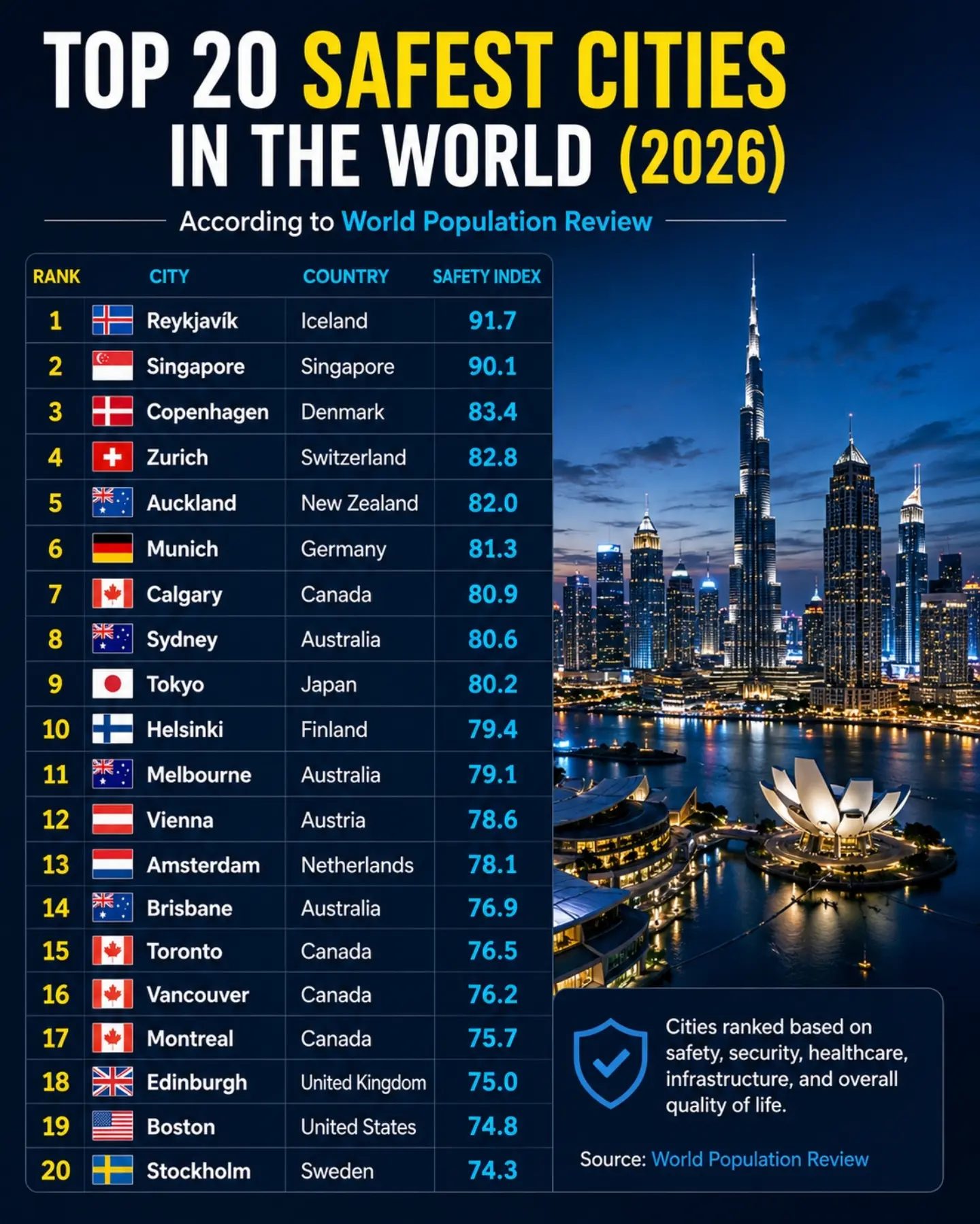
The World Population Review has identified the top 20 safest cities globally for 2026, offering valuable insights into urban safety, infrastructure, healthcare, and quality of life. These rankings provide a comprehensive look at how different cities fare in terms of public safety and overall livability. Whether you're considering a move or simply curious about global urban safety trends, this list offers a detailed snapshot.
Context / Why this matters
Understanding which cities are the safest can be crucial for various reasons. For travelers, it helps in choosing destinations that prioritize security. For residents, it provides reassurance about living in a secure environment. For urban planners and policymakers, these rankings can serve as benchmarks for improving safety measures and infrastructure. Additionally, for businesses, safety rankings can influence decisions on where to set up operations or invest.
Main discussion
Global Ranking Highlights
Reykjavík, Iceland
Leading the list is Reykjavík, Iceland, with a remarkable safety index of 91.7. This Scandinavian city is renowned for its low crime rates, robust healthcare system, and high-quality infrastructure. Reykjavík's commitment to public safety and community well-being makes it a top choice for those seeking a secure and comfortable urban environment.
Singapore and Copenhagen
Following closely are Singapore and Copenhagen. Singapore scores 90.1 on the safety index, thanks to its stringent laws, efficient public services, and well-maintained urban spaces. Copenhagen, with an index of 83.4, stands out for its high quality of life, excellent healthcare, and strong social welfare systems. These cities exemplify how effective governance and community engagement can enhance urban safety.
The list continues with Zurich, Switzerland, scoring 82.8, and Auckland, New Zealand, at 82.0. Zurich is known for its stable political environment and comprehensive public transportation system. Auckland, on the other hand, offers a blend of urban amenities and natural beauty, complemented by a strong focus on public safety.
Middle-Ranked Cities
Munich, Germany
Munich, Germany, ranks eighth with a safety index of 81.3. This Bavarian city combines rich cultural heritage with modern infrastructure and a strong emphasis on public safety. Munich's efficient public services and well-planned urban development contribute to its high ranking.
Calgary, Canada
Calgary, Canada, follows with a safety index of 80.9. Known for its spacious layout and efficient public transportation, Calgary offers a high quality of life with a strong emphasis on community safety. The city's proactive approach to public safety has earned it a place among the top safest cities.
Lower-Ranked but Still Notable
Sydney, Australia
Sydney, Australia, comes in at the 11th position with a safety index of 80.6. While Sydney is a global tourism hotspot, it also boasts a robust public safety infrastructure. The city's focus on community policing and modern technology in crime prevention has helped maintain its high ranking.
Tokyo, Japan
Tokyo, Japan, is another standout with a safety index of 80.2. Renowned for its advanced public transportation and efficient governance, Tokyo's commitment to public safety is evident in its low crime rates and well-maintained urban spaces. This urban metropolis offers a unique blend of modernity and tradition, making it a safe and attractive destination for residents and visitors alike.
Other Notable Mentions
- Helsinki, Finland, with a safety index of 79.4, is known for its high standard of living and excellent healthcare system.
- Melbourne, Australia, scores 79.1 and is celebrated for its vibrant arts scene and diverse cultural offerings.
- Vienna, Austria, ranks 14th with a safety index of 78.6, boasting a rich cultural heritage and a high quality of life.
- Amsterdam, Netherlands, scores 78.1 and is renowned for its picturesque canals and progressive social policies.
- Brisbane, Australia, ranks 17th with a safety index of 76.9, offering a blend of urban and natural environments.
- Toronto, Canada, scores 76.5, known for its multicultural diversity and robust public services.
- Vancouver, Canada, follows closely with a safety index of 76.2, celebrated for its natural beauty and high standard of living.
- Montreal, Canada, scores 75.7, offering a unique blend of European charm and modern amenities.
- Edinburgh, United Kingdom, ranks 20th with a safety index of 75.0, admired for its historic charm and strong community spirit.
- Boston, United States, scores 74.8, renowned for its educational institutions and rich history.
- Stockholm, Sweden, ranks 21st with a safety index of 74.3, known for its high standard of living and green initiatives.
Methodology and Data Source
The rankings are based on a comprehensive analysis of various factors, including safety, infrastructure, healthcare, and overall quality of life. The data is sourced from the World Population Review, a reputable organization that specializes in global population statistics and urban safety analyses. This data provides a reliable and authoritative source for understanding urban safety trends.
Practical tips
When considering the safety of a city, it's essential to look beyond the rankings. Here are some practical tips to help you gauge the safety of a city:
- Research Crime Rates: Look for detailed crime statistics, including types of crimes and their frequency. This can give you a clearer picture of the city's safety landscape.
- Public Transportation: Efficient and well-maintained public transportation systems often correlate with higher safety levels. Cities with reliable public transit generally have lower crime rates in public spaces.
- Healthcare Accessibility: Access to quality healthcare is crucial for overall safety and well-being. Look for cities with robust healthcare systems and easy access to medical services.
- Community Engagement: Cities with active community engagement and strong community policing often have lower crime rates. Participate in local forums and community events to get a sense of the city's social fabric.
- Emergency Services: Evaluate the efficiency and responsiveness of emergency services. Cities with well-trained and accessible emergency services are generally safer.
Important takeaways
- Safety, infrastructure, healthcare, and quality of life are key factors in determining a city's safety ranking.
- Reykjavík, Iceland, is the safest city in the world, followed by Singapore and Copenhagen.
- Cities like Zurich, Auckland, and Munich also rank high due to their robust public services and community engagement.
- Lower-ranked cities like Sydney, Tokyo, and Helsinki maintain high safety standards through efficient governance and modern infrastructure.
- Consider various factors beyond rankings, such as crime rates, public transportation, healthcare accessibility, community engagement, and emergency services.
Conclusion
The top 20 safest cities in the world for 2026, as identified by the World Population Review, provide a comprehensive overview of urban safety trends. Whether you're a traveler, a resident, or a policymaker, understanding these rankings can offer valuable insights into the factors that contribute to a city's safety and overall livability. By evaluating these rankings and considering various practical factors, you can make informed decisions about which cities offer the best living and travel experiences.
Watch the Reel
Questions readers ask
Which criteria were used to determine the safest cities in 2026?
The rankings consider factors such as public safety, healthcare quality, and overall quality of life. This includes low crime rates, effective healthcare systems, and robust infrastructure.
Why is Singapore often ranked as one of the safest cities?
Singapore's high ranking is due to its strict laws and low tolerance for crime, which contributes to its exceptional public safety. The city also boasts an excellent healthcare system and well-maintained infrastructure.
Which cities in Australia are among the safest in 2026?
Australia is home to several safe cities. Melbourne and Sydney, for instance, are recognized for their low crime rates, high-quality healthcare, and excellent infrastructure, making them top choices for safe urban living.
How do these rankings benefit travelers planning trips for 2026?
For travelers, these rankings highlight destinations with strong public safety measures, ensuring a secure environment. This information helps in choosing destinations where personal safety and healthcare services are reliable, enhancing the overall travel experience.
What makes Reykjavík notable in the context of global city safety?
Reykjavík is notable for its remarkably high safety index. The city's low crime rates and strong community support systems contribute to its reputation as one of the safest cities globally, making it an attractive option for both residents and visitors.
Why are the safest cities important for businesses?
For businesses, operating in safe cities means lower risks of theft, vandalism, and other crime-related disruptions. Additionally, these cities often provide a stable environment for employees, which can improve productivity and morale.
How do the safety rankings of Vancouver and Toronto compare in 2026?
Both Vancouver and Toronto are among the safest cities in Canada, known for their low crime rates and high-quality healthcare. They offer a good balance of public safety and quality of life, making them attractive options for expats and travelers alike.
Related deep dives
Similar reads based on topic and creator.




Recent articles
Fresh deep dives from the latest Reels we unpacked.




Comments
Be the first to comment.