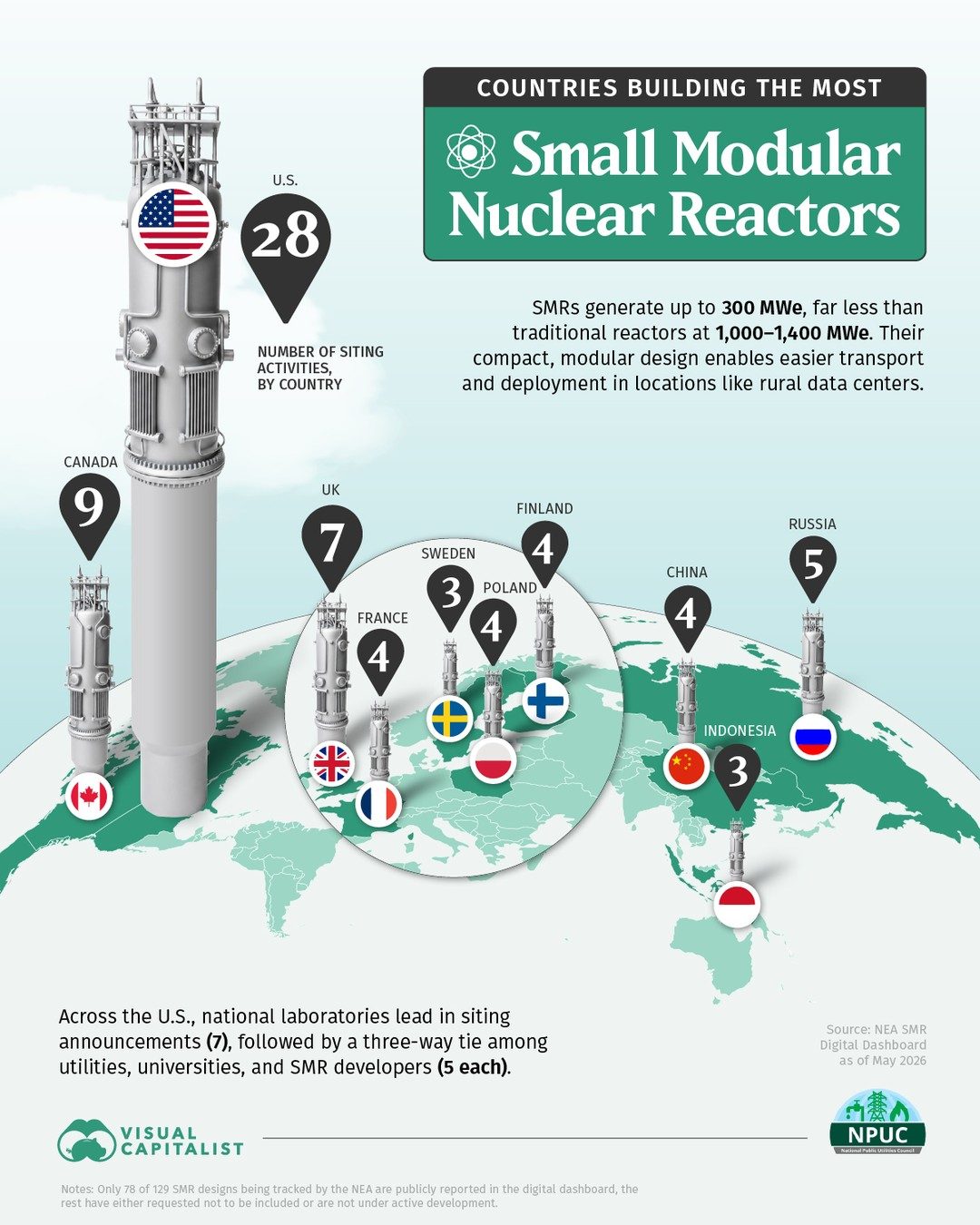
Small Modular Reactors: Global Developments and US Leadership
In the global push for sustainable energy solutions, small modular reactors (SMRs) are emerging as a key player. These compact, scalable nuclear reactors offer significant advantages in terms of flexibility, safety, and deployment. The U.S. is at the forefront of this technological advance, with 28 siting announcements as of 2026.
Why This Matters
The surge in power demand coupled with the need for clean energy sources has propelled the development of SMRs. Traditional nuclear reactors, while powerful, are large and complex, making them challenging to deploy in various settings. SMRs, on the other hand, generate up to 300 megawatts of electricity (MWe), which is significantly less than traditional reactors but still substantial for many applications.
Global Landscape of SMR Development
The global landscape of SMR development is diverse, with several countries investing heavily in this technology. Here are some key players:
United States
The United States leads the pack with 28 siting announcements, reflecting a strong commitment to advancing nuclear technology. Across the U.S., national laboratories are at the forefront of siting activities. This leadership is part of a broader effort to ensure energy security and reduce greenhouse gas emissions.
United Kingdom and Finland
Following the U.S., the United Kingdom and Finland are also making significant strides. The UK has 9 SMRs in progress, while Finland is tracking 7. These countries are leveraging their existing nuclear expertise to integrate SMRs into their energy grids.
Sweden and Poland
Sweden and Poland each have 4 SMRs in development. These countries are utilizing SMRs to enhance their energy infrastructure and support their commitment to clean energy.
France, China, and Russia
France, China, and Russia are also active in the SMR sector, each with 4, 5 and 4 SMRs respectively. These nations are focusing on SMRs as part of their long-term energy strategies, aiming to balance energy production with environmental sustainability.
Sweden and Indonesia
Sweden and Indonesia have 4 and 3 SMRs in progress, respectively. These countries are exploring the potential of SMRs to provide reliable and clean energy sources, particularly in areas where traditional grids are less feasible.
The Advantages of Small Modular Reactors
SMRs offer several advantages that make them an attractive option for various energy needs:
Compact and Modular Design
The compact and modular design of SMRs allows for easier transport and deployment. This flexibility means SMRs can be used in remote areas or as part of existing energy grids, making them versatile for different energy needs.
Enhanced Safety Features
SMRs are designed with enhanced safety features, often including passive safety systems that do not require operator intervention. This reduces the risk of accidents and makes them a safer option compared to traditional reactors.
Scalability
The scalability of SMRs is another significant advantage. Multiple SMRs can be deployed together to meet growing energy demands, making them ideal for scaling energy production over time.
Practical Tips for SMR Deployment
Deploying SMRs involves careful planning and execution. Here are some practical tips for successful SMR deployment:
Site Selection
Choosing the right site is crucial. Consider factors such as proximity to water sources, grid connections, and local regulations. National laboratories and energy experts can provide valuable insights for site selection.
Stakeholder Engagement
Engage with local communities and stakeholders to build support and address concerns. Transparent communication about the benefits and safety measures of SMRs can help garner public support.
Regulatory Compliance
Ensure compliance with all local and national regulations. Work closely with regulatory bodies to obtain necessary permits and approvals, as this can streamline the deployment process.
Important Takeaways
The development of SMRs represents a significant shift in the energy landscape, offering a flexible, safe, and scalable solution to meet growing power demands. The U.S. leadership in this sector, along with the contributions of other countries, highlights the global commitment to advancing nuclear technology.
As the world continues to seek sustainable energy solutions, SMRs will play a crucial role in balancing energy production with environmental concerns.
Conclusion
Small modular reactors are poised to revolutionize the energy sector, offering a cleaner, more flexible energy solution. With the U.S. leading the way and other countries actively investing in this technology, the future of energy looks promising. By understanding the global landscape and practical considerations for SMR deployment, we can better appreciate the potential of SMRs in shaping a sustainable energy future.
Watch the Reel
Questions readers ask
Which countries are leading the development of small modular reactors (SMRs) globally?
The United States is at the forefront of SMR development, with significant investments and 28 siting announcements by 2026. Other countries actively involved in SMR development include Finland, which is building Onkalo, a deep geological repository for nuclear waste, and Canada, which is advancing its SMR technology through various projects. Additionally, countries like China and Russia are making strides in this area, contributing to the global push for advanced nuclear energy solutions.
What are the key advantages of small modular reactors over traditional nuclear reactors?
SMRs offer several advantages, including their compact size, which makes them easier to deploy in various settings, and their scalability, allowing for incremental power increases. They also provide enhanced safety features and require less upfront capital investment compared to traditional nuclear reactors. Furthermore, SMRs can generate up to 300 megawatts of electricity, which is significant for smaller grids or remote areas.
How do SMRs contribute to energy security and greenhouse gas emission reduction?
SMRs contribute to energy security by providing a stable and reliable source of power, reducing dependence on fossil fuels. They also help in reducing greenhouse gas emissions by offering a low-emission energy source. This is particularly important as global power demand increases, requiring clean and efficient energy solutions.
What is the significance of the United States' role in SMR development?
The United States is a leader in SMR development, with numerous siting announcements and investments in modular reactor technology. This leadership position helps drive global innovation and sets a precedent for other countries to follow. The U.S.'s progress in SMR development also supports its energy security goals and provides a model for sustainable nuclear power plant advancements.
How does the deployment of SMRs address the challenges of traditional nuclear reactors?
Traditional nuclear reactors are often criticized for their large size, complex deployment processes, and high upfront costs. SMRs address these challenges by being more compact, easier to deploy, and requiring less initial investment. Additionally, their modular design allows for phased construction, reducing financial risks and making nuclear power more accessible to a wider range of settings.
What types of environments are SMRs suitable for?
SMRs are versatile and can be deployed in a variety of environments, including remote communities, islands, and industrial sites. Their compact size makes them ideal for areas where land and resources are limited. They can also be used to support existing power grids by providing additional, reliable power sources, enhancing overall energy stability.
What are the key factors driving the global development of SMRs?
Several factors are driving the global development of SMRs, including the increasing demand for power, the need for clean energy sources to mitigate climate change, and the desire for energy independence. Additionally, advancements in nuclear technology and growing concerns over the environmental impact of fossil fuels are propelling the adoption of SMRs as a key component in the future energy landscape.
Related deep dives
Similar reads based on topic and creator.


Recent articles
Fresh deep dives from the latest Reels we unpacked.




Comments
Be the first to comment.