The Evolution of Television
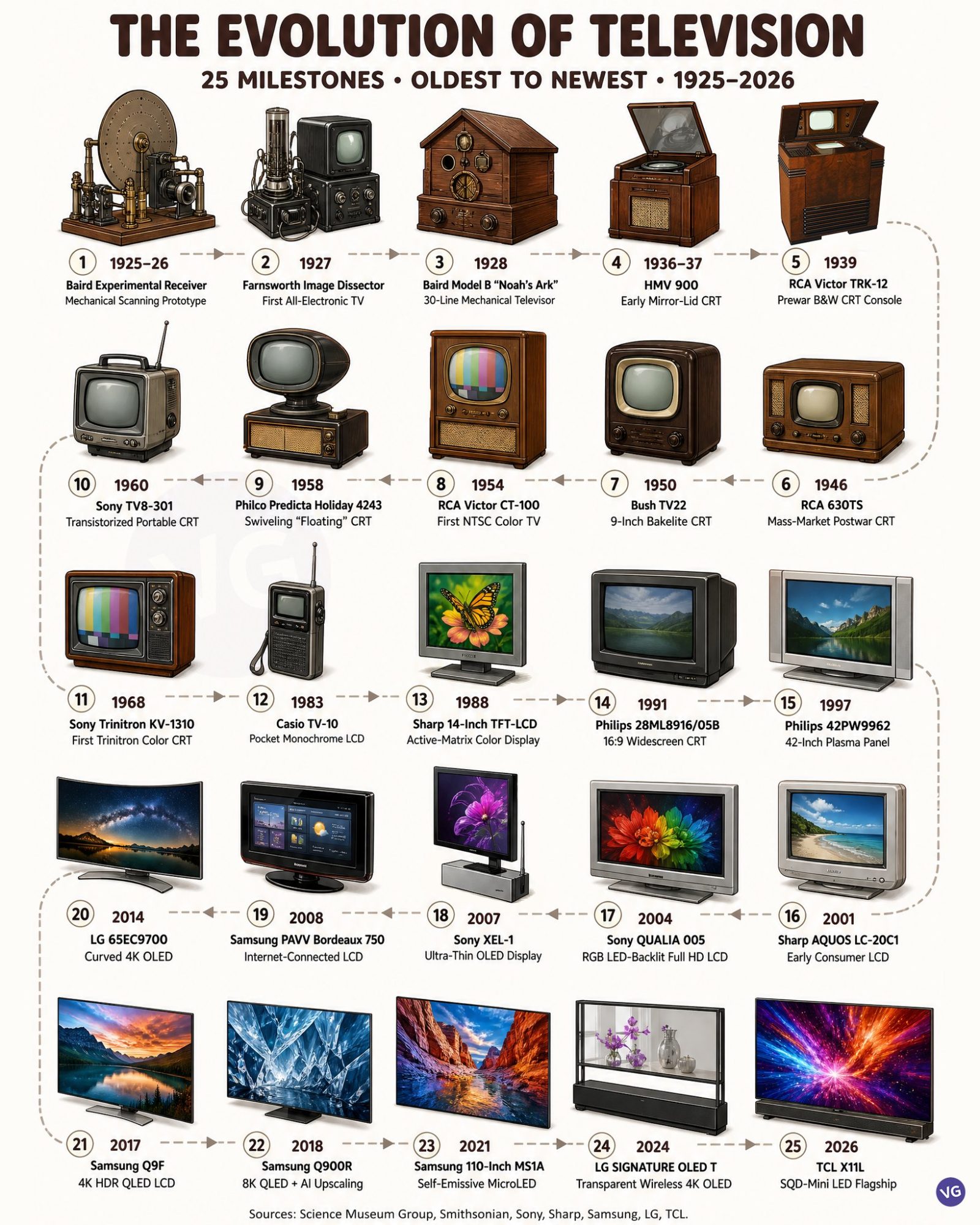
The journey of television technology from its humble beginnings in the 1920s to the sleek, modern flat-screen displays of today is a fascinating story of innovation and progress. This timeline spans from 1925 to 2026, highlighting key milestones and advancements in design and technology, showcasing models from various manufacturers, including Sony, RCA, Philips, Samsung, LG, Sharp, Panasonic, and TCL.
Why This Matters
Understanding the evolution of television technology provides a unique perspective on how far we've come in terms of visual and audio quality, design, and user experience. The journey from mechanical scanning prototypes to the cutting-edge displays of today reflects the broader advancements in technology that have shaped our world.
Timeline of Television Technology
Early Innovations (1925-1940s)
The earliest televisions were mechanical, relying on spinning disks to scan images. One of the earliest prototypes was the Farnsworth Image Disector, developed by Philo Farnsworth in 1927. This device used a beam of electrons to scan images, a fundamental principle that would later be used in cathode-ray tube (CRT) televisions.
The 1930s saw significant advancements with the introduction of the first commercially available televisions. The Bush B2 was launched in the UK and Philips in Europe, though they were still quite primitive by today's standards. RCA's models, like the RCA 630 and RCA 123, began to gain popularity in the United States.
The CRT Era (1940s-1990s)
The mid-20th century marked the rise of the CRT television. These sets used cathode-ray tubes to project images onto a screen, providing better picture quality and reliability. The Sony TV-301, released in 1960, was one of the first color televisions to gain widespread popularity, showcasing Sony's early leadership in this field.
The 1970s and 1980s saw further improvements in CRT technology, with manufacturers like Samsung, LG, and Phillips introducing models with better picture quality and more features. The introduction of remote controls and color adjustments made televisions more user-friendly.
The Transition to Flat-Screen Displays (1990s-Present)
The late 1990s and early 2000s marked a significant shift with the introduction of flat-screen televisions. These sets, initially LCD and then LED models, offered thinner profiles, better picture quality, and reduced weight. Companies like Sony, Samsung, and LG led the charge, offering models that quickly replaced the bulky CRT sets in homes worldwide.
The Future of Television (2020s and Beyond)
Looking ahead, the future of television technology is even more exciting. OLED and QLED technologies promise even better picture quality, deeper blacks, and brighter colors. Smart TVs, which integrate internet connectivity and streaming services, are becoming the norm. By 2026, we can expect televisions to be even more integrated into our smart homes, offering voice control, personalized viewing experiences, and even augmented reality features.
Practical Tips for Choosing a Television
When selecting a television, several factors should be considered to ensure you get the best viewing experience for your needs:
Screen Size and Type
Consider the size and type of screen that best fits your space and viewing habits. Larger screens can provide a more immersive experience, while smaller screens can be more practical for limited spaces. OLED and QLED screens offer superior picture quality, while LED and LCD models are more budget-friendly.
Picture Quality
Pay close attention to the resolution and refresh rate. Higher resolutions, such as 4K, provide clearer and more detailed images. A higher refresh rate can make fast-motion content, like sports or action movies, smoother and more enjoyable.
Connectivity
Ensure the television has the necessary ports and connectivity options for all your devices. HDMI ports are essential for connecting gaming consoles, streaming devices, and other media players. Wi-Fi and Bluetooth capabilities can enhance the overall user experience.
Smart Features
Many modern televisions come with built-in smart features, allowing you to stream content directly from the internet, browse apps, and more. Ensure the TV's operating system is user-friendly and has access to the apps and services you prefer.
Important Takeaways
The evolution of television technology has been marked by significant leaps and innovations. From mechanical scanning prototypes to modern flat-screen displays, each era has brought us closer to the ultimate viewing experience. Understanding this timeline can help you make informed decisions when choosing a television that suits your needs and preferences.
Conclusion
The journey of television technology is a testament to human ingenuity and the relentless pursuit of better visual and audio experiences. From the early mechanical prototypes to the sleek, smart displays of today, each innovation has shaped how we consume media and interact with the world. As we look to the future, the excitement around what's next in television technology is palpable, promising even more immersive and personalized viewing experiences.
Watch the Reel
Questions readers ask
What were the first televisions like in the 1920s, particularly around 1925?
The earliest televisions from the 1920s, including those from 1925, were mechanical prototypes. They featured spinning disks with holes that scanned images line by line, creating a very basic moving picture. These early models were far from the high-definition screens we enjoy today, but they laid the groundwork for future developments.
Which significant events marked the evolution of television between the 1920s and the 1960s?
Several key milestones marked this period. The transition from mechanical to electronic television in the 1930s, the introduction of color TVs by RCA in the 1950s, and the widespread adoption of cathode ray tube (CRT) televisions in the 1960s. These advancements significantly improved picture quality and accessibility.
How did the design and technology of televisions change from the 1970s to the 2000s?
From the 1970s to the 2000s, televisions evolved from bulky CRT models to sleeker, lighter designs. The introduction of LCD and plasma screens in the 1990s and 2000s marked a shift towards thinner, more energy-efficient displays, with manufacturers like Sony, Samsung, and LG leading the charge with innovative designs.
What have been some of the most notable advancements in television technology from 2000 to 2026?
Recent advancements include the rise of flat-screen LED and OLED TVs, which offer superior picture quality and color accuracy. Smart TV technology has also evolved, integrating internet connectivity and streaming services directly into television sets, enhancing user experience and entertainment options.
Which manufacturers have played a significant role in the evolution of television technology?
Several manufacturers have been pivotal in driving television technology forward. These include companies like RCA, which introduced color TVs; Sony, known for its innovations in flat-screen and high-definition TVs; and Samsung and LG, which have led the way in LED, OLED, and smart TV technology. Other notable contributors include Philips, Sharp, Panasonic, and TCL.
How have advancements in television technology impacted user experience?
Technological advancements have greatly enhanced user experience. From improved visual and audio quality to more intuitive interfaces and smart features, the evolution of television has made viewing more enjoyable and interactive. Modern televisions offer a wider range of content options and seamless integration with other devices.
What can we expect from television technology in the future, particularly by 2026?
By 2026, we can expect even more innovative developments, such as advancements in 8K resolution, enhanced AI integration for personalized content recommendations, and more immersive viewing experiences. Additionally, ongoing improvements in display technology and sustainability are likely to continue shaping the future of television.
Related deep dives
Similar reads based on topic and creator.


Recent articles
Fresh deep dives from the latest Reels we unpacked.




Comments
Be the first to comment.