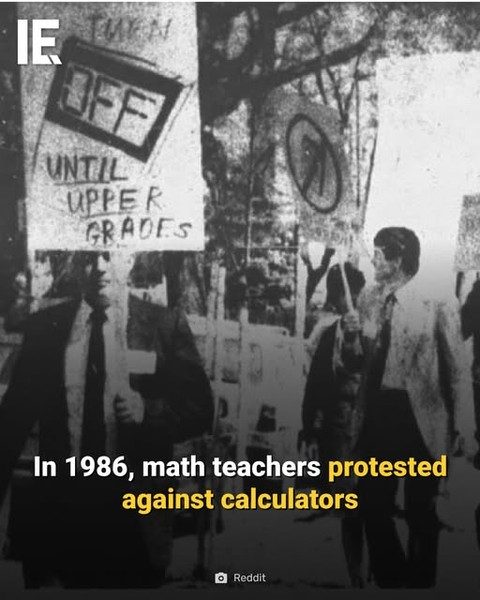
Teachers' Protest Against Calculators in the Classroom
Between 1986 and 1988, a group of teachers in Washington, D.C. took to the streets to protest a policy that recommended the widespread integration of calculators into math curricula. Their primary concern? The fear that these new technological tools would hinder, rather than enhance, students' learning.
The Context: Why This Matters
To understand the gravity of this historical protest and its relevance today, it's important to delve into the historical context and the concerns that drove these educators to take such a significant stand.
The Advent of Calculators in Education
The 1980s were a period of rapid technological advancement, and the calculator was one of the most impactful innovations of the time. These devices promised to simplify complex mathematical calculations, making learning more efficient. However, they also presented a paradox: while they could enhance speed and accuracy, there was a genuine concern that over-reliance on calculators might stifle foundational mathematical skills.
The Teachers' Dilemma
The protesting teachers, predominantly from Washington, D.C., were not against progress but were deeply concerned about the balance between technology and traditional learning methods. Their key argument was that calculators, if not used judiciously, could lead to a decline in fundamental mathematical understanding. They worried that students might become overly dependent on the devices, missing out on the mental exercises that are crucial for deeper learning.
Historical Impact
The immediate result of the protest was a slowdown in the adoption of calculators in classrooms. However, the long-term effects were quite different. History has shown that calculators eventually became indispensable tools in the educational landscape. They didn't replace thinking but rather supplemented it, allowing students to focus on problem-solving and conceptual understanding rather than getting bogged down by tedious calculations.
Main Discussion
Calculators: Tools for Efficiency
Calculators emerged as tools that could enhance classroom efficiency without replacing traditional learning methods. They allowed educators to focus more on teaching concepts and less on repetitive calculations, leading to a more holistic approach to mathematics. Today, calculators are not just tools for arithmetic but also for statistical analysis, graphing functions, and more.
The Evolution of Technology in Education
The debate over calculators is not an isolated case. Technologies in education have continually evolved, presenting both opportunities and challenges. Computers, calculators, and now AI — each has faced similar resistance and eventual acceptance. The key lies in finding the middle ground, where technology complements rather than replaces traditional teaching methods.
Parallels with Artificial Intelligence
Today, the educational landscape is once again facing a similar dilemma, this time with artificial intelligence (AI). Just as calculators revolutionized mathematics, AI is poised to transform education. It can help personalize learning, provide instant feedback, and even take over routine administrative tasks, freeing up educators to focus more on student interaction and conceptual teaching.
The Current Debate
The current debate surrounding AI in education mirrors the calculus protests of the 1980s. Some educators and policymakers advocate for embracing AI, believing it to be the future of education. Others are cautious, fearing that over-reliance on AI could lead to a decline in critical thinking and human interaction.
Practical Tips
For Educators Embracing New Technologies
- Start Small: Introduce new technologies gradually. Start with small pilot programs and assess their impact before integrating them fully into the curriculum.
- Maintain Balance: Ensure that technology supplements rather than replaces traditional teaching methods. Don't let the tools become the focus; keep the learning objectives at the forefront.
- Stay Informed: Keep up-to-date with the latest research and best practices in educational technology. Attend workshops, read relevant literature, and collaborate with tech-savvy educators.
Important Takeaways
- Historical Lessons: The protest against calculators in the 1980s offers valuable lessons. While new technologies can pose challenges, they often lead to significant improvements in educational outcomes.
- Adaptation: The evolution of calculators from feared tools to indispensable resources highlights the importance of adapting to change. Teachers and educators must be open to new methods and technologies.
- Future Prospects: Just as calculators revolutionized mathematics, AI has the potential to transform education. The key is to use it judiciously, ensuring it complements rather than replaces traditional learning methods.
Educational Technology and Student Learning
The integration of technology in education is not a new phenomenon. Each wave of innovation has brought about a shift in how we think about learning. Calculators, computers, and now AI — each has faced resistance and eventual acceptance. The key to navigating this landscape lies in understanding the balance between traditional and technological teaching methods.
Philosophical Considerations
The protest against calculators raises a deeper philosophical question: what is the essence of learning? Should it be about memorization and rote learning, or should it focus on critical thinking and problem-solving? The debate over AI in education reflects this question, reminding us that technology is a tool, not a solution.
Conclusion
The historical protest against calculators in the 1980s offers a fascinating glimpse into the complex relationship between technology and education. It serves as a reminder that while new tools and methods can be disruptive, they often pave the way for significant advancements. As educators and policymakers grapple with the integration of AI in education, it's crucial to learn from the past and embrace innovation thoughtfully. The future of education lies in finding a harmonic balance between traditional methods and cutting-edge technology, ensuring that both students and educators benefit from this symbiotic relationship.
Watch the Reel
Questions readers ask
Why did teachers in Washington, D.C. protest calculator use in the 1980s?
Teachers in Washington, D.C. protested the use of calculators in schools from 1986 to 1988 due to concerns that these devices would hinder students' development of essential mathematical skills. The protest was a reaction to a policy that promoted the integration of calculators into math curricula, which teachers feared would undermine traditional learning methods.
What was the main concern of teachers during the 1986 calculator protest?
The primary concern of teachers during the 1986 calculator protest was that the widespread use of calculators would lead to a decline in students' fundamental mathematical abilities. They believed that relying on calculators could prevent students from learning and practicing core math skills.
How did the 1986 calculator protest reflect the tensions of the time?
Tensions were high in the 1980s, thanks to the rapid technological advancements of the era. The calculator was hailed as a revolutionary tool in many sectors, including schools. However, teachers' protests highlighted a significant divide between those who embraced the new technology and those who feared it would replace essential mathematical skills.
What historical context surrounded the 1986 calculator protests in Washington, D.C.?
The 1986 calculator protests in Washington, D.C. occurred during a period of significant technological change. The calculator was a groundbreaking device that promised to streamline calculations, but its introduction in schools sparked debate over its potential to alter traditional teaching and learning practices.
What methods did teachers use to protest against calculator use in schools during the 1986 protest?
From 1986 to 1988, teachers in Washington, D.C., engaged in public protests to voice their concerns about the use of calculators in math curricula. These protests involved teachers taking to the streets to demonstrate against policies that encouraged the integration of calculators into classrooms, highlighting their belief that calculators could negatively impact students' learning methods.
What was the significance of the 1986 teacher protests against calculator use?
The 1986 teacher protests against calculator use in Washington, D.C. schools marked a pivotal moment in the debate over technology in learning. The protests underscored the importance of balancing innovation with traditional learning methods, ensuring that essential math skills are preserved while new tools are integrated.
What were the long-term implications of the 1986 calculator protest?
The 1986 calculator protest sparked a broader conversation about the role of technology in learning. It influenced future policies and practices, encouraging a more thoughtful approach to integrating tools like calculators into math curricula. The protest also highlighted the need for ongoing dialogue between teachers and policymakers on the best ways to support student learning.
Related deep dives
Similar reads based on topic and creator.



Recent articles
Fresh deep dives from the latest Reels we unpacked.




Comments
Be the first to comment.