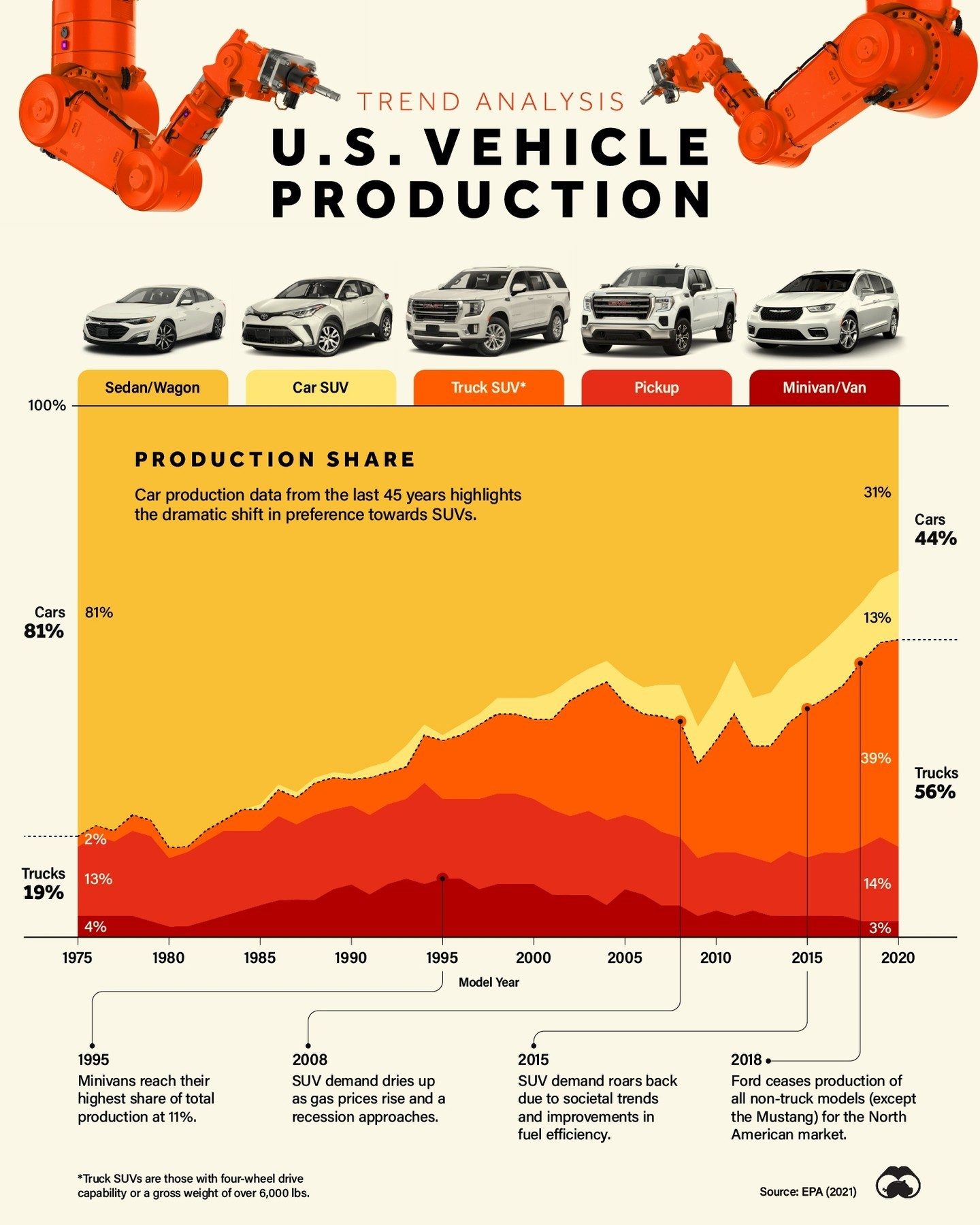
U.S. Vehicle Production Trends: The Rise of SUVs
Over the last few decades, the landscape of vehicle production in the U.S. has undergone a dramatic shift. SUVs, once primarily associated with off-road adventures, have emerged as the frontrunners in the automotive market. This transformation reflects broader changes in consumer preferences, production strategies, and societal trends.
Context: Why This Matters
Understanding the rise of SUVs in the U.S. market provides valuable insights into the automotive industry's evolution. This trend impacts not only the types of vehicles on the road but also the environmental footprint of transportation. SUVs, with their larger size and typically lower fuel efficiency, have significant implications for emissions and fuel consumption. Additionally, the shift towards SUVs influences the design and production strategies of automakers, driving innovation and competition in the industry.
Main Discussion
Historical Overview
Historically, SUVs were designed for rugged, off-road use, catering to a niche market of adventurers and outdoor enthusiasts. However, their robust build and spacious interiors soon made them appealing to families and those needing more cargo space. This versatility, along with marketing and societal factors, contributed to their growing popularity.
The data visualization of U.S. vehicle production trends from 1980 to 2020 provides a clear picture of this shift. In the 1980s and 1990s, sedans and wagons dominated the production landscape. Minivans also saw a surge in the mid-1990s, reaching their peak production in 1995. However, as consumer preferences evolved, SUVs began to take a larger share of the market.
Key Events and Trends
Several key events and trends have influenced the production and popularity of SUVs:
- 1995: Minivans reached their highest production share, at 11%. This period marked a high point for family-oriented vehicles, but it was short-lived.
- 2008: The demand for SUVs declined as gas prices rose and the U.S. faced a recession. Economic uncertainty and high fuel costs made SUVs, which typically have lower fuel efficiency, less attractive to consumers.
- 2015: As societal trends shifted and improvements in fuel efficiency were made, SUV demand roared back. This resurgence was driven by factors such as increased availability of fuel-efficient SUVs and a growing preference for vehicles with more cargo and passenger space.
- 2018: Ford made a significant decision to cease production of all non-truck models (except the Mustang) for the North American market. This move underscored the shift in market demand and production focus towards trucks and SUVs.
Impact on Production
The increasing demand for SUVs has led to significant changes in vehicle production. Automakers have adapted their manufacturing processes to prioritize SUVs, which require different design and engineering considerations than sedans or minivans. This shift has also influenced the supply chain, with parts and materials being allocated more towards SUV components.
Trucks, including those with four-wheel-drive capability or a gross weight over 6,000 lbs, have consistently held a significant share of production. This category includes pickup trucks, which have remained popular for their utility and versatility, maintaining a steady presence in the market.
Practical Tips
For consumers and industry professionals, understanding these trends can be beneficial in making informed decisions. Here are some practical tips:
-
Consumers:
- Consider the long-term costs of ownership, including fuel efficiency and maintenance, when choosing between different vehicle types.
- Evaluate your specific needs and preferences, such as cargo space, passenger capacity, and off-road capabilities, to make the best decision for your lifestyle.
- Stay informed about the latest advancements in fuel efficiency and environmental impact, as these factors can influence future market trends.
-
Industry Professionals:
- Keep an eye on societal trends and technological advancements that can affect consumer preferences and production strategies.
- Invest in research and development to improve the fuel efficiency and sustainability of SUVs and other vehicle types.
- Adapt manufacturing processes to meet the growing demand for SUVs and ensure the supply chain is equipped to support this shift.
Important Takeaways
The rise of SUVs in the U.S. market highlights several important takeaways:
- Consumer Preferences: SUVs have become a dominant choice due to their versatility, cargo space, and passenger capacity.
- Market Adaptation: Automakers have adapted their production strategies to meet the growing demand for SUVs, influencing the types of vehicles available in the market.
- Environmental Impact: The shift towards SUVs has implications for fuel consumption and emissions, driving the need for more efficient and sustainable vehicle designs.
Conclusion
The evolution of U.S. vehicle production, with SUVs taking the lead, reflects a broader shift in consumer preferences and societal trends. Understanding this transformation provides valuable insights for both consumers and industry professionals, helping them navigate the changing automotive landscape. By staying informed about these trends and adapting to new developments, stakeholders can make better decisions and contribute to a more sustainable future.
Watch the Reel
Questions readers ask
What were SUVs primarily used for in the 1980s?
In the 1980s, SUVs were primarily used for off-road adventures and rugged terrain. They were not as common on regular roads and highways as they are today. This niche usage has significantly evolved over the years.
How has the market share of SUVs changed since 1980 in the U.S.?
Since 1980, SUVs have seen a dramatic increase in market share. Initially a small segment of the market, they have become the dominant vehicle type in U.S. production, surpassing cars and other vehicle types in terms of sales and production volume.
Why have SUVs become more popular than minivans?
SUVs have become more popular than minivans due to their versatility, rugged appearance, and higher driving position, which many consumers find appealing. Additionally, advances in technology and design have made SUVs more comfortable and efficient, further boosting their popularity.
How does the environmental impact of SUVs compare to smaller vehicles?
SUVs generally have a larger environmental impact compared to smaller vehicles due to their size and lower fuel efficiency. This results in higher emissions and increased fuel consumption, contributing more significantly to carbon footprints.
What are some key factors driving the increase in SUV production in the U.S.?
The increase in SUV production is driven by shifts in consumer preferences towards larger vehicles, industry strategies focusing on higher-profit margins from SUV sales, and societal trends that favor versatile and capable vehicles. Additionally, technological advancements have made SUVs more appealing and accessible to a broader audience.
How has the fuel efficiency of SUVs changed over the years?
The fuel efficiency of SUVs has improved over the years due to advancements in engine technology, hybrid and electric powertrains, and more aerodynamic designs. However, SUVs still generally consume more fuel than smaller vehicles, reflecting their larger size and heavier weight.
What role do SUVs play in the current U.S. automotive landscape?
SUVs play a dominant role in the current U.S. automotive landscape, driving industry trends, influencing production strategies, and shaping consumer preferences. Their popularity has led to a significant increase in the number of SUVs on the road, impacting both the market and the environment.
Related deep dives
Similar reads based on topic and creator.


Recent articles
Fresh deep dives from the latest Reels we unpacked.




Comments
Be the first to comment.