Sudan Conflict and History
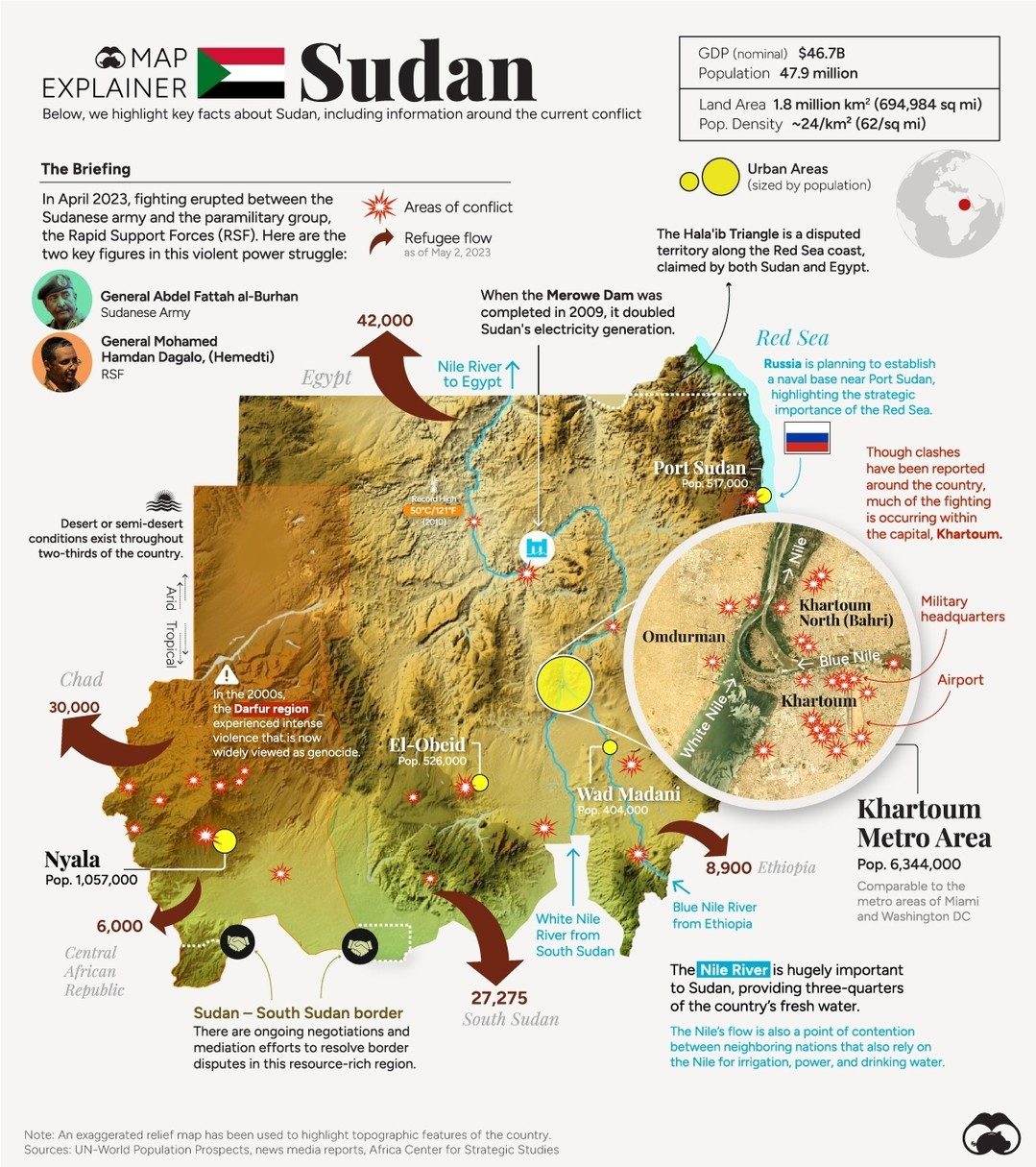
Sudan, the third-largest country in Africa, has been in the headlines due to intense fighting that has rocked the nation. This conflict is part of a complex power struggle that has deep historical roots. Understanding the current situation requires a look back at key events and the geographical context of the country.
Context / Why This Matters
Sudan's current conflict involves a power struggle between two main factions: the Sudanese Army, led by General Abdel Fattah al-Burhan, and the Rapid Support Forces (RSF), commanded by Hamdan Dagalo, also known as Hemedti. This power struggle is centered in Khartoum, the capital city, and has led to significant clashes and displacement of civilians. The conflict has drawn international attention due to its potential to destabilize the region and the humanitarian crisis it has created.
Main Discussion
Historical Backdrop
Sudan's journey to its current state is marked by significant historical events that have shaped its political and military landscape.
Independence and Early Instability
Sudan gained independence from Britain and Egypt in 1956. This marked the beginning of a tumultuous period characterized by political instability and military coups. The first major military coup occurred in 1958, leading to a series of governments that struggled to maintain stability. The October Revolution of 1964 brought a brief period of democratic rule, but it was short-lived. In 1969, Colonel Gaafar Nimeiry led a military coup that established a socialist-oriented government, which ruled until 1985.
Civil War and Regional Conflicts
The civil war between the Sudanese government and the Sudan People’s Liberation Army/Movement (SPLA/M) began in 1983. This conflict, which lasted until 2005, was one of the longest and deadliest in Africa. It was fueled by ethnic, religious, and political differences, particularly between the predominantly Muslim north and the largely Christian and animist south. The conflict resulted in millions of deaths and displacement of people.
The Era of Omar al-Bashir
Omar al-Bashir seized power in a military coup in 1989, establishing an Islamist regime. His rule was marked by authoritarianism and human rights abuses. In 2003, rebel groups in the Darfur region rose up against the government, sparking a bloody conflict that involved ethnic cleansing and genocide. Despite international pressure, al-Bashir's government continued its brutal campaign, leading to widespread displacement and suffering.
The Transition to a New Era
In 2011, the Sudanese government signed a peace deal with the SPLA/M, granting South Sudan autonomy. This deal eventually led to South Sudan's secession and the formation of the world's newest independent nation. However, the secession sparked intense fighting in Sudan, as the country struggled to adapt to the loss of its oil-rich southern region.
In 2019, widespread protests led to the ousting of Omar al-Bashir in a military coup. A transitional government was formed, but political instability persisted. This set the stage for the current power struggle between the Sudanese Army and the RSF.
Geographic and Strategic Considerations
Sudan's geographical features and strategic locations play a significant role in the current conflict. The country's vast land area, spanning 1.8 million square kilometers, and its population density of approximately 24 people per square kilometer, make it challenging to manage resources and maintain control.
The Hali’ib Triangle
The Hali’ib Triangle is a disputed territory along the Red Sea coast, claimed by both Sudan and Egypt. This strategic area is significant due to its potential for oil and gas reserves, as well as its strategic location for maritime trade. The dispute over this territory adds another layer of complexity to the regional dynamics and has the potential to escalate tensions between Sudan and Egypt.
Khartoum: The Epicenter of Conflict
Khartoum, the capital city, is the epicenter of the current power struggle. The city, with its strategic military installations and political significance, has become a battleground for control between the Sudanese Army and the RSF. The fighting has led to significant displacement of civilians and disruption of essential services, exacerbating the humanitarian crisis.
Key Players in the Conflict
Understanding the key players in the current conflict is crucial for grasping the dynamics at play.
The Sudanese Army
The Sudanese Army, led by General Abdel Fattah al-Burhan, is one of the main factions in the power struggle. The army has a long history of involvement in Sudan's political and military landscape, and its leadership has played a pivotal role in shaping the country's future.
The Rapid Support Forces (RSF)
The RSF, commanded by Hamdan Dagalo (Hemedti), is a paramilitary group that has gained significant power and influence in recent years. Originally formed from the Janjaweed militias, the RSF has been involved in numerous conflicts and human rights abuses. Its involvement in the current power struggle adds another layer of complexity to the situation.
Practical Tips
Understanding the complexities of the Sudan conflict can be overwhelming, but there are practical steps one can take to stay informed and support efforts to resolve the crisis.
Stay Informed
Following reliable news sources and organizations that provide updates on the situation in Sudan can help you stay informed. Websites, news outlets, and reports from international organizations like the United Nations and Human Rights Watch offer valuable insights and updates on the conflict.
Support Humanitarian Efforts
Humanitarian organizations are on the ground providing much-needed aid and support to those affected by the conflict. Donating to reputable organizations can make a significant difference in the lives of those impacted by the crisis. Organizations like the Red Cross, Médecins Sans Frontières (Doctors Without Borders), and the United Nations Refugee Agency (UNHCR) are actively involved in providing relief and support.
Advocate for Peace
Advocating for peace and stability in Sudan can take many forms. Engaging with policymakers, supporting peace initiatives, and raising awareness about the situation can help put pressure on those in power to seek a resolution. Social media campaigns, petitions, and public demonstrations are effective ways to amplify your voice and join a global movement for peace.
Important Takeaways
Sudan's current conflict is a complex and multifaceted issue that requires a nuanced understanding of its historical, geographic, and strategic dimensions. Key points to remember include:
- The current conflict is centered around a power struggle between the Sudanese Army and the RSF, with significant fighting occurring in Khartoum.
- The Hali’ib Triangle, a disputed territory claimed by both Sudan and Egypt, adds another layer of complexity to the regional dynamics.
- Sudan's history is marked by political instability, military coups, and civil wars, which have shaped the country's current political landscape.
- Staying informed, supporting humanitarian efforts, and advocating for peace are practical steps one can take to contribute to resolving the crisis.
Conclusion
The conflict in Sudan is a complex and evolving situation that requires continuous attention and support. By understanding the historical context, geographic dimensions, and key players involved, we can better appreciate the challenges and opportunities for resolving the crisis. Staying informed, supporting humanitarian efforts, and advocating for peace are crucial steps in contributing to a lasting resolution. As the situation continues to unfold, it is essential to remain vigilant and engaged in efforts to bring stability and peace to Sudan.
Watch the Reel
Questions readers ask
What are the two main factions involved in the current Sudan conflict?
The current power struggle in Sudan is primarily between the Sudanese Army, led by General Abdel Fattah al-Burhan, and the Rapid Support Forces (RSF), commanded by Hamdan Dagalo, also known as Hemedti. These two factions have been engaged in intense fighting, particularly in the capital city of Khartoum.
Why is Sudan experiencing political instability?
Sudan's political instability is a result of a long history of civil wars, military coups, and regional tensions. The country has faced numerous power struggles and shifts in leadership, creating an environment of uncertainty and conflict.
How does Sudan's geography influence its conflicts?
Sudan's vast size and diverse terrain, including deserts, mountains, and the Nile River, have played significant roles in its conflicts. Geographical features often affect the movements of opposing forces, control of resources, and accessibility to international borders.
What are the key events in the Sudan conflict timeline?
The Sudan conflict timeline includes several significant events, such as the independence from British rule in 1956, the First Sudanese Civil War (1955-1972), the Second Sudanese Civil War (1983-2005), and the secession of South Sudan in 2011. More recent events include the 2019 overthrow of President Omar al-Bashir and the ongoing power struggle between the Sudanese Army and the RSF.
What is the significance of Khartoum in the current Sudan conflict?
Khartoum, the capital city of Sudan, is a strategic location in the current conflict. It serves as a hub for political power and is a focal point for the power struggle between the Sudanese Army and the Rapid Support Forces. The fighting in Khartoum has resulted in significant civilian displacement and humanitarian concerns.
What are the regional tensions contributing to the Sudan conflict?
The regional tensions in Sudan are influenced by factors such as ethnic and tribal rivalries, control over natural resources, and external influences from neighboring countries. These tensions have exacerbated the internal power struggles and contributed to the complexity of the conflict.
How has Sudan's military government influenced its history of conflict?
Sudan's military government, which has been a recurring feature in the country's history, has significantly impacted its history of conflict. Military leaders have often seized power through coups, leading to periods of authoritarian rule, political repression, and civil unrest. This has created a cycle of instability, with military interventions frequently shaping the course of the country's conflicts.
Related deep dives
Similar reads based on topic and creator.


Recent articles
Fresh deep dives from the latest Reels we unpacked.




Comments
Be the first to comment.