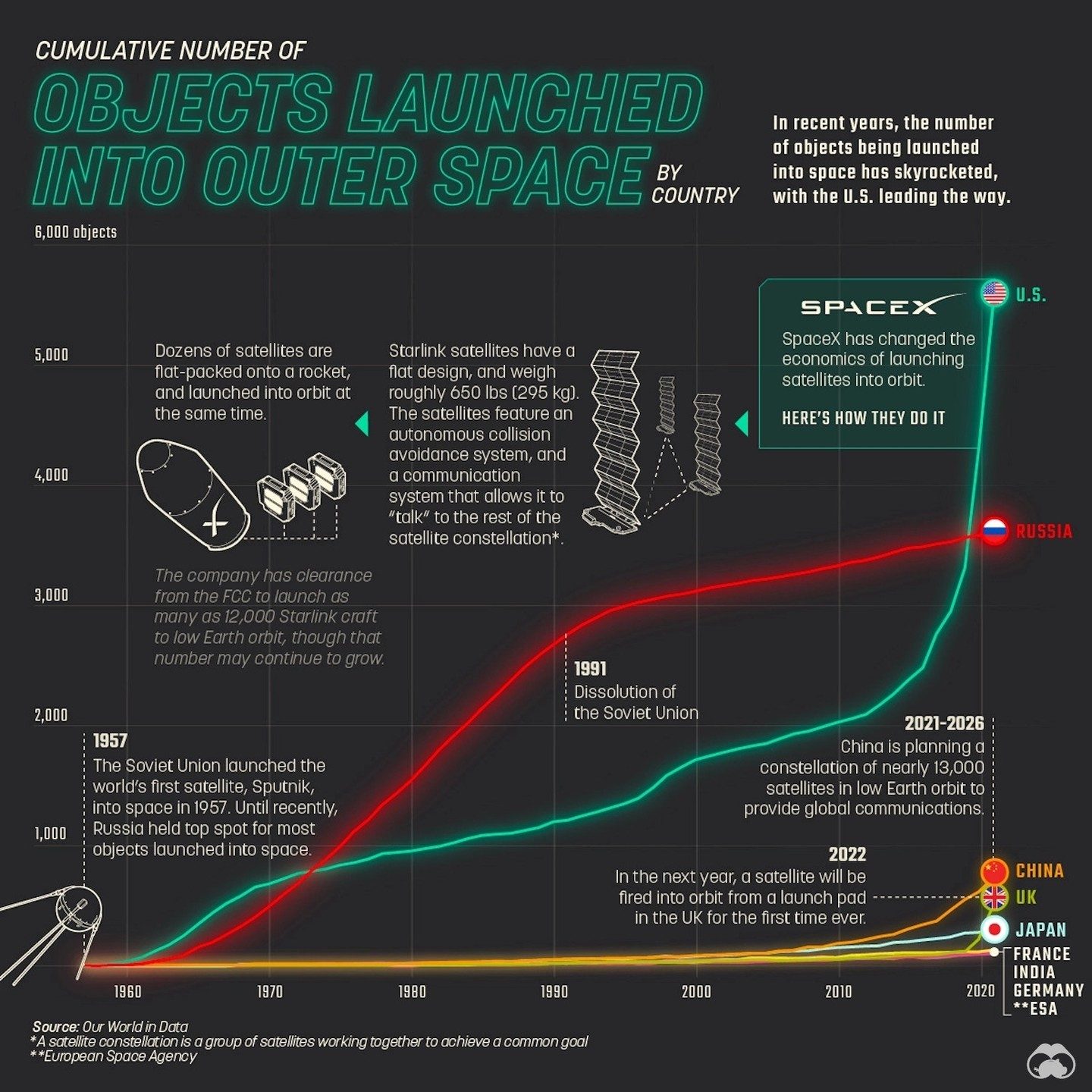
Space exploration has evolved significantly since its inception. More than 11,000 objects have been launched into space since the beginning of the Space Race, which started during the Cold War. Initially, the Soviet Union dominated, but the United States, with the help of companies like SpaceX, has since taken the lead in the number of objects launched into orbit. This shift has been driven by significant advancements in space technology and the increasing role of private space companies.
Context
The Early Space Race
The Space Race began in earnest in 1957 when the Soviet Union launched Sputnik, the world's first artificial satellite. This event marked the start of a competitive period where both the Soviet Union and the United States aimed to outdo each other in space exploration. The Soviet Union successfully sent the first human to space, Yuri Gagarin, in 1961, and the United States followed with the Apollo 11 mission, which landed astronauts on the moon in 1969. The early dominance of the Soviet Union in the Space Race was due to its early achievements and the number of satellites it launched.
Later, other nations, including China, the UK, Japan, and the European Space Agency (ESA), began contributing to the growing number of objects in space. These countries, along with the US, Russia, and others, have collectively expanded human presence in space.
The Role of SpaceX
SpaceX, founded by Elon Musk, has transformed the economics of launching satellites into orbit, contributing to a surge in space activities. With its reusable rockets and innovative technologies, SpaceX has made space launches more cost-effective and accessible. The company has been instrumental in increasing the number of objects launched by the United States, helping it surpass the number of objects launched by the Soviet Union.
Global Contributions
Beyond the United States and Russia, other countries have made significant contributions to space exploration. China, for instance, has ambitious plans to launch a constellation of nearly 18,000 satellites in low Earth orbit. This constellation, known as Guowang (or the China Satellite Internet), aims to provide global internet coverage, demonstrating China's growing capabilities and ambitions in space.
The European Space Agency (ESA) has also played a crucial role. Comprising multiple European countries, ESA collaborates on various space missions, including the development of the Ariane rocket and the Rosetta mission to comet 67P.
Other nations, such as the UK and Japan, have also launched numerous satellites, contributing to the overall increase in space objects. These countries have developed their space programs to support various applications, including communications, navigation, and scientific research.
Infographic Summary
An infographic displaying the cumulative number of objects launched into outer space from 1957 to 2021-2026 provides a visual representation of these advancements. The graph details the increasing number of satellites launched by various countries, highlighting key events and technological milestones.
Practical Tips
Understanding the trends and contributions of different countries in space exploration can provide insights into the current state and future of space activities. For those interested in space technology and exploration, keeping up with the latest developments from SpaceX, NASA, the ESA, and other space agencies can be beneficial. These advancements can influence various sectors, including communications, navigation, and scientific research.
Important Takeaways
The key takeaways from the evolution of space launches include:
-
Early Dominance of the Soviet Union: The Space Race began with the Soviet Union's early dominance, marked by the launch of Sputnik and the first human spaceflight.
-
Rise of the U.S. and SpaceX: The United States, with the help of SpaceX, has surpassed the number of objects launched by the Soviet Union, making space exploration more accessible and cost-effective.
-
Global Contributions: Countries like China, the UK, Japan, and the ESA have made significant contributions, each with its own space programs and ambitious projects.
-
Impact of SpaceX: SpaceX has revolutionized the economics of space launches, changing the way satellites are deployed and operated.
Conclusion
The history of space launches is a testament to human ingenuity and the competitive nature of space exploration. From the early days of the Space Race to the current dominance of the United States and the increasing role of private companies, the number of objects in space continues to grow. Understanding these trends and the contributions of different countries can provide valuable insights into the future of space exploration and its impact on various sectors.
Watch the Reel
Questions readers ask
What was the first significant achievement in the global space exploration timeline?
The first significant achievement in the global space exploration timeline was the launch of Sputnik by the Soviet Union in 1957. Sputnik marked the beginning of the Space Race and was the world's first artificial satellite.
Which country has launched the most objects into space?
The United States, with significant contributions from companies like SpaceX, has launched the most objects into space. This is a result of advancements in space technology and the growing involvement of private space companies.
What role did the Soviet Union play in the early Space Race?
The Soviet Union dominated the early Space Race, launching the first artificial satellite, Sputnik, and the first human into space, Yuri Gagarin. Their early achievements set the stage for the competitive period that followed.
How has China contributed to global space exploration?
China has been a key player in space exploration, making significant contributions with missions like the Chang'e lunar exploration program and the Tiangong space station. In 2020, China became the third country to successfully retrieve lunar samples, demonstrating its technological capabilities in space exploration.
What is the significance of the SpaceX launch timeline?
The SpaceX launch timeline is significant because it marks the rise of private space companies in global space exploration. SpaceX has made strides in reusable rockets, reducing costs, and improving efficiency, while also contributing to the high number of objects launched by the United States.
What are some key milestones in the global Space Race?
Some key milestones in the global Space Race include Sputnik's launch in 1957, the first human in space (Yuri Gagarin) in 1961, the first Moon landing (Apollo 11) in 1969, and the first reusable spacecraft (Space Shuttle) in 1981. These achievements highlight the competitive and innovative nature of space exploration.
How has the role of private space companies evolved in space exploration?
Private space companies have evolved from being mere contractors to becoming key players in space exploration. Companies like SpaceX have developed reusable rockets, and made significant advancements in space technology, contributing to a surge in the number of launches and driving innovation in the space industry.
Related deep dives
Similar reads based on topic and creator.


Recent articles
Fresh deep dives from the latest Reels we unpacked.




Comments
Be the first to comment.