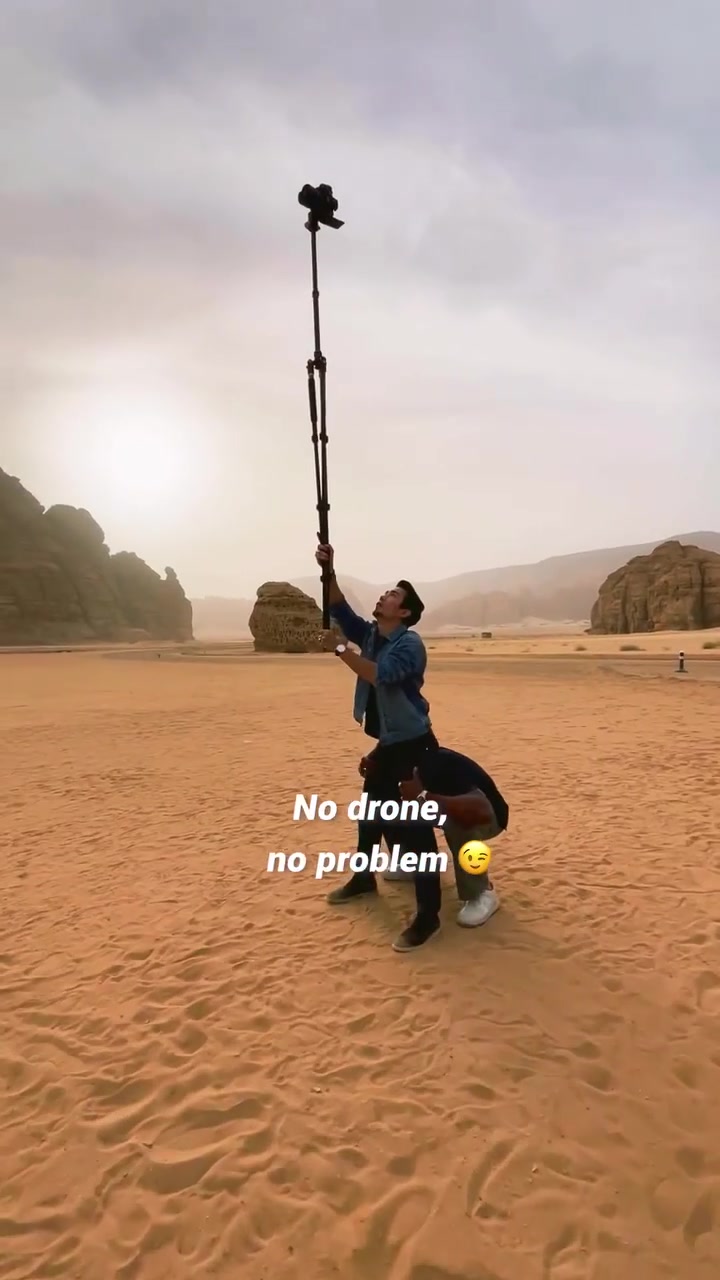
"Selfie sticks might seem like novelty items, but when they can help you create big angles like this, they're worth another look." One person's desert adventure demonstrates the unexpected power of these devices. A mirrored pyramid looms large as the image steadies, revealing the creative reach of a selfie stick.
The Selfie Stick's Hidden Strength
These days, selfie sticks often elicit raised eyebrows, reminding us of tourist self-portrait sessions that overshadow real sightseeing. Yet, when a person is traveling in a remote desert, a selfie stick can be a traveler’s most innovative tool. A 9.9 second video demonstrates how this simple gadget turns into a makeshift drone. It transformed a gawky device into a cinematic tool. Some selfie sticks fold out into tripods or extend as high as 56 inches for heights over 6’ 5”. The percussion of the wind might be the only sound audible in this conjoined pyramid and desert experience, but it is the visuals that stun. It simplifies photography’s most important elements: focus and framing. The selfie stick’s detachable arm can be used for more than just holding your phone. It captures the cinematic by using remote shutters. With a 360-degree rotating sphere at the top, the selfie stick offers endless possibilities for creative photography. Because the camera is extended away from the user, it is easier to hold the device steady. You can use the whole length of the stick, or extend it to the handle. No need for a drone. Using a selfie stick to create better angles is a smart solution.
Selfie Stick Adventures and a More Budget-Friendly World
Selfie sticks are the most budget-friendly, portable equipment you can carry for deserts or fields. It takes only one hand to operate, and keeps you situated close to the subject. “No drone, no problem” text appears on the screen accompanied by a laugh emoji. The big mirrored pyramid foreshadows what the visual summary tells us. The person is holding the selfie stick high above their head to get a better angle. The text overlay indicates the stick compensates for the lack of a drone. The device is particularly useful in environments where drones are restricted or prohibited, such as national parks, certain cities, or events with strict no-fly zones. This could be everything from security concerns to noise complaints. No drones allowed? No problem in this case. The video shows how they can be used to make creative aerial shots from any angle.
Sliding into the Frame
The pyramid’s mirrored walls glimmer in the sunlight and the lone person holds a selfie stick. It is a tool that turns the user’s creativity into texture. It is not a tool that generates content overnight. This image created an image capturing the landscape. The person’s unique choice of location shines the lens through the window of high-powered camera equipment. The stick has a wide shot of the beautiful mirrored pyramid structure. The mirrored ceiling and walls of the pyramid are reflected in the person’s body, making it look as if they are floating in the middle of the pyramid.
Elevations and Stability
A selfie stick can be expensive, so it's important to look for one that’s high-quality. As the visual summary tells, the stick in question was extended nearly up to the height of the user. Choose a model that offers a flexible grip so that you can easily snap pictures of yourself or someone else while being held securely in place. The rollers on the phone holder make it easier to turn the phone from horizontal to vertical. The handle's stabilizer bar helps with stability and grip. Lightweight design makes it easy to carry. The 360-degree rotating sphere at the top makes it easy to get any angle you want. The selfie stick can be extended up to 56 inches, making it a versatile tool. The selfie stick is lightweight and has a slip-resistant and textured handle.
Be the Director and Star
A selfie stick is like a portable tripod and camera mount all-in-one. It allows you to capture images with ease. Selfie sticks have been modified to include tripod functionality, making them a great option. It’s not just for selfies—it’s for filming high-angle shots. Depending on the model, it can extend up to 56 inches and be set up within seconds, ensuring that you don't miss any of those amazing photos. The two different legs allow for stability, making it easier to capture steady photos in the desert. The tripod legs can be adjusted, and the phone holder can go 360 degrees. The lightweight design makes it easy to pack and carry, even in the desert. The selfie stick’s light weight makes it easy to carry around, making it a practical option for travelers.
The Selfie Stick: An Unlikely Hero
Despite its unwelcome reputation, the selfie stick is an affordable, portable answer to the question of aerial cinematic shots. It's also a way to capture beautiful desert landscapes. With no drone and no problem, the selfie stick is a must for anyone looking to capture stunning aerial images. The expensive drones make it difficult for some to capture what selfie sticks do. The camera can be extended to get a high-angle shot. It's easy to set up and doesn't require a drone.
Watch the Reel
Questions readers ask
How exactly did the traveler use a selfie stick to mimic a drone in the desert?
The traveler used the selfie stick's extendable arm and remote shutter to capture smooth, cinematic footage from various angles, mimicking the movements of a drone. By holding the stick high and steady, they could frame shots that would typically require aerial equipment.
What are the key advantages of using a selfie stick for desert photography compared to traditional camera equipment or drones?
Selfie sticks are budget-friendly, portable, and easy to use with one hand. They are also useful in areas where drones are restricted or prohibited, such as national parks or events with no-fly zones. Plus, they simplify focus and framing, making it easier to capture stunning desert landscapes.
Can a selfie stick really replace the need for a drone in certain situations?
In many cases, yes. A selfie stick can provide a similar aerial perspective and allow for creative angles, especially in environments where drones are not allowed. However, it won't reach the same heights or offer the same smoothness of movement as a drone, so it's more of a makeshift solution.
What kind of creative possibilities does a selfie stick offer for photography in a desert landscape?
With a 360-degree rotating sphere at the top, a selfie stick offers endless possibilities for framing and angles. It allows you to capture unique perspectives, such as the mirrored pyramid scene, where the user appears to be floating in the middle of the structure.
Are there any limitations to using a selfie stick for photography in remote or desert locations?
While selfie sticks are versatile, they do have limitations. They can't reach the same heights as drones or offer the same stability for long shots. Additionally, they might not be suitable for all types of photography, such as fast-moving subjects or low-light conditions, but for capturing cinematic landscapes, they can be quite effective.
Related deep dives
Similar reads based on topic and creator.
Recent articles
Fresh deep dives from the latest Reels we unpacked.
Comments
Be the first to comment.