EV Charging Density: A Global Comparison
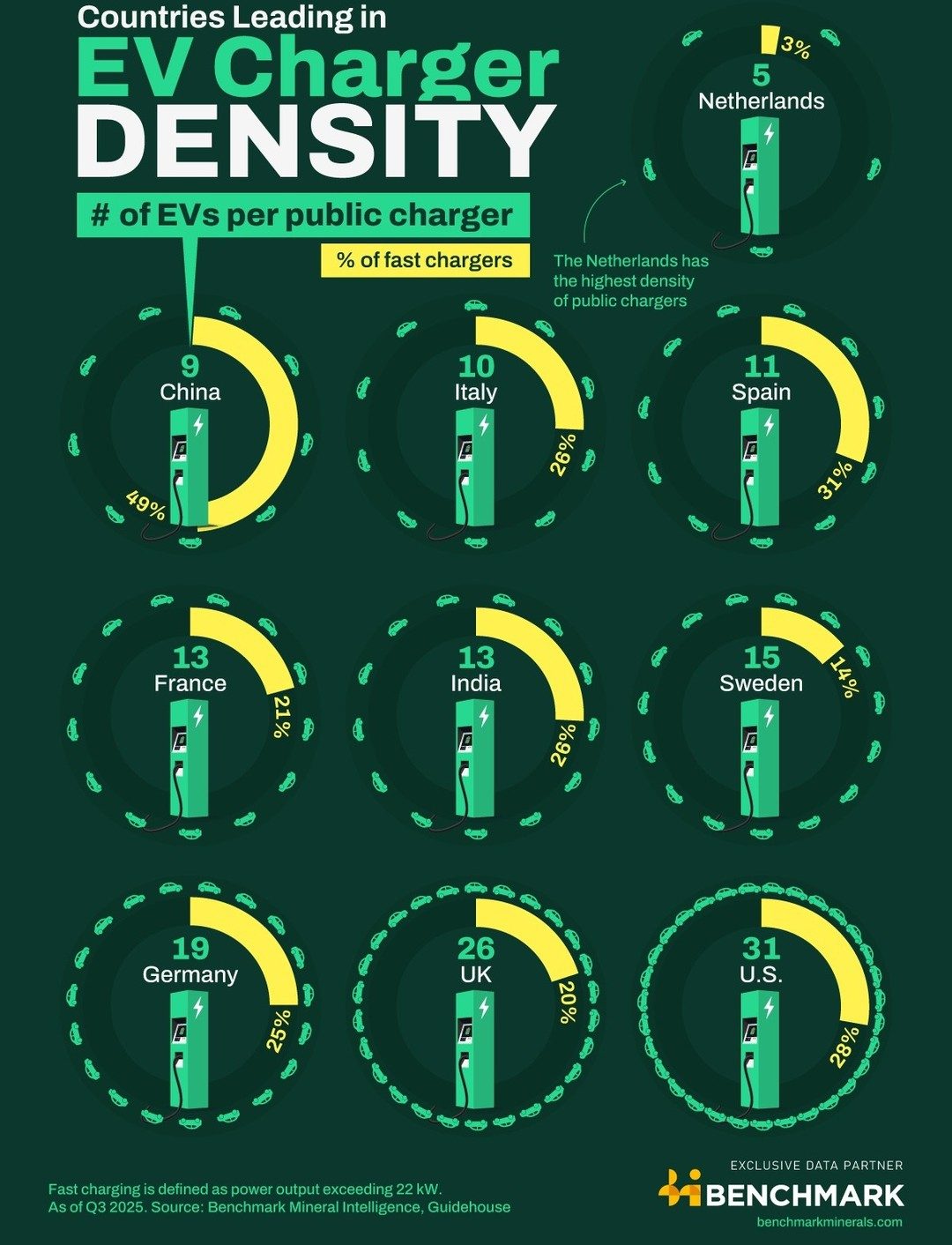
The Netherlands leads the world in electric vehicle (EV) charger density, boasting an impressive ratio of just five EVs per public charger. Meanwhile, China is rapidly expanding its fast-charger deployment, now making up nearly half of its public charging network. As the adoption of electric vehicles accelerates globally, the scaling of charging infrastructure has become a critical bottleneck for many countries. Let's dive into the data to understand the current state of EV charging densities worldwide.
Why This Matters
As more drivers switch to electric vehicles, the demand for reliable and accessible charging infrastructure becomes increasingly important. A well-distributed network of chargers can alleviate range anxiety, making EV ownership more convenient and appealing. Countries with higher charger densities are better positioned to support the growing number of EVs on their roads. Understanding the current landscape of EV charging infrastructure can help policymakers, and industry stakeholders make informed decisions to accelerate the transition to electric mobility.
Global EV Charger Density
The Netherlands: A Leader in Charging Infrastructure
The Netherlands stands out as a global leader in EV charging density, with just 5 EVs per public charger. This high density reflects the country's proactive approach to promoting electric vehicle adoption. The Netherlands has invested significantly in its charging infrastructure, ensuring that drivers have easy access to charging points. This investment has paid off, as the country now has one of the most robust EV charging networks in the world.
China: Rapid Expansion of Fast Chargers
While the Netherlands leads in overall charger density, China is making significant strides in fast-charger deployment. Fast chargers, defined as those with a power output exceeding 22 kW, now account for nearly half of China's public charging network. With 9 EVs per public charger, China's focus on fast charging is crucial for accommodating the massive growth in EV adoption. This rapid expansion of fast chargers ensures that drivers can quickly recharge their vehicles, making long-distance travel more feasible.
Other Countries: Progress and Challenges
Several other countries are also making notable progress in EV charging infrastructure. Italy, for instance, has 10 EVs per public charger and 26% of its chargers are fast chargers. Spain follows closely with 11 EVs per public charger and 31% fast chargers. These countries are investing in both the quantity and quality of their charging networks, aiming to support the growing number of EV drivers. In contrast, countries like India, Sweden, Germany, the UK, and the U.S. show varying levels of charger density and fast-charger deployment, reflecting different stages of EV adoption and infrastructure development.
Understanding the Data
The data used in this comparison comes from exclusive sources, including Benchmark Minerals and Guidehouse, as of Q3 2025. These sources provide valuable insights into the current state of EV charging infrastructure across major countries. The information highlights the importance of both charger density and the availability of fast chargers in supporting EV adoption.
Practical Tips for EV Drivers
Planning Your Routes
For EV drivers, planning your routes with charging points in mind is essential. Use dedicated apps and navigation systems that provide real-time information on the availability and location of charging stations. This way, you can ensure that you always have access to a charger when needed.
Utilizing Fast Chargers
Fast chargers are particularly useful for long-distance travel. They allow you to quickly recharge your vehicle, minimizing downtime and making your journey smoother. Identify fast-charging stations along your route and plan your stops accordingly. Remember that fast chargers are often located at major highways and rest areas.
Monitoring Charger Availability
Charger availability can vary, especially in high-traffic areas. Apps and navigation systems can provide real-time updates on charger availability, helping you avoid unnecessary delays. Some apps also offer features like reservation, allowing you to secure a charging point before you arrive.
Important Takeaways
The Role of Infrastructure in EV Adoption
The availability and density of charging infrastructure play a crucial role in the adoption of electric vehicles. Countries with higher charger densities are better equipped to support the growing number of EVs on their roads. This infrastructure not only makes EV ownership more convenient but also helps to alleviate range anxiety, a significant barrier to wider EV adoption.
The Importance of Fast Chargers
Fast chargers are essential for long-distance travel and quick recharging. Countries that invest in fast-charging infrastructure are better positioned to support EV drivers who need to recharge their vehicles quickly. The rapid expansion of fast chargers, as seen in China, highlights the importance of this technology in accommodating the growing number of EVs.
Global Efforts and Progress
While some countries are leading the way in EV charging infrastructure, others are making notable progress. The global effort to scale charging networks reflects a collective commitment to promoting electric mobility. As more countries invest in their charging infrastructure, the transition to electric vehicles will become more feasible and accessible for drivers worldwide.
Conclusion
As the world accelerates towards electric mobility, the availability and density of charging infrastructure become increasingly important. Countries like the Netherlands and China are setting the standard for EV charging density and fast-charger deployment, respectively. By understanding the global landscape of EV charging infrastructure, we can better support the transition to electric vehicles and create a more sustainable future.
Watch the Reel
Questions readers ask
What makes the Netherlands a leader in EV charger density?
The Netherlands tops global rankings with a ratio of just five EVs per public charger. This high density of chargers makes it a benchmark for other countries aiming to boost electric vehicle adoption.
How is China addressing its EV charging needs?
China is rapidly expanding its fast-charging network, which now constitutes nearly half of its public charging infrastructure. This strategic focus helps accommodate the country's rapid EV adoption.
What is the current global landscape for EV charging infrastructure?
The global demand for EV charging infrastructure is growing as more countries and drivers adopt electric vehicles. The scaling of this infrastructure is crucial to support widespread EV use.
Which countries have the highest EV charger density?
The Netherlands currently leads with the highest EV charger density, but other countries are also investing heavily in their public charging infrastructure to keep up with the demand.
Why is the distribution of EV chargers important for EV owners?
A well-distributed network of chargers helps alleviate range anxiety, making it easier for EV owners to travel and confidently rely on their vehicles for daily use.
What are the 2025 EV charging goals for major countries?
Countries are setting ambitious targets for 2025 to expand their EV charging infrastructure. These goals focus on increasing the number of public chargers and enhancing fast-charging capabilities.
How does the growth of the fast-charging network impact EV adoption?
The growth of fast-charging networks, especially in countries like China, plays a pivotal role in accelerating EV adoption by providing quicker and more convenient charging options for EV owners.
Related deep dives
Similar reads based on topic and creator.



Recent articles
Fresh deep dives from the latest Reels we unpacked.




Comments
Be the first to comment.