Music Sales Trends
The recorded music industry has experienced a significant evolution in the past five decades, with 2022 marking a record high of $15.9 billion in revenues. This growth highlights a dynamic shift in consumer preferences and technological advancements.
Context / Why this matters
Understanding the trends in music sales is crucial for industry stakeholders, including artists, record labels, and distributors, to make informed decisions about production, marketing, and distribution strategies. The data offers insights into which formats are gaining traction and which are becoming obsolete, guiding the industry's future direction.
Main Discussion
Historical Overview
The music industry's journey over the past 50 years is marked by the rise and fall of various formats. From the dominance of vinyl and cassette tapes in the 1970s and 1980s to the digital revolution of the 2000s and the current streaming era, each format has left a lasting impact on how music is consumed.
Vinyl and Cassette Eras
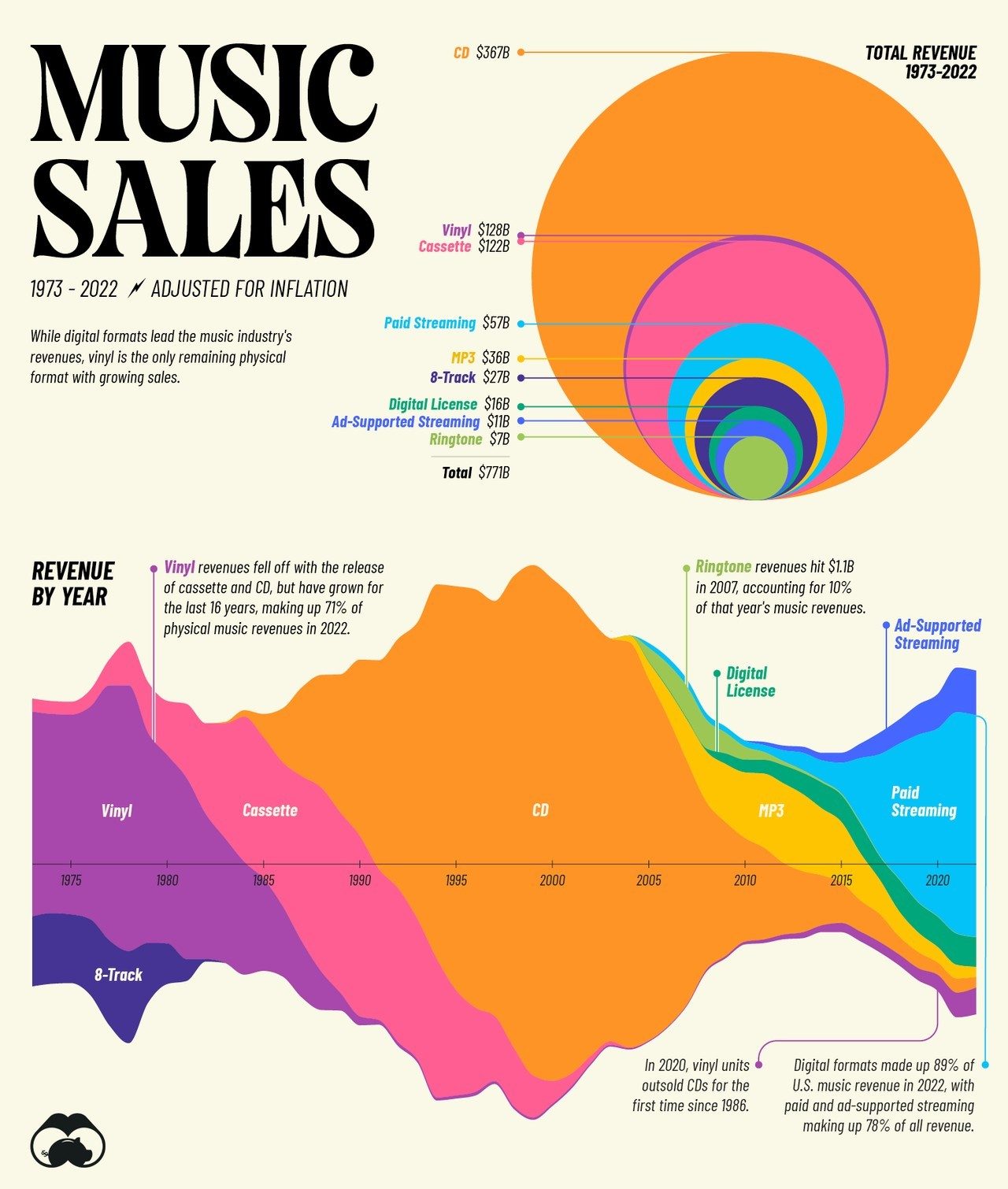
Vinyl records, once the primary medium for music consumption, saw a significant decline with the advent of cassette tapes. However, vinyl has recently experienced a resurgence, with revenues reaching $128 billion, representing 71% of physical music revenues in 2022. Cassette tapes, which generated $122 billion in revenue, also played a pivotal role in the music industry's history.
Digital Revolution
The digital revolution transformed the music industry with the introduction of MP3s, digital licenses, and ringtone downloads. MP3s, in particular, generated $36 billion in revenue, while digital licenses and ringtone downloads contributed $16 billion and $7 billion, respectively. This digital shift laid the groundwork for the streaming era, which now dominates the industry.
Streaming Dominance
Digital formats, including streaming, made up 89% of U.S. music revenue in 2022, with paid and ad-supported streaming accounting for 78% of all revenue. This dominance is a clear indicator of the consumer's preference for convenience and accessibility, driving the industry towards a more digital-centric model.
Key Trends
Resurgence of Vinyl
For the past 16 years, vinyl revenues have been on the rise. In 2020, vinyl units outsold CDs for the first time since 1986, marking a significant milestone in the format's resurgence. This trend is driven by a renewed interest in physical media and the collectors' market, making vinyl a valuable segment in the industry.
Streaming Growth
The dominance of digital formats is driven largely by the growth of streaming services. Paid and ad-supported streaming platforms have revolutionized how consumers access music, offering vast libraries at affordable prices. This convenience has led to an 89% market share for digital formats, with streaming making up 78% of this share. Streaming services continue to innovate, providing features such as personalized playlists, offline downloads, and exclusive content, making them an indispensable part of the music industry.
Market Segmentation
The music industry's evolution over the past 50 years can be broken down into various segments, each with its unique characteristics and contributions to the overall revenue.
Physical Formats
Physical formats such as vinyl, cassette, 8-track, and CD have played a significant role in the music industry. While these formats have seen a decline in popularity, they still hold a place in the market. Vinyl, in particular, has experienced a resurgence, with revenues reaching $128 billion, making it a valuable segment in the industry.
Digital Formats
Digital formats, including MP3, digital licenses, and ringtone downloads, have transformed the music industry. MP3s, in particular, generated $36 billion in revenue, while digital licenses and ringtone downloads contributed $16 billion and $7 billion, respectively. These digital formats have paved the way for the streaming era, which now dominates the industry.
Streaming
Streaming services have revolutionized the music industry, offering vast libraries of music at affordable prices. Paid and ad-supported streaming platforms have made up 78% of all revenue, making them a crucial segment in the industry. Streaming services continue to innovate, providing features such as personalized playlists, offline downloads, and exclusive content, making them an indispensable part of the music industry.
Practical Tips
For Artists
- Embrace Streaming Platforms: Leverage streaming services to reach a broader audience. Focus on creating content that resonates with streaming algorithms to increase visibility.
- Engage with Physical Media: Consider releasing vinyl records or other physical formats to cater to collectors and enthusiasts.
- Diversify Revenue Streams: Explore multiple formats and platforms to maximize revenue, including streaming, digital downloads, and physical sales.
For Record Labels
- Invest in Digital Infrastructure: Ensure robust digital distribution networks to support streaming and digital downloads.
- Promote Physical Releases: Capitalize on the resurgence of vinyl by investing in high-quality physical releases.
- Collaborate with Streaming Services: Partner with streaming platforms to offer exclusive content and promotions, driving subscriber engagement and revenue.
For Consumers
- Explore Different Formats: Experiment with various formats, including vinyl and digital downloads, to enrich your music listening experience.
- Support Artists: Consider subscribing to streaming services or purchasing physical copies to support your favorite artists.
- Stay Updated: Keep an eye on industry trends to discover new artists and formats, ensuring you are always part of the evolving music landscape.
Important Takeaways
- Digital Dominance: The music industry is increasingly driven by digital formats, with streaming services dominating the market.
- Vinyl Resurgence: Vinyl records are experiencing a resurgence, appealing to collectors and enthusiasts.
- Historical Evolution: Understanding the historical evolution of music formats provides valuable context for current trends and future predictions.
- Diversified Revenue: Embracing multiple formats and platforms can maximize revenue and reach for artists and record labels.
Conclusion
The music industry has undergone a transformative journey over the past 50 years, driven by technological advancements and shifting consumer preferences. From the dominance of physical formats like vinyl and cassette tapes to the digital revolution and the current streaming era, each format has contributed to the industry's evolution. The resurgence of vinyl, the dominance of digital formats, and the rise of streaming services all highlight the industry's dynamic nature. As the industry continues to evolve, understanding these trends and adapting to consumer preferences will be crucial for success.
Watch the Reel
Questions readers ask
What were the major milestones in the evolution of music formats over the past 50 years?
The evolution of music formats has seen several key milestones, including the transition from vinyl records to cassette tapes, the predominance of CDs in the 1980s and 1990s, the rise of digital downloads in the 2000s, and the current dominance of streaming services. Each format shift has been driven by advancements in technology and changes in consumer behavior.
How has streaming impacted the music industry's revenue model?
Streaming has revolutionized the music industry by becoming the primary source of revenue. In 2022, streaming services generated the majority of the record $15.9 billion in total revenue. This shift has led to changes in how artists and record labels approach marketing, distribution, and royalty structures.
What were the impacts of the shift from vinyl to cassette tapes to CDs?
The shift from vinyl to cassette tapes and later to CDs brought about significant changes in music consumption. Cassette tapes offered portability, while CDs provided better sound quality and durability. These formats also changed how music was distributed and consumed, leading to new business models for the industry.
Why has there been a resurgence in vinyl sales in recent years?
The resurgence in vinyl sales can be attributed to a combination of factors, including nostalgia, the tactile experience of handling records, and the perceived superior sound quality. In 2022, vinyl sales reached significant heights, showing that while digital formats dominate, there is still a market for physical media.
How have music industry trends influenced the role of record labels?
The shift from physical formats to digital downloads and then to streaming has significantly altered the role of record labels. They have had to adapt to new revenue models, focus on digital marketing, and manage streaming rights and royalties. The industry's trends have also led to a greater emphasis on data analytics to understand listener preferences and optimize music distribution.
What can be said about the decline of MP3s and the rise of streaming services?
MP3s were popular due to their convenience and file size, but streaming services have surpassed them by offering vast libraries, easy accessibility, and personalized recommendations. Streaming platforms provide a seamless user experience, making them the preferred choice for many listeners and driving significant revenue for the music industry.
Related deep dives
Similar reads based on topic and creator.


Recent articles
Fresh deep dives from the latest Reels we unpacked.




Comments
Be the first to comment.