An Earth Off Its Axes
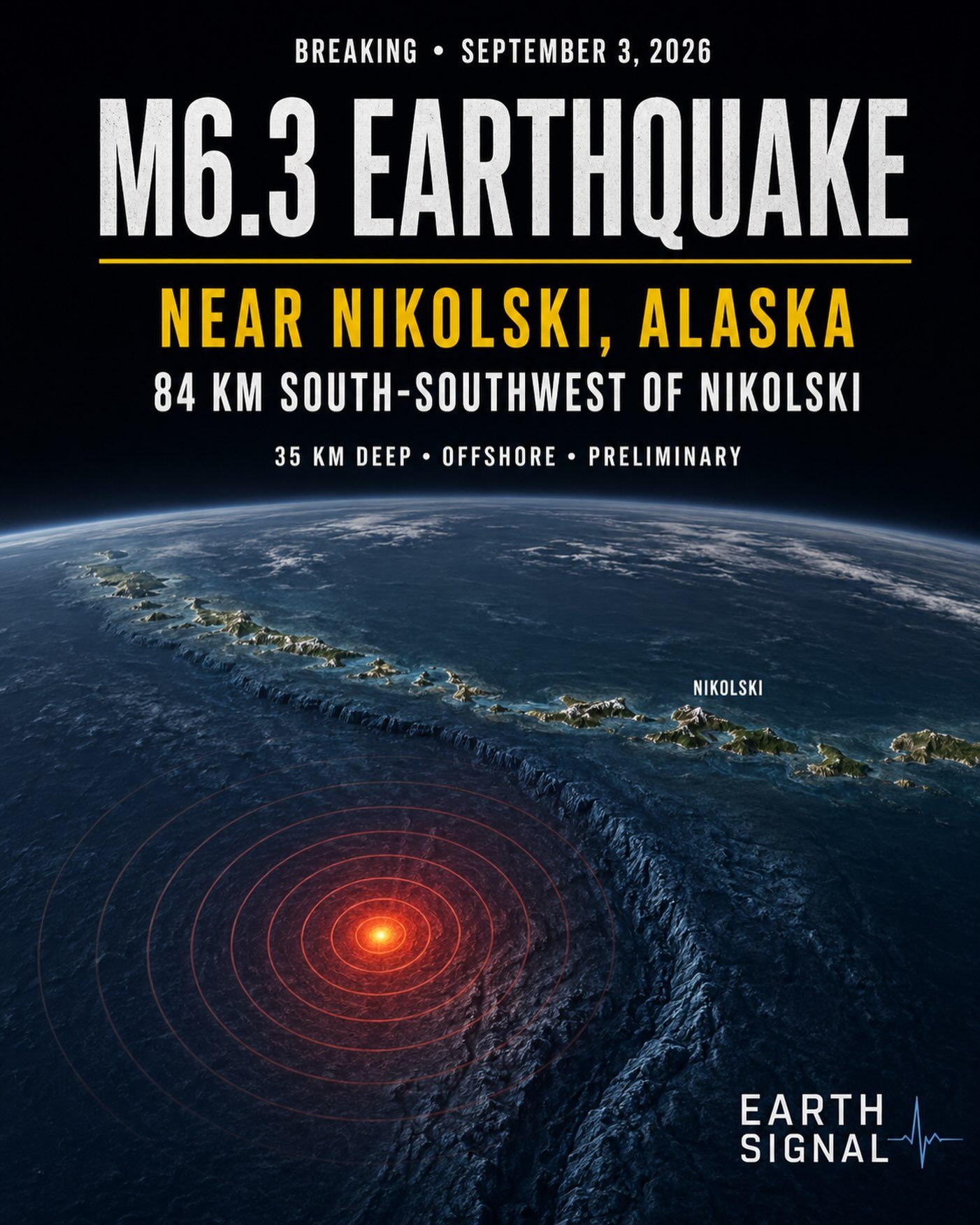
Earth may be thought of as a sturdy platform, but its crust is a dynamic and porous interface. The details of the magnitude 6.3 earthquake that struck near Nikolski, Alaska early this month show how sudden tremors can alter the perception of geological stability. According to the graphic, the quake occurred 84 kilometers south-southwest of Nikolski, approximately 35 kilometers deep. The depth of an earthquake can influence its impact on the surface. Shallow earthquakes — generally considered to be less than 70 km deep, such as this one — can be more damaging than deeper earthquakes. This is because the energy released has less distance to travel, and thereby requires less attenuation. However, the extent and distribution of damage can also be influenced by the local geology and the specific characteristics of the earthquake itself. Nikolski is a remote island location, so its occupants are somewhat familiar with the seismic reality of Alaska. However, even for them, a magnitude 6.3 is significant. The reported preliminary data on the quake is indicative of a system built to detect and respond to seismic activity. This includes more widespread implementation of earthquake detection across Alaska.
The Trouble with Precursor Indicators
Earthquakes are often seen as unpredictable. Data from this event shows that there were no definitive precursor indicators. Quakes are caused by the sudden release of energy built up in the Earth's crust, often along faults. The abrupt nature of this release does not always allow for reliable prediction, even with sophisticated monitoring systems. Researchers continue to push the boundaries of what can be predicted or forecasted. The possibility of earthquakes may be suggested by smaller tremors. But in this event, the data did not predict the quake. This reinforced the concept that current technology and understanding provide a clear picture of past events but are unable to see through the uncertainty of what may happen. Geological uncertainty presents a challenge for those attempting to develop earthquake prediction models. Paradoxically, the aim of prediction is to provide enough time for people to prepare and respond. However, if this uncertainty is recognised, then this window of preparation may be vulnerable to false alarms.
The Consequences of an Earthquake
Earthquakes often cause the most damage because of the secondary effects. The tremors of the earthquake itself can cause buildings to collapse and infrastructure to be damaged. However, the effects of the earthquake do not end with the shaking. Surface effects such as liquifaction, landslides, tsunamis, and fires can significantly exacerbate the impact of the earthquake, amplifying its destructive potential. Offshore earthquakes, such as this one, can also worsen the impact of earthquakes as tsunamis. Tsunamis can travel great distances. Because of their ability to continue to travel for long distances, even countries far away from the epicenter of the quake may experience major damage. Tsunamis can result in significant flooding and erosion. The secondary impacts of an earthquake can significantly alter the outcome of a quake and make it notoriously difficult to pinpoint the impact of a quake.
The Trust of Prioritizing Resilience
Life on earth is marked by the knowledge that volcanic activity, earthquakes, and other factors render the planet unstable. The trust that arises from early alert systems such as Earth Signal can benefit both individuals and communities alike. The communication of information about earthquake activity, even before it happens, could potentially promote personal preparedness. Reliable earthquake alerts could provide people with crucial seconds to brace themselves or evacuate dangerous areas. The successful implementation of these systems could lead to increased public confidence. However, to guarantee the success of these systems, it is essential to engage with local communities. The ability to engage with local communities to ensure the success of such systems is critical.
Watch the Reel
Related deep dives
Similar reads based on topic and creator.




Recent articles
Fresh deep dives from the latest Reels we unpacked.



Comments
Be the first to comment.