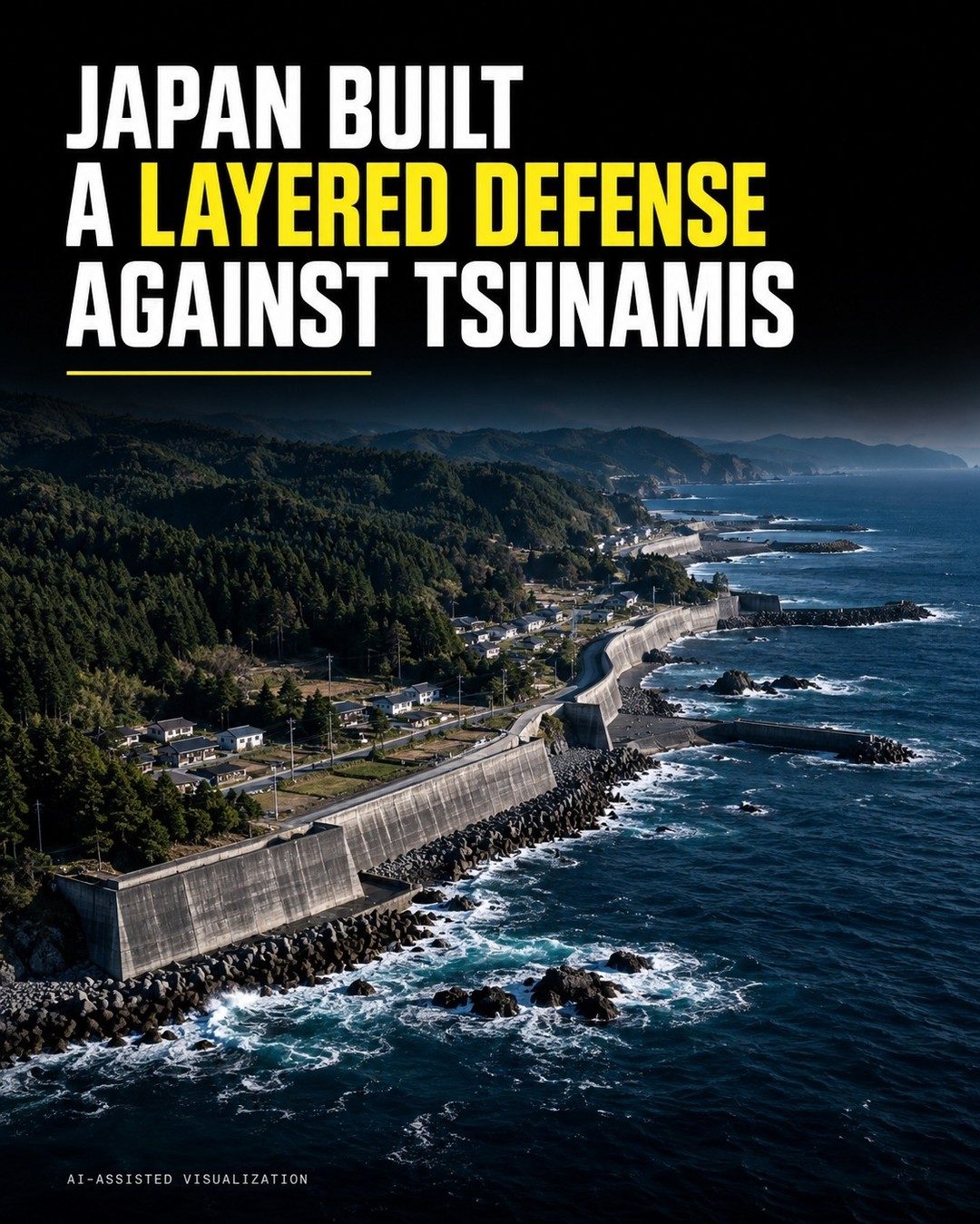
Layered Defenses: Japan's Approach to Tsunami Protection
Japan’s tsunami defenses are not merely about building taller walls. Instead, the country has adopted a multi-faceted approach to guarding its coastline, which includes engineered structures, natural barriers, and clear evacuation routes. The heart of this approach is layering: combining different defenses to mitigate risk and protect communities. According to an on-screen text: "Protection is layered, Walls and forests can reduce risk, but when a tsunami warning comes, evacuation to higher ground is still essential." Japan rebuilt and expanded coastal defenses in many communities along the Tōhoku coast, post the devastating 2011 Tōhoku tsunami. The most striking aspect of these defenses is their discontinuity. In other places, seawalls might line up without interruption. Here, the barriers can be enormous, but they are complemented by a patchwork of breakwaters, lands that are moved higher, and most important, the wise use of large forests. The coastal forests help reduce the energy of incoming waves, trap debris, and restore damaged ecosystems. Coastal forests help to protect the land by making a series of small barriers instead of one big wall. “Coastal forests can help reduce wave energy, trap debris and restore damaged ecosystems,” indicates an on-screen text.
The Role of Coastal Forests
This isn’t to say that walls are insignificant. Rather, they are part of a comprehensive strategy. The phrase "natural barriers complement engineered defenses" ensures that these are not a choice between one or the other, but that each element plays a different function in the broader system. The defenses work better and last longer because of this layered approach. Coastal forests act as a crucial second line of defense. In addition to reducing wave energy, they trap debris that could otherwise exacerbate damage. Forests also help restore ecosystem health, adding to the resilience of coastal communities. On-screen text yells out this message: "Natural barriers complement engineered defenses. They do not replace evacuation". These natural barriers are a vital component in Japan’s layered defense strategy. They make the system more robust, less likely to fail at a single point, and more adaptable to different scenarios. Natural barriers are also crucial in difficult conditions and in periods of rebuilding. Surviving tsunamis also devastates your natural barriers, and forests may take decades to restore — but they are a critical defense nonetheless.
Reducing Risk: How it works
The layering isn’t just about structures, though. Evacuation routes and warning systems are also integral to Japan’s tsunami defense. These systems provide timely alerts and safe paths for inhabitants to escape incoming tsunamis. This is something that doesn’t get talked about in other contexts very much: efficient warning systems and evacuation routes are usually thought of as separate from defenses. But in Japan, there is an understanding that defense is an integrated system. Coastal forests play a crucial role in minimizing the impact of tsunamis. They disperse wave energy, trap debris, and restore ecosystems. However, they are not a replacement for evacuation. When a tsunami warning is issued, the primary line of defense is to move to higher ground. “Evacuation is still essential. When a tsunami warning comes, evacuation to higher ground is still essential.” This is especially important for Japan, a country with a relatively high population density along coastal areas. The recent earthquake and tsunami that devastated Japan in 2011 is the reason for this layered defense. It was clear that a traditional, single-layered defense system was insufficient. Japan’s rebuilding efforts, therefore, have prioritized a more nuanced, multi-layered approach that combines natural and engineered defenses. Coastal forests emerged as a unexpected key player in this strategy.
Watch the Reel
Related deep dives
Similar reads based on topic and creator.


Recent articles
Fresh deep dives from the latest Reels we unpacked.



Comments
Be the first to comment.