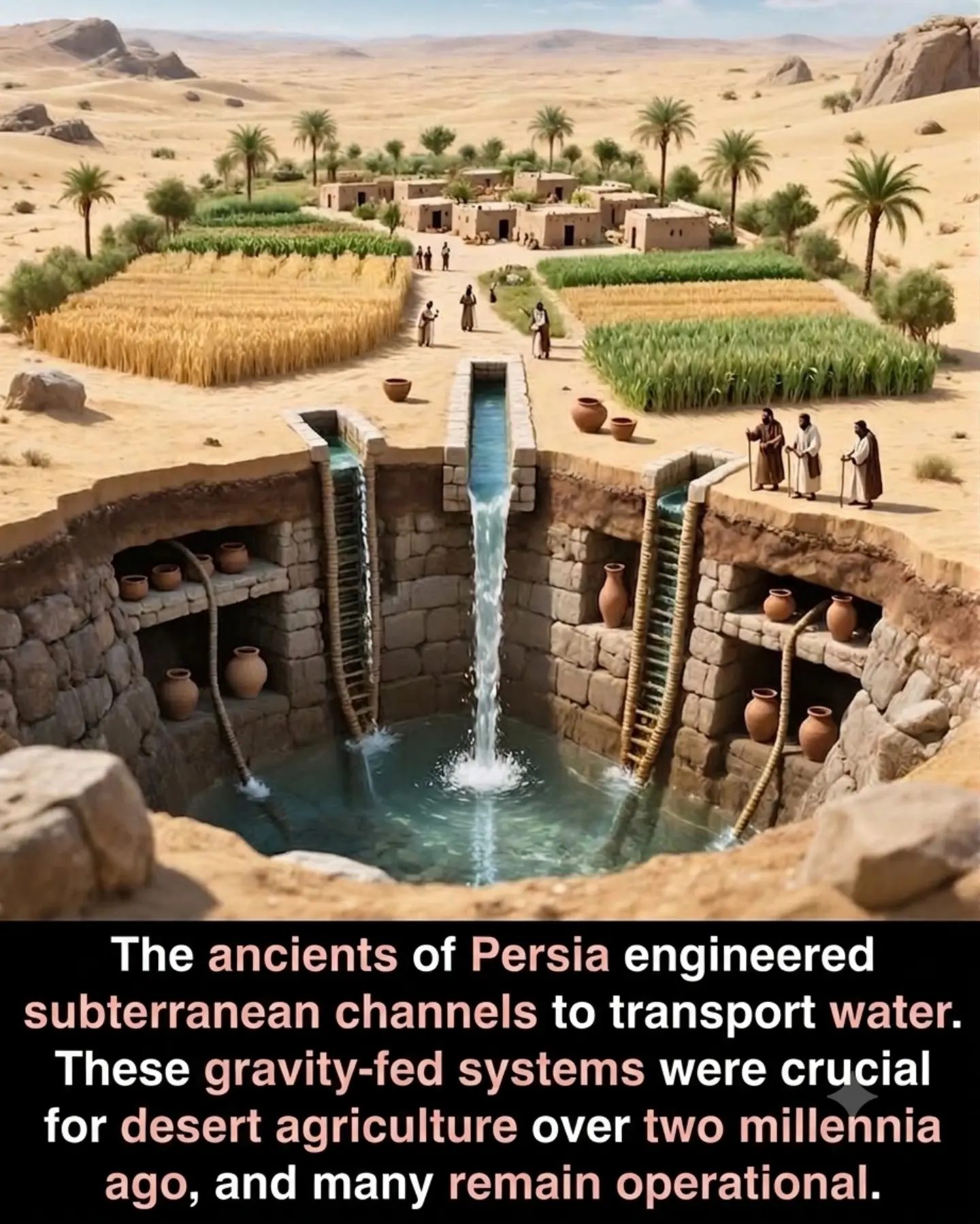
Ancient Persian Irrigation
Ancient Persian irrigation systems are a testament to the ingenuity and engineering prowess of one of the world's earliest civilizations. These systems, featuring subterranean channels and gravity-fed water transport, were crucial for sustaining agriculture in the arid desert regions of Persia. Remarkably, some of these systems, which are over two millennia old, remain operational today.
Context / Why this matters
Understanding ancient Persian irrigation is important for several reasons. It provides a window into the advanced engineering and agricultural practices of the time. Moreover, these systems offer valuable lessons in water management and sustainability, which are increasingly relevant in today's world where water scarcity is a growing concern. By examining these ancient technologies, we can gain insights into effective and efficient water use, which can inform modern irrigation practices.
Historical Significance
The ancient Persians, who lived in an arid region, had to develop innovative ways to manage water resources. Their solution was to engineer subterranean channels that transported water from higher elevations to lower-lying agricultural areas. This gravity-fed system ensured that water flowed steadily without the need for pumps or other mechanical devices. The Persians' understanding of topography and hydrology was instrumental in creating these systems, which not only facilitated agriculture but also supported the growth of urban centers.
Agricultural Impact
The irrigation systems were vital for the development of agriculture in Persia. The subterranean channels allowed water to reach crops efficiently, even in the harsh desert environment. This enabled the cultivation of various crops, including grains and fruits, which were essential for the Persians' diet and trade. The consistent water supply also supported livestock farming, further diversifying the agricultural landscape. This agricultural productivity laid the foundation for the economic prosperity of the Persian Empire, allowing it to thrive and expand.
Main discussion
Subterranean Channels
The subterranean channels used in ancient Persian irrigation were a marvel of engineering. These channels were designed to be as wide as possible and as deep as necessary to transport water efficiently. The primary advantage of these channels is that they minimized water loss through evaporation and seepage, ensuring that a significant portion of the water reached the fields. The channels were typically lined with clay or other impermeable materials to prevent water loss, demonstrating the Persians' understanding of materials science.
Gravity-Fed Systems
Gravity was the primary force behind the ancient Persian irrigation systems. By strategically placing the water sources at higher elevations, the Persians ensured that water would flow naturally downhill to the agricultural areas. This eliminated the need for complex and energy-intensive pumping systems, making the irrigation system both efficient and sustainable. In addition, the use of gravity reduced the risk of water contamination, as the water would flow smoothly without the need for mechanical intervention.
Water Transport and Distribution
The water transport and distribution systems were meticulously designed to ensure that water reached all parts of the agricultural fields. The Persians developed a network of channels and canals that crisscrossed the landscape, allowing water to be distributed evenly. This intricate network was essential for maintaining the fertility of the soil and ensuring that crops received adequate water supply. The distribution system was also designed to be flexible, allowing farmers to adjust the water flow based on the needs of different crops.
Practical tips
For those interested in understanding and potentially implementing some of the principles of ancient Persian irrigation, here are some practical tips:
Study the Terrain
One of the first steps in creating an efficient irrigation system is to study the terrain. Understand the topography and identify the highest points where water sources can be located. This will help in designing a gravity-fed system that ensures water flows naturally to the fields. Topographical maps and surveys can be invaluable in this process, providing a detailed understanding of the landscape.
Use Subterranean Channels
Consider using subterranean channels for water transport. These channels, when lined with impermeable materials, can significantly reduce water loss through evaporation and seepage. This method not only saves water but also ensures that the soil remains fertile. By keeping the water underground, the channels also protect the water from contamination, ensuring a clean and reliable supply for crops.
Design a Flexible Distribution System
Develop a flexible water distribution system that can adapt to the needs of different crops. This involves creating a network of channels and canals that can be adjusted to control the flow of water to various parts of the field. This flexibility allows farmers to optimize water usage, ensuring that each crop receives the right amount of water at the right time.
Consider Modern Technology
While the ancient Persian irrigation systems are a marvel of engineering, modern technology can enhance their efficiency. For example, sensors and automated systems can be used to monitor water levels and soil moisture, providing real-time data to farmers. This data can help in making informed decisions about water usage, ensuring that crops receive the optimal amount of water without wasting resources.
Sustainability
Sustainability is a key principle that can be learned from ancient Persian irrigation. Focus on minimizing water loss and maximizing its efficient use. By adopting sustainable practices, it is possible to ensure that water resources are used efficiently, benefiting both the environment and agricultural productivity.
Important takeaways
The ancient Persian irrigation systems offer several important takeaways:
- Efficient Water Transport: Understand the significance of designing efficient water transport systems that minimize loss through evaporation and seepage.
- Gravity-Fed Systems: Utilize gravity-fed systems to ensure that water flows naturally and efficiently to agricultural areas.
- Topographic Awareness: Recognize the importance of studying the terrain and using topographic information to design the irrigation system.
- Adaptive Designs: Implement flexible and adaptive water distribution systems that can cater to the needs of different crops.
- Sustainability: Prioritize sustainability to ensure effective and efficient use of water resources.
Conclusion
Ancient Persian irrigation systems are a remarkable example of engineering and innovation. These systems, with their subterranean channels and gravity-fed water transport, were crucial for the development of agriculture in the arid regions of Persia. Studying these systems can provide valuable insights into efficient water management and sustainable practices, which remain relevant today. By understanding and applying the principles of these ancient irrigation systems, we can develop more effective and sustainable water management strategies for modern agriculture.
Watch the Reel
Questions readers ask
What are the key features of ancient Persian irrigation systems?
Ancient Persian irrigation systems are primarily known for their use of subterranean channels and gravity-fed water transport. These features allowed water to flow efficiently from higher elevations to lower areas, making irrigation possible in arid regions where surface water was scarce. This ingenious design minimized water loss due to evaporation and seepage.
How did the ancient Persians manage water in such a dry climate?
The ancient Persians employed advanced water management techniques, such as constructing subterranean irrigation channels to transport water over long distances. By using gravity to move water, they ensured a consistent water supply to agricultural fields without the need for pumps or other mechanical devices. These methods were remarkably effective in sustaining farming activities.
Why are some ancient Persian irrigation systems still in use today?
The durability and effectiveness of ancient Persian irrigation systems are a testament to their remarkable engineering. These systems were designed with sustainability in mind, using natural forces like gravity to transport water. As a result, many of these systems have withstood the test of time and continue to operate more than two thousand years after their creation.
What makes the gravity-fed water transport in Persian irrigation systems so significant?
Gravity-fed water transport was a groundbreaking method in ancient Persia, allowing water to flow naturally from higher elevations to lower areas. This approach eliminated the need for manual labor to lift or move water, making irrigation more efficient and less labor-intensive. The use of gravity also helped maintain a steady water supply, critical for agriculture in dry regions.
How did ancient Persian irrigation systems influence modern water management practices?
Ancient Persian irrigation systems serve as valuable case studies for modern water management. Their use of sustainable methods, such as subterranean channels and gravity-fed transport, offers insights into effective water conservation and long-term sustainability. These ancient techniques continue to inspire contemporary solutions to water scarcity and efficient agricultural practices.
What role did irrigation play in the agriculture of ancient Persia?
Irrigation was vital to the agriculture of ancient Persia, enabling farming in desert regions where rainfall alone was insufficient for crop growth. The sophisticated irrigation systems allowed farmers to cultivate a variety of crops, sustain livestock, and support a thriving civilization in an otherwise harsh environment. These systems were instrumental in shaping the agricultural landscape of the region.
What are some notable examples of ancient Persian irrigation features?
Some notable examples include the extensive network of subterranean channels, known as qanats, which carried water from mountainous regions to settlements and farmlands. These channels were expertly engineered to maintain a consistent water flow, ensuring that water reached its destination efficiently. Additionally, the integration of storage reservoirs and distribution systems further exemplifies the advanced engineering capabilities of the Persians.
Related deep dives
Similar reads based on topic and creator.




Recent articles
Fresh deep dives from the latest Reels we unpacked.




Comments
Be the first to comment.