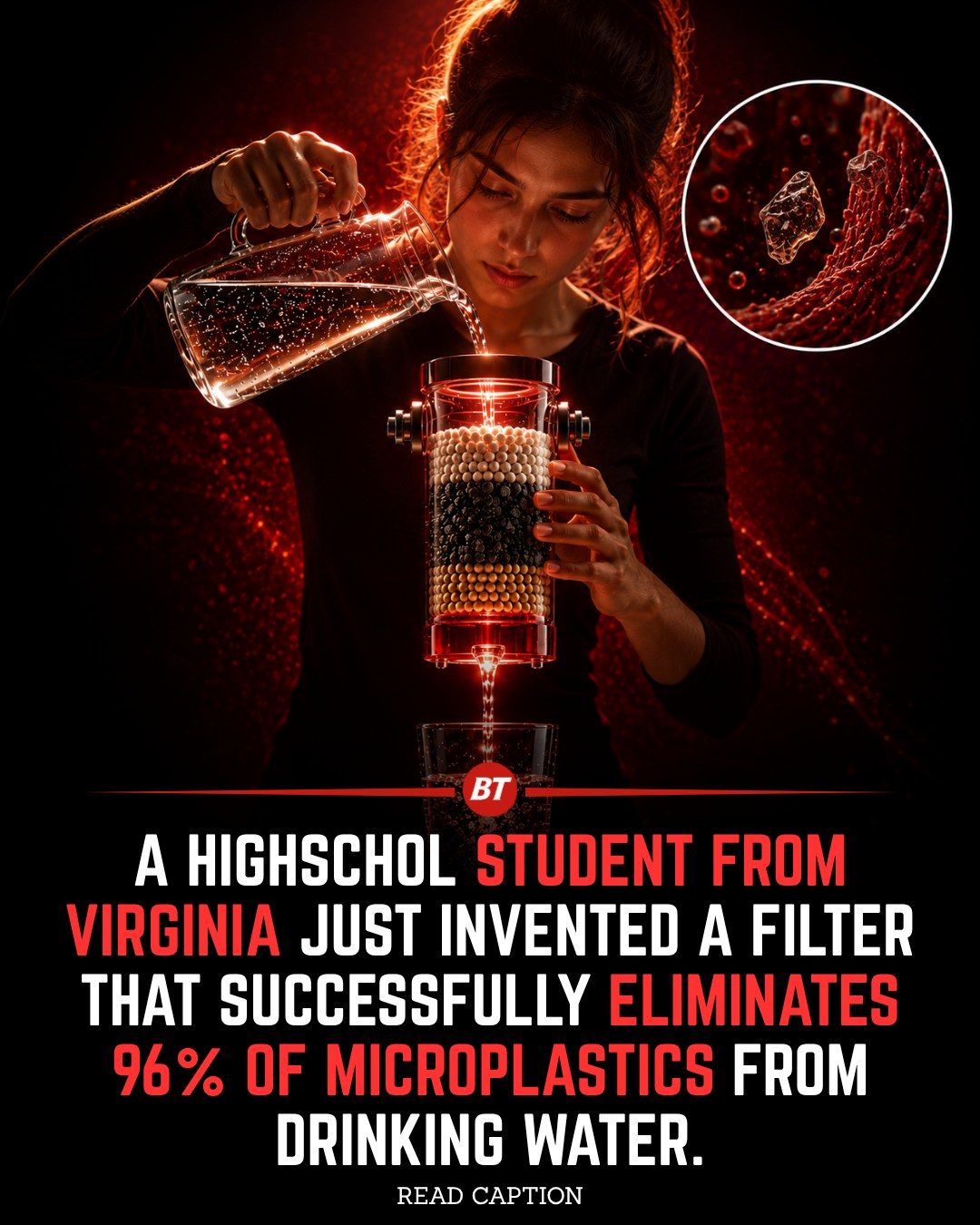
Microplastics Filter
Microplastics have emerged as a significant environmental concern, contaminating drinking water, food, and even human tissue. An innovative solution has come from an unlikely source: an 18-year-old high school student from Virginia. Mia Heller of Kettle Run High School has developed a water filter that removes approximately 96% of microplastics from drinking water. This groundbreaking invention uses a magnetic liquid instead of traditional filter membranes, offering a promising new approach to addressing one of today's fastest-growing environmental challenges.
Context / Why this matters
The presence of microplastics in our environment is a growing concern. These tiny plastic particles, often smaller than 5 millimeters, have been detected in drinking water, food, human blood, lungs, and even brain tissue. While researchers are still working to understand the long-term health effects of microplastic contamination, the potential risks are significant. This is where innovative filtration technologies, like the one developed by Mia Heller, become crucial.
Main discussion
The Invention
Mia Heller's water filter is a prototype that uses ferrofluid, a magnetic liquid, to capture microplastic particles. Unlike traditional filters that trap particles with disposable membranes, this system employs a magnet to pull the ferrofluid and attached plastics out of the water. The magnetic liquid can be recovered and reused, making the system potentially less expensive and more environmentally friendly than conventional filtration methods.
How It Works
The filtration process involves a few straightforward steps:
- Water is poured into the device, which contains the ferrofluid.
- The magnetic liquid attaches to the tiny microplastic particles suspended in the water.
- A magnet pulls both the ferrofluid and the attached plastics out of the water, leaving clean, filtered water behind.
- The ferrofluid can then be recovered and reused, reducing waste and lowering costs.
Innovation and Impact
Mia's invention has gained significant attention, particularly at the 2025 Regeneron International Science and Engineering Fair. The prototype's ability to remove 96% of microplastics demonstrates the potential of simple engineering solutions to address complex environmental problems. While the technology is still in the prototype stage and requires further testing before becoming commercially available, scientists believe it represents a promising new approach to water filtration.
Practical tips
Understanding Microplastic Contamination
To appreciate the significance of Mia's invention, it's essential to understand the extent of microplastic contamination. These particles come from various sources, including the breakdown of larger plastic items, microbeads in personal care products, and fibers from synthetic fabrics. They can enter water systems through sewage, industrial discharge, and runoff from landfills.
Reducing Microplastic Consumption
While filtration technologies like Mia's are crucial, reducing our consumption of plastics is also essential. Here are some practical tips to minimize microplastic contamination:
- Use Reusable Items: Opt for reusable water bottles, bags, and containers instead of single-use plastics.
- Choose Natural Fibers: Select clothing made from natural fibers like cotton or wool, which are less likely to shed microfibers.
- Avoid Microbeads: Check the labels of personal care products and avoid those containing microbeads.
Important takeaways
- Microplastics are a significant environmental concern, contaminating water, food, and human tissue.
- An 18-year-old high school student from Virginia, Mia Heller, has developed a water filter that removes 96% of microplastics using a magnetic liquid.
- The filtration system uses ferrofluid, a magnetic liquid that attaches to microplastic particles, which can be recovered and reused.
- The invention has gained international attention and represents a promising new approach to water filtration.
- Reducing plastic consumption and choosing environmentally friendly products can also help mitigate microplastic contamination.
Conclusion
Mia Heller's innovative water filter offers a glimpse into the future of water purification technologies. By using a magnetic liquid to capture microplastics, her invention provides an effective and affordable solution to a pressing environmental problem. As research continues and the technology advances, we can hope to see more innovative solutions that protect our water and health.
Watch the Reel
Questions readers ask
How does Mia Heller's magnetic liquid filter work?
Mia Heller's filter uses a magnetic liquid to attract and remove microplastics from drinking water. Unlike traditional filters that use membranes, this innovative approach leverages the magnetic properties of the liquid to capture and eliminate up to 96% of microplastic particles.
What are microplastics and why are they a concern in drinking water?
Microplastics are tiny plastic particles, often smaller than 5 millimeters, that have been found in various environmental sources, including drinking water. They pose a concern because they can absorb and concentrate harmful pollutants, which may then be ingested by humans and animals, potentially causing health issues.
How effective is Mia Heller's microplastic water filter?
Mia Heller's magnetic liquid filter has shown impressive results, removing approximately 96% of microplastics from drinking water. This high level of effectiveness makes it a promising solution for addressing microplastic contamination in water sources.
What inspired Mia Heller to create a microplastic water filter?
As a high school student from Virginia, Mia Heller was likely exposed to and motivated by the growing awareness of microplastic contamination in our environment. Her innovative solution was driven by a desire to tackle this pressing environmental challenge and make a tangible impact on water quality.
How does the magnetic liquid filter compare to traditional water filtration systems?
Traditional water filtration systems often rely on membranes to physically trap particles, whereas Mia Heller's magnetic liquid filter uses the magnetic properties of a liquid to attract and remove microplastics. This novel approach may offer advantages in terms of efficiency and the ability to capture smaller particles.
What are the potential benefits of using a magnetic liquid filter for microplastic removal?
Magnetic liquid filters, like the one developed by Mia Heller, offer several potential benefits. These include high removal rates, effective capture of small microplastic particles, and a unique mechanism that could complement or improve upon existing water treatment methods.
Are there plans to commercialize or implement Mia Heller's magnetic liquid filter on a larger scale?
The article does not provide specific details about commercialization or large-scale implementation. However, given the filter's effectiveness, there is potential for further development and wider application. Interested parties might want to reach out to Mia Heller or her school for more information.
Related deep dives
Similar reads based on topic and creator.



Recent articles
Fresh deep dives from the latest Reels we unpacked.



Comments
Be the first to comment.