Global Water Security
The state of global water security is a pressing concern, with a significant portion of the world's population living in countries that struggle with critical water issues. These challenges include declining freshwater availability, increasing demand from growing populations, insufficient infrastructure, and flawed water governance. Together, these factors create a multifaceted problem that affects how easily populations can access water.
Context / Why This Matters
Water security is essential for sustainable development, public health, and economic stability. Understanding the current state of global water security helps policymakers, organizations, and individuals address these issues effectively. The United Nations University (UNU) Institute for Water, Environment and Health (UNU INWEH) published a Global Water Security Report in 2023, which offers valuable insights into the water security levels of various countries. This report assesses water security across ten components, including water availability, resource stability, infrastructure, and safety from floods and droughts.
Components of Water Security
Water security encompasses a wide range of factors that collectively determine a country's ability to manage its water resources effectively. These components include:
Water Availability
Water availability refers to the amount of freshwater resources available in a country. This includes surface water (rivers, lakes, and reservoirs) and groundwater. Declining freshwater availability is a significant concern, particularly in regions with high population densities and limited natural water sources.
Resource Stability
Resource stability involves the consistency and reliability of water sources. This includes factors such as seasonal variations, droughts, and floods. Countries with stable water resources can better plan for and mitigate the impacts of water scarcity.
Infrastructure
Infrastructure plays a crucial role in ensuring water security. This encompasses the construction and maintenance of water storage facilities, distribution networks, and treatment plants. Insufficient infrastructure can lead to water wastage, contamination, and unequal access to clean water.
Governance
Water governance refers to the policies, laws, and institutions that manage water resources. Effective governance is essential for ensuring fair and efficient use of water. Flawed governance can result in mismanagement, corruption, and unequal distribution of water resources.
Safety from Floods and Droughts
Natural disasters such as floods and droughts can severely impact water security. Countries must have mechanisms in place to predict, prepare for, and respond to these events to minimize their impact on water availability and quality.
Water Insecurity Across the Globe
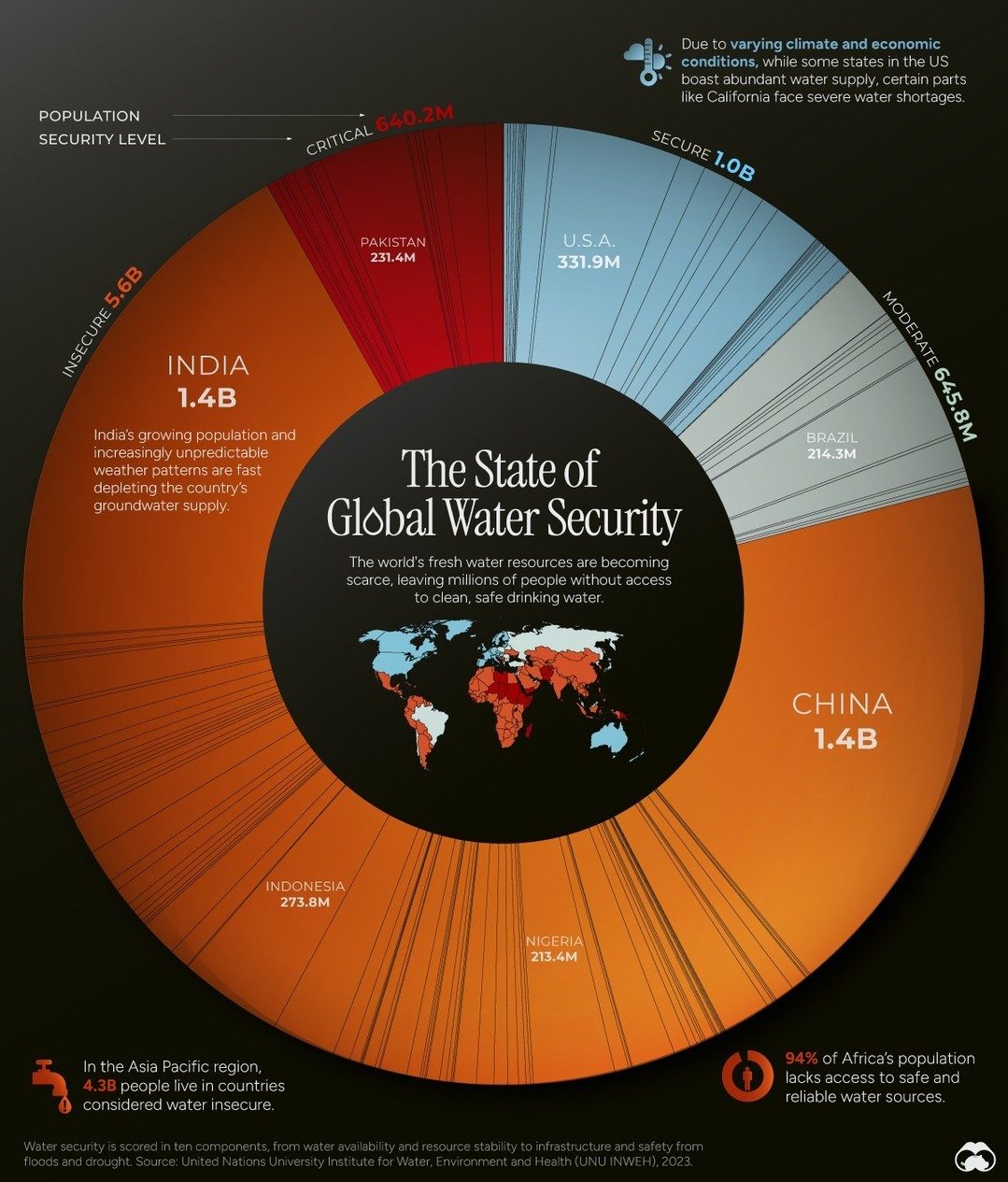
The infographic highlights the water security status of several countries, including Pakistan, India, the USA, Brazil, China, Indonesia, and Nigeria. It underscores the stark reality that 4.3 billion people live in countries considered water-insecure.
Pakistan
With a population of 231.4 million, Pakistan faces significant water security challenges. The country struggles with declining freshwater availability and inadequate infrastructure.
India
India, home to 1.4 billion people, is another country grappling with water insecurity. Rapid population growth and insufficient infrastructure exacerbate the problems of water availability and resource stability.
The USA
The United States, with a population of 331.9 million, has relatively secure water resources compared to many other countries. However, it still faces challenges related to infrastructure and governance, especially in regions prone to droughts and floods.
Brazil
Brazil, with 214.3 million people, has abundant water resources but faces issues related to governance and infrastructure. Effective management of these resources is crucial for ensuring long-term water security.
China
China, home to 1.4 billion people, faces significant water security challenges. The country's rapid urbanization and industrialization have put immense pressure on its water resources, leading to issues such as water scarcity and pollution.
Indonesia
Indonesia, with a population of 273.8 million, struggles with water security due to inadequate infrastructure and governance. The country's archipelagic nature also poses unique challenges in managing water resources.
Nigeria
Nigeria, with 213.4 million people, faces severe water security issues, exacerbated by inadequate infrastructure and governance. A significant portion of the population lacks access to safe and reliable water sources.
Africa's Water Crisis
The infographic emphasizes that 94% of Africa's population lacks access to safe and reliable water sources. This stark statistic highlights the urgent need for improved water security measures across the continent. Effective solutions must address infrastructure, governance, and resource stability to ensure that more people have access to clean water.
Practical Tips for Improving Water Security
Improving water security requires a multifaceted approach involving governments, organizations, and individuals. Here are some practical tips for addressing these challenges:
-
Invest in Infrastructure: Governments and organizations should invest in building and maintaining robust water infrastructure, including storage facilities, distribution networks, and treatment plants.
-
Promote Sustainable Practices: Encourage sustainable water practices such as rainwater harvesting, efficient irrigation, and wastewater treatment to conserve water resources.
-
Strengthen Governance: Implement effective water governance policies that ensure fair and efficient use of water resources, reduce corruption, and promote transparency.
-
Enhance Resource Stability: Develop strategies to mitigate the impacts of seasonal variations, droughts, and floods. This includes investing in early warning systems, disaster preparedness, and water conservation measures.
-
Encourage Community Participation: Engage local communities in water management initiatives to ensure their needs and concerns are addressed. Community participation can lead to more effective and sustainable water management practices.
Important Takeaways
- 4.3 billion people live in countries considered water-insecure, highlighting the global scale of the issue.
- Water security is scored across ten components, including water availability, resource stability, infrastructure, and safety from floods and droughts.
- Effective water governance, infrastructure, and sustainable practices are crucial for addressing water security challenges.
- Africa, in particular, faces severe water security issues, with 94% of its population lacking access to safe and reliable water sources.
- Improving water security requires a multifaceted approach involving governments, organizations, and individuals.
Conclusion
Water security is a critical issue that affects billions of people worldwide. Understanding the current state of global water security and the factors contributing to it is essential for developing effective solutions. By investing in infrastructure, promoting sustainable practices, strengthening governance, enhancing resource stability, and encouraging community participation, we can work towards a more water-secure future. The insights provided by the UNU INWEH report serve as a call to action, urging immediate and concerted efforts to address these pressing water security challenges.
Watch the Reel
Questions readers ask
What is the current state of global water security?
The current state of global water security is alarming, with over 4.3 billion people affected by insufficient water access. This is due to a combination of declining freshwater resources, increasing demand, and poor management, making it a critical global issue.
Which factors contribute to water scarcity in many countries?
Water scarcity is primarily driven by declining freshwater availability, population growth, insufficient infrastructure to manage and distribute water effectively, and flawed governance which hinders proper water management.
How does water security impact public health and economic stability?
Water security is vital for public health, as clean water is essential for hygiene and preventing waterborne diseases. Economically, reliable water access supports industries, agriculture, and overall development, making it a key factor in economic stability.
What role does governance play in addressing water challenges?
Effective water governance is crucial for managing water resources sustainably. Good governance ensures fair distribution, prevents misuse, and promotes infrastructure development, while poor governance exacerbates water scarcity and inequity.
Which regions are most affected by the global water crisis?
Regions most affected by the global water crisis include parts of Africa, Asia, and the Middle East. These areas often face severe water scarcity, infrastructure challenges, and governance issues, making water access a significant concern.
How does understanding global water security help in addressing these issues?
By understanding global water security, policymakers, organizations, and individuals can develop targeted strategies to improve water management, infrastructure, and governance. This knowledge is essential for creating effective solutions to mitigate water scarcity and enhance accessibility.
How does water availability impact sustainable development?
Water availability is a cornerstone of sustainable development. It affects various sectors, including agriculture, industry, and domestic use. Ensuring reliable water access supports economic growth, improves public health, and promotes environmental sustainability, making it a key factor in overall development.
Related deep dives
Similar reads based on topic and creator.


Recent articles
Fresh deep dives from the latest Reels we unpacked.




Comments
Be the first to comment.