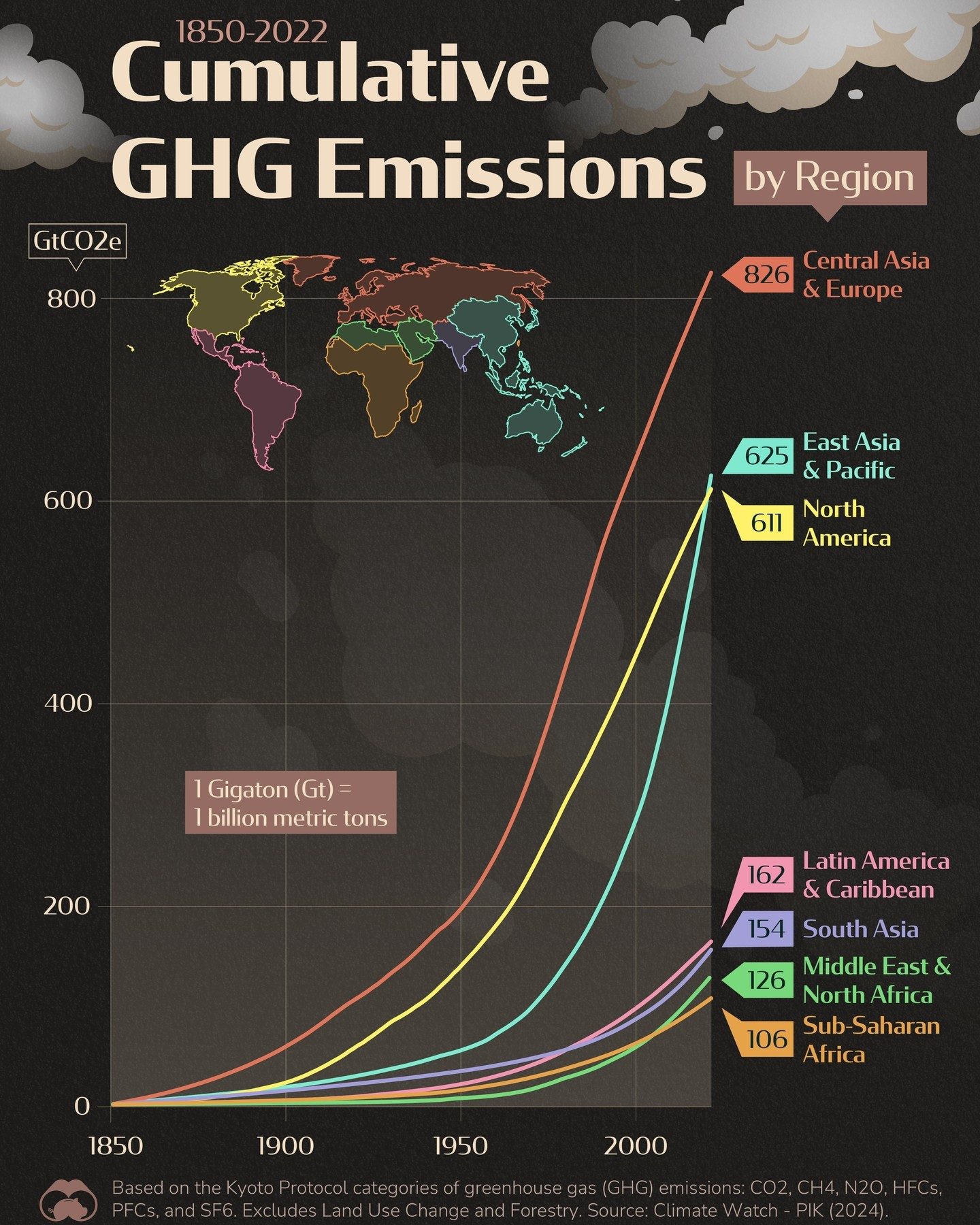
GHG Emissions Over Time
Cumulative greenhouse gas (GHG) emissions tell a stark story of global industrialization and consumption. Since 1850, Europe, Central Asia, East Asia, the Pacific, and North America have collectively accounted for 79% of the world's GHG emissions. This significant contribution can be attributed to industrialization, rapid population growth, and escalating consumption patterns.
Why This Matters
Understanding the distribution and trends of GHG emissions is crucial for tackling climate change. By examining cumulative emissions, we can identify the historical contributors and pinpoint periods of rapid increase. This information helps in formulating policies and strategies to reduce future emissions and mitigate climate impacts.
Factors Driving GHG Emissions
Industrialization
The Industrial Revolution marked the beginning of significant GHG emissions. Industrial processes in Europe and North America, followed by rapid growth in East Asia and the Pacific, have been major contributors. Factories, power plants, and manufacturing facilities are responsible for a substantial portion of these emissions.
Population Growth
The global population has increased exponentially, particularly in regions like South Asia and the Pacific. This growth has led to increased demand for energy, food, and consumer goods, all of which contribute to GHG emissions.
Rising Consumption
Increased consumption, particularly in affluent regions, has driven up GHG emissions. Higher standards of living often correlate with greater energy use and more significant carbon footprints. This trend is evident in North America and Europe, which have historically high consumption rates.
Global Cumulative GHG Emissions by Region
Europe and Central Asia
Europe and Central Asia have a cumulative emission of 826 Gigatons of CO2 equivalent (GtCO2e). This region has been at the forefront of industrialization and has a long history of fossil fuel use, contributing significantly to global emissions.
South Asia and the Pacific
With 625 GtCO2e, South Asia and the Pacific have seen considerable increases in emissions due to industrial development and urbanization. Rapid population growth and economic expansion in countries like India and China are major factors.
North America
North America's cumulative emissions stand at 611 GtCO2e. As one of the most industrialized regions, it has a high per-capita emission rate. The extensive use of fossil fuels for energy, transportation, and industry has been a significant contributor.
Latin America and the Caribbean
Latin America and the Caribbean, with 162 GtCO2e, have a comparatively lower cumulative emission. However, increasing industrial activities and energy demands are leading to a rise in emissions in this region.
Middle East and North Africa
The Middle East and North Africa have contributed 154 GtCO2e. The region's emissions are heavily influenced by its reliance on fossil fuels, particularly petroleum, which is a significant export product and energy source.
Sub-Saharan Africa
Sub-Saharan Africa, with 126 GtCO2e, has the lowest cumulative emissions among the regions mentioned. While this region has experienced industrial growth, it remains relatively low compared to other areas. However, the rapid rise in energy demand and industrial activities pose a threat to future emissions.
Categories of GHG Emissions
Cumulative GHG emissions are based on the Kyoto Protocol, which categorizes GHG emissions into several types:
- Carbon Dioxide (CO2)
- Methane (CH4)
- Nitrous Oxide (N2O)
- Hydrofluorocarbons (HFCs)
- Perfluorocarbons (PFCs)
- Sulphur Hexafluoride (SF6)
These categories exclude emissions from Land Use Change and Forestry, which are significant contributors but are measured separately.
Practical Tips for Addressing GHG Emissions
Policies and Regulations
Implementing stricter emission standards and regulations can help reduce GHG emissions. Policies that promote renewable energy and reduce dependence on fossil fuels are essential.
Renewable Energy
Transitioning to renewable energy sources like solar, wind, and hydro can significantly reduce emissions. Governments and industries should invest in renewable energy infrastructure and incentivize its adoption.
Energy Efficiency
Improving energy efficiency in industrial processes, transportation, and residential systems can lower GHG emissions. This includes developing more efficient technologies and promoting sustainable practices.
Sustainable Practices
Encouraging sustainable consumption practices can help reduce emissions. This involves promoting recycling, reducing waste, and adopting eco-friendly lifestyles.
Important Takeaways
- Europe, Central Asia, East Asia, the Pacific, and North America are responsible for 79% of global GHG emissions since 1850.
- Factors like industrialization, population growth, and rising consumption have driven emissions.
- Cumulative emissions by region highlight the historical contributors to GHG emissions, with Europe and North America leading the way.
- The Kyoto Protocol categories provide a framework for understanding the types of GHG emissions.
- Addressing GHG emissions requires policies and practices that promote renewable energy, energy efficiency, and sustainable consumption.
Conclusion
GHG emissions have a profound impact on the environment and climate. By understanding the historical and regional contributions to emissions, we can better formulate strategies to mitigate future impacts. Addressing GHG emissions requires a concerted effort from governments, industries, and individuals to promote sustainable practices and reduce reliance on fossil fuels.
Watch the Reel
Questions readers ask
Which regions have been the largest contributors to global GHG emissions since 1850?
Europe, Central Asia, East Asia, the Pacific, and North America have been the largest contributors, accounting for 79% of global GHG emissions from 1850 to 2000. This significant contribution is largely due to these regions' industrialization, population growth, and consumption patterns.
What are cumulative greenhouse gas emissions, and why are they important for understanding climate change?
Cumulative greenhouse gas emissions refer to the total amount of GHGs released into the atmosphere over a specific period. They are important because they provide a comprehensive view of historical emission trends, helping to identify major contributors and periods of rapid increase, which is crucial for developing effective climate policies.
How have industrialization and consumption patterns influenced GHG emissions in key regions?
Industrialization and consumption patterns have significantly influenced GHG emissions in key regions. As these regions industrialized, their reliance on fossil fuels and energy-intensive processes increased, leading to higher emissions. Similarly, escalating consumption patterns have driven demand for goods and services, further contributing to GHG emissions.
Why is it important to examine historical GHG emissions data?
Examining historical GHG emissions data is important because it provides insights into the long-term trends and patterns of emissions. This information is essential for understanding the root causes of current climate issues and for developing targeted strategies to reduce future emissions and mitigate climate impacts.
How do the GHG emissions of Central Asia and East Asia compare to those of North America and Europe?
Central Asia and East Asia, along with North America and Europe, have been significant contributors to global GHG emissions. While North America and Europe have historically been the largest emitters, Central Asia and East Asia have also seen substantial increases in emissions, particularly due to rapid industrialization and economic growth in the latter half of the 20th century.
What role do population growth and consumption play in regional GHG emissions?
Population growth and consumption play crucial roles in regional GHG emissions. As populations increase, so does the demand for resources and energy, leading to higher emissions. Additionally, increasing consumption patterns, driven by economic growth and urbanization, drive up emissions as more goods and services are produced and consumed.
What can historical emission data tell us about future emission trends and climate change mitigation strategies?
Historical emission data can provide valuable insights into future emission trends by identifying regions and sectors with high emission potentials. This allows for the development of targeted climate change mitigation strategies, including policies for reducing industrial emissions, promoting renewable energy, and encouraging sustainable consumption practices.
Related deep dives
Similar reads based on topic and creator.


Recent articles
Fresh deep dives from the latest Reels we unpacked.




Comments
Be the first to comment.