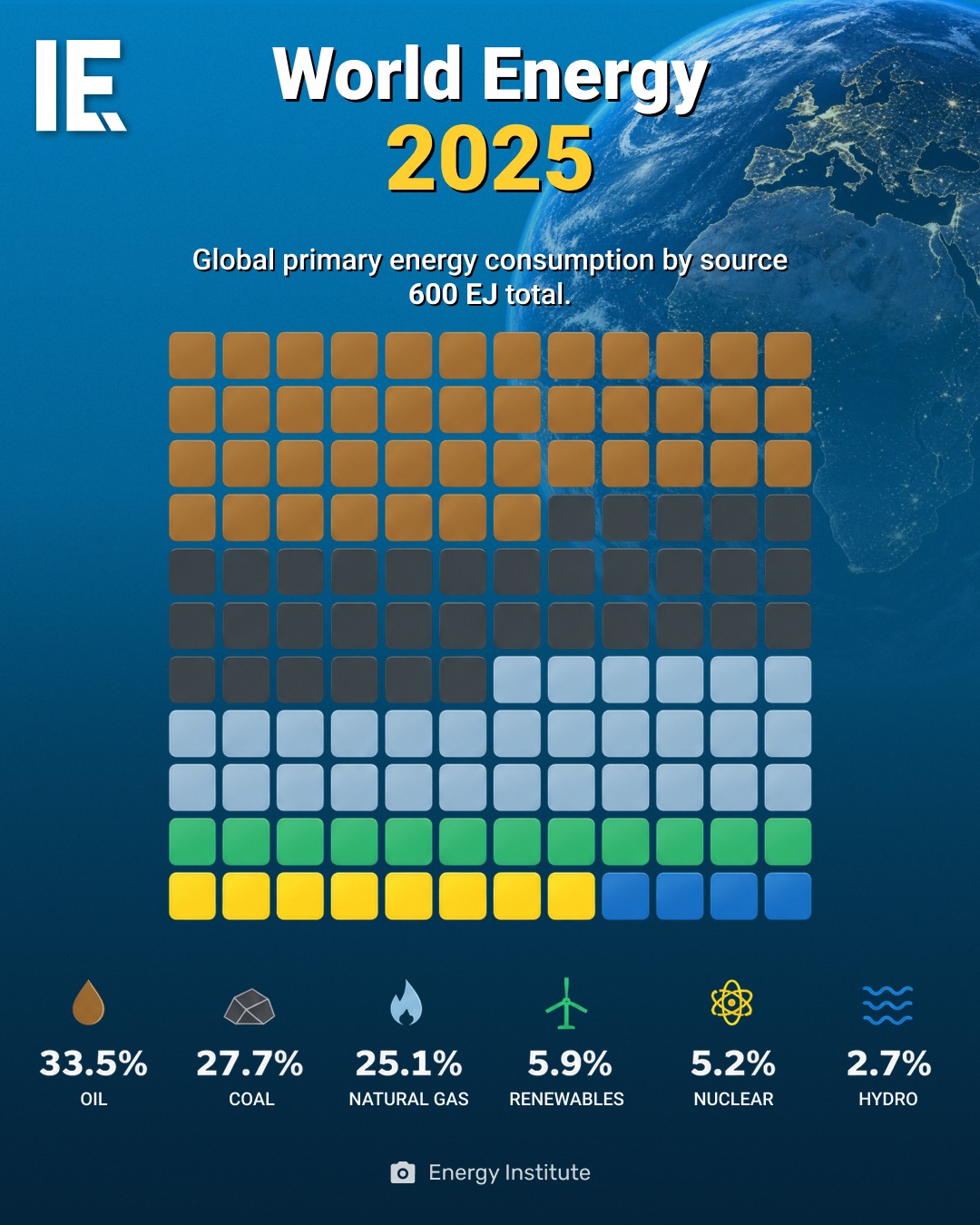
In 2025, global primary energy consumption is projected to reach an astonishing 600 exajoules (EJ) — nearly equivalent to humanity's entire global electricity generation in 2022. The breakdown of energy sources will represent both the world's energy hunger and the growing importance of certain fuels.
A Commercial Collaboration
The infographic visualizes the forecasted energy consumption by source, offering a detailed view of the energy landscape. Analogously, it’s like a pie chart in physical form showing Earth's energy consumption in 2025. The squares, block highlights, colors, and on-screen text translate 600 EJ of energy consumption visually into energy sources in their correct proportions. The Energy Institute’s infographic displays the full world energy projection, including coal, oil, natural gas, renewables, nuclear, and hydro. The entire energy consumption is broken into squares to create an easy-to-read visual. The Energy Institute, a distinguished research organization, has provided this informative breakdown. Although their data remains proprietary, they provide a valuable reference table on the global energy mix focused exclusively on primary energy sources used directly.
The Energy Shift
As global energy consumption rises, the politics, economics, and environmental impact of energy change drastically. This graphically represented data reflects the planet's attempt to balance economic growth, energy security, and environmental sustainability. The types of energy sources indicated in this infographic are a reflection of global trends: The world’s energy consumption will increasingly be more diverse and renewable, while the reliance on fossil fuels continues. The rise of natural gas, for example, reflects the choice for cleaner energy sources with lower emissions than coal and oil. The Energy Institute's infographic data indicates that while the fossil fuel mix of energy remains dominant, renewables and possibly nuclear energy will gain strength. This projection underlines the need for widespread adoption of renewable technologies and the continuous push to decarbonize the global economy.
The Breakdown
The Fossil Fuel Foundation
The projected breakdown of energy sources reveals coal, oil, and natural gas collectively fueling 86.3 percent of global primary energy consumption. Coal — set to comprise 33.5 percent — ensures it will continue as the world's dominant energy source. Oil comes in second, powering 27.7 percent of the world's energy consumption. Meanwhile, natural gas will provide 25.1 percent of global energy consumption. This dependence on fossil fuels is a far cry from an energy transition.
Renewables' Expanding Role
Renewables, including wind, solar, geothermal, and hydropower, are projected to account for a smaller, 5.9 percent of global energy consumption. With accelerating adoption of wind and solar projects, the sector will likely grow despite a relatively small fraction. The role of renewables is significant. Renewables' contributions will grow through government actions, such as mandating new power plants to use only solar or wind energy, incentivizing homeowners to install solar panels, or taxing fossil fuels to reduce carbon emissions.
Nuclear’s Steady Contribution
Nuclear energy will account for an estimated 5.2 percent of global energy consumption — a stable source of electricity that operates without the carbon emissions of fossil fuels. While the energy sector is shifting away from nuclear power because an accident poses a potential catastrophe for the environment and human health, nuclear energy has been one of the main components of emissions-free energy alongside renewables.
The Persistence of Hydro
Hydroelectric power will contribute just 2.7 percent of global energy in 2025. While hydroelectric power represents an abundant renewable source, the production can be affected by climate change, drought, and environmental concerns. Large dams and their reservoirs limit water flow downstream, affecting wildlife and ecosystems.
Renewable Growth in a Changing World
Around 2020, the planet was at a critical juncture. The global energy system was transitioning due to technological advancements and climate policy. As a result, the energy system in 2025 will be fundamentally different from that of today, as global warming accelerates, countries will face severe environmental impacts, such as increased frequency of heatwaves and droughts. While coal, oil, and natural gas dominate the energy mix, the role of renewables and nuclear power will expand further in the coming decades. The projected future of global energy will be one of decreasing reliance on fossil fuels and increasing reliance on renewable and nuclear energy. To prevent severe consequences for our society and the environment, countries worldwide must continue to increase their renewable energy capacity. The fight for clean energy must include policy reforms to reduce the carbon footprint and implement effective climate policies.
Exploring Clean Energy Solutions
Seeking more reliable, sustainable energy solutions requires exploring clean technologies. Technology, new ideas, and innovation are essential to transition to a sustainable future.
- Government action: Governments must implement robust policies to promote energy independence and environmental sustainability. Policies aimed at incentives for the development of new energy systems can be decisive in promoting a clean energy future.
- Investment Energy: The government and private sector should invest in renewable energy infrastructure development.
- Energy policy: Policies and programs to transition to clean energy will need a new, balanced approach that can help to integrate renewable energy resources and energy efficiency, and to reduce barriers.
- Public education: Educate the general public on the importance of using clean energy, energy efficiency, and renewable resources. Education and awareness can play a critical role in accelerating clean-energy technology adoption.
Shaping the Future
In 2025, global energy consumption will reach 600 EJ, with fossil fuels powering most of our energy consumption. However, the unstoppable push toward renewable energy will continue. Fossil fuels will still remain valuable — but future energy leaders must develop technology and policies to leverage renewable energy to secure a sustainable future.
Watch the Reel
Questions readers ask
What are exajoules and why are they used to measure energy consumption in 2025?
Exajoules are a unit of energy equivalent to 10^18 joules. They're used to measure energy consumption in 2025 because they can represent the vast amounts of energy the world consumes. One exajoule is roughly equivalent to 278 terawatt-hours, and the global energy consumption in 2025 is projected to reach 600 exajoules.
How does the Energy Institute's infographic help visualize energy consumption?
The Energy Institute's infographic translates the projected 600 exajoules of energy consumption into a visual format. It uses squares, colors, and text to represent different energy sources and their proportions, making it easier to understand the global energy mix at a glance.
Why is there a shift towards renewable energy sources in the global energy mix?
The shift towards renewable energy sources is driven by the need to balance economic growth, energy security, and environmental sustainability. Renewables offer cleaner energy with lower emissions, and governments are increasingly adopting policies to incentivize their use.
What are the projected percentages of energy consumption for coal, oil, and natural gas in 2025?
In 2025, coal is projected to fuel 33.5 percent, oil 27.7 percent, and natural gas 25.1 percent of global primary energy consumption. Together, these fossil fuels will account for 86.3 percent of the world's energy use.
What role do government policies play in the growth of renewable energy sources?
Government policies play a significant role in promoting renewable energy. They can mandate new power plants to use solar or wind energy, incentivize homeowners to install solar panels, and implement taxes on carbon emissions, all of which encourage the adoption and growth of renewable energy technologies.
How does the Energy Institute's data reflect the global trends in energy consumption?
The Energy Institute's data shows that while fossil fuels remain dominant, there is a growing trend towards more diverse and renewable energy sources. This reflects the world's efforts to decarbonize the global economy and move towards cleaner energy sources.
What are the implications of the projected energy consumption data for the global economy?
The projected data indicates a continued reliance on fossil fuels, which has implications for energy security and environmental sustainability. However, the growing role of renewable energy sources suggests a potential path towards a more sustainable and secure energy future. The data underscores the need for continued innovation and investment in renewable technologies.
Related deep dives
Similar reads based on topic and creator.




Recent articles
Fresh deep dives from the latest Reels we unpacked.



Comments
Be the first to comment.