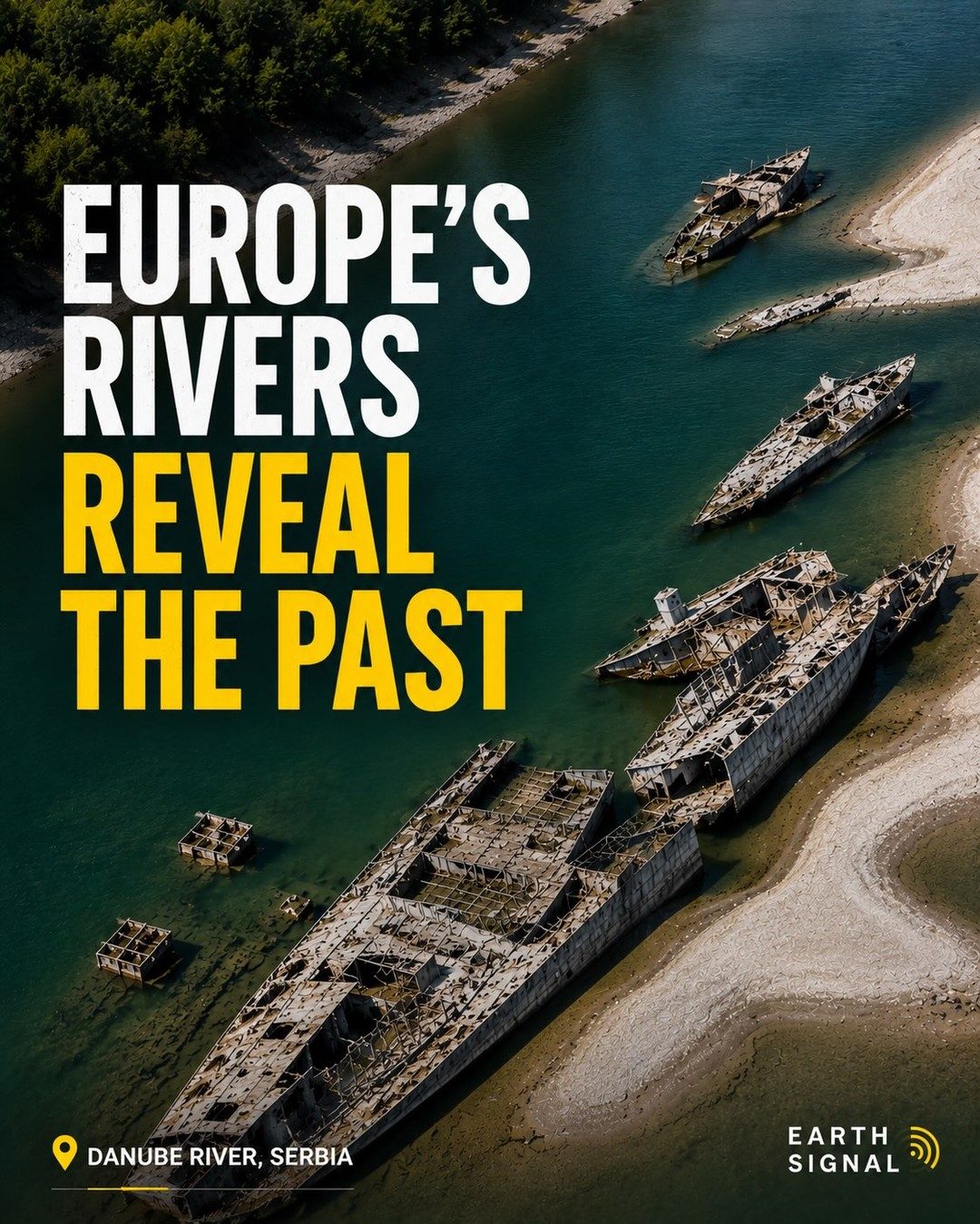
The Danube's Watery Cache
The Danube River in Serbia is literally reshuffling history. As drought and climate change alter water levels, the river has begun yielding long-lost remnants of the past. In August 2026, the Danube's waters were uncharacteristically low, revealing what the local Earth Signal crew documented. Among the uncovered artifacts are sunken ships, remnants of a bridge in Prahovo, and a ghost bridge. The Danube's historical significance lies in its role as a key transport and communication route for various civilizations. The river runs through ten countries, fostering cultural exchange — at least before the climate crisis. As water levels fluctuate, it's likely they will continue to alter the river's course. This could cause previously submerged regions to resurface. Stranded vessels could be a commercial goldmine as it could boost tourism. But the Danube's changing waters highlight a grim reality: extreme weather events driven by climate change are altering landscapes, disrupting communities, and exposing long-dormant history.
The Danube's Water Levels are Changing
The Danube is changing. Due to climate change and drought, its water levels have dropped significantly in recent years. For instance, the water levels aren't simply lower, they're unpredictably fluctuating. The river's unique trajectory — winding through diverse European regions — amplifies the impacts of these fluctuations. Compared to three decades ago, the Danube now has a lesser tendency to maintain stable flow levels. This unpredictability reveals the magnitude of the climate crisis. Many are now unaware that these newly exposed artifacts were hidden underwater. The discovery of a ghost bridge, for example, would have been unthinkable a few years ago. The truth is that if nothing changes, this will happen to other rivers as well. The extrema of water levels is nothing short of a wake-up call; it underscores the urgency of mitigating climate change. The extremes are robbing both commercial vessels and environmentalists of their antidotes. For example: Sunken ships and decayed bridges weren't always meant to be public attractions.
The Danube's Hidden History
The dramatic exposure of historical sites is a unique double-edged sword. While it offers an unprecedented opportunity for archaeologists, it also presents a race against time. A few years ago, the water was impossibly high to expose these artifacts. As the world gets hotter and the water levels fluctuate, more and more history will be exposed to the elements, eventually deteriorating. Under climate change, the Danube River Basin has seen reduced water levels and changing precipitation patterns. These changes have exposed long-forgotten sites. The precipitous decrease in river volume has revealed hidden history. Structures engineered in the 19th or 20th centuries are morphing into relics, while the Danube itself is evolving from a trusted commercial route to an archaeological goldmine.
A River's Shifting Identity
It's easy to imagine that the river has been behaving like a living organism. Upon revealing its archaeological cache, it's as though the river is redefining itself. For centuries, the Danube has been a crucial route for transportation and trade. Its waters have linked towns and cities, serving as a conduit for goods, people, and cultures. It has had an intimate role in the region's economic development. It has helped sustain livelihoods and fostered regional exchange. Water levels in the Danube are changing at an alarming rate. In particular, the river's role as a stabilizer of regional identity is transforming. This may be messing with locals' sense of who they are. The heritage that the Danube has been hiding is being sidelined to become a problem for historians. Yet, from a historical perspective, this is a golden era.
Watch the Reel
Related deep dives
Similar reads based on topic and creator.

Recent articles
Fresh deep dives from the latest Reels we unpacked.

Comments
Be the first to comment.