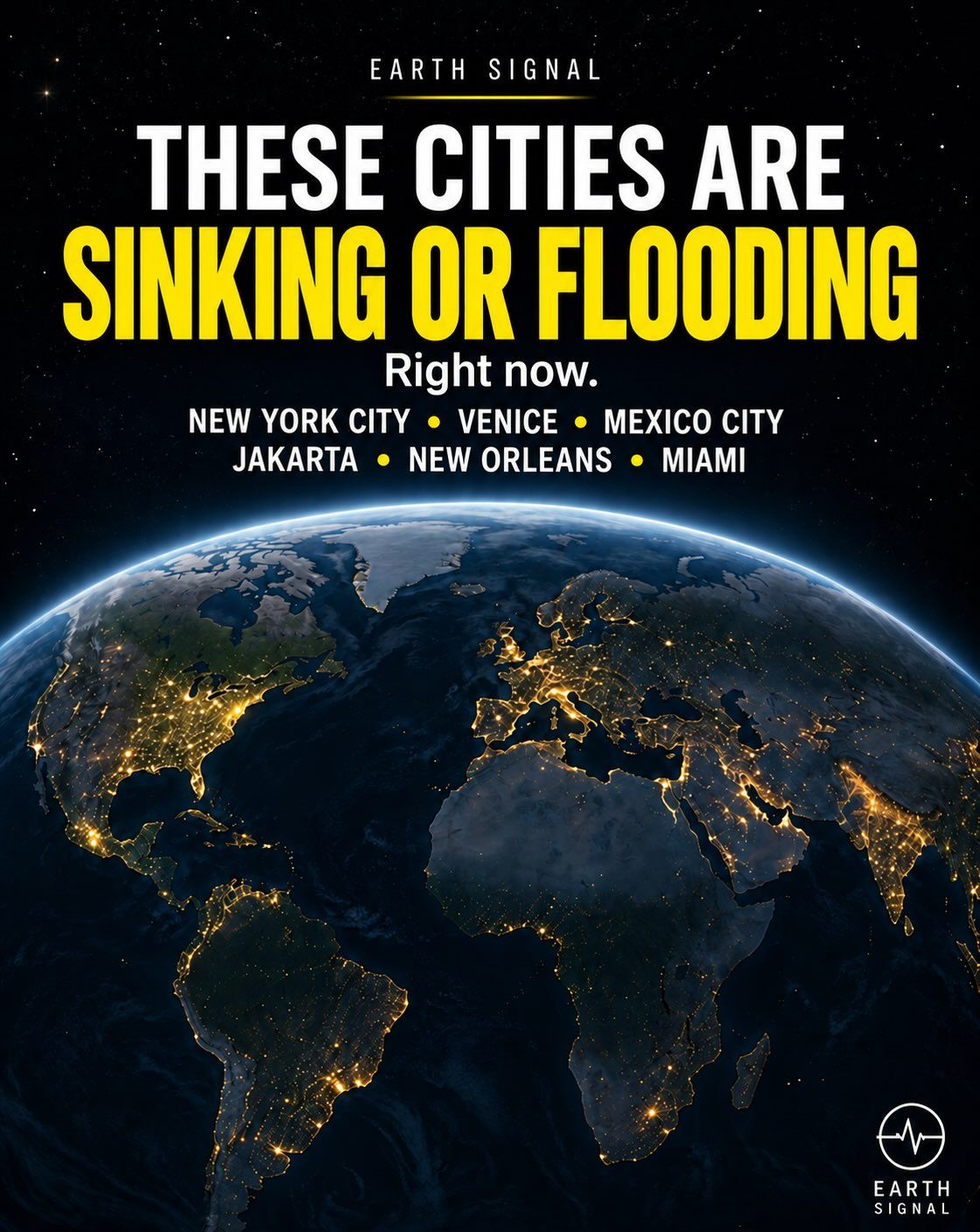
Inexorable Descent
Cities, once taunted as urban fortresses, are quietly succumbing to the forces of nature and human activity. Earth Signal has shed light on the unsettling truth that many major cities are sinking or flooding, right now, as we speak. The malady is not uniform. The causes and rates of descent vary widely. Some cities sink due to sediment compaction, a process that occurs when soft, layered sediments compact under buildings. Scientists confirm this "gradual subsidence” is measurably occurring in New York City: sediments compact against bedrock, leaving Manhattan shrinking at a rate of 1 - 2 mm/yr. Earth’s crust is also readjusting to the retreat of glaciers, a process known as glacial isostatic adjustment. The weight of ancient glaciers depressed the Earth’s crust, which is now slowly springing back. Now, in the era where glaciers have retracted, this weight is decreasing, consequently causing the crust to rise slowly in other parts. The Earth is a complex entity, and the mechanisms of its movement cannot be pinned down to one or two processes. Venice, for example, has been sinking for centuries, but the problem has been exacerbated by human influences. The city now has an average rate of sinking at about 1-2 mm/yr in its historic center. This example, along with the examples of other cities, makes clear that the Earth’s surface is constantly changing, and cities are shifting because of such geological influences.
Weight of Water
In Miami, flooding is not just a consequence of heavy rain or storms. The culprit is porous limestone, which allows seawater to move inland and flood the city. Seawalls designed to stop flooding prove insufficient. The porous limestone not only allows flooding to deepen, but also creates localized flood spots, even on sunny days. Miami’s struggle with flooding is a stark reminder that not all urban flooding is caused by weather events. Porous limestone means having surface openings. The resultant pores are quite strong and allow seawater to pass through the ground. The porous limestone is only one of Earth's materials that are particularly vulnerable to flooding. Sediments and lakes are other examples. These all allow for flooding to occur, not just locally, but across the board.
Draining the Problem
For other cities, the cause of sinking may not be water from above or porous rock, it’s the water below. Mexico City and Jakarta are sinking due to groundwater extraction into lake sediments. Groundwater extraction has caused Mexico City to sink at a rate of 24 cm/year in some areas, while Jakarta is sinking at about 15–25 cm/year in some northern areas. This means that what lies beneath the surface of a city can significantly impact its subsidence. The rate of sinking is not uniform across all cities. Venice and New York are sinking at about 1-2 mm/year. Mixed sediment compaction and fluid withdrawal have caused New Orleans to sink up to 28.6 mm/year in some areas. Groundwater extraction is a shared cause in both Mexico and Jakarta, but the rates are different.
Collapsing Settlements
Statistically, New Orleans is sinking at the most radical rate, up to 28.6 mm/yr, while Venice and Jakarta aren't far behind, each sinking about 1-2 mm/yr. It doesn't take a seabird to predict that if cities continue sinking at this rate, it will be a recipe for catastrophe. The most dramatic evidence for these claims is the city of Jakarta. The stark contrast of city sinking rates exemplifies that the Earth's crust has loosely compacted sediments that are highly vulnerable. Such cities are seeing their shorelines get swallowed by the sea, and their land sink. If the rate of sinking continues, this phenomenon will only accelerate. This means that cities need to address this issue with urgency. By understanding these natural geological processes, cities can develop strategies to mitigate the effects of sinking.
Watch the Reel
Related deep dives
Similar reads based on topic and creator.


Recent articles
Fresh deep dives from the latest Reels we unpacked.



Comments
Be the first to comment.