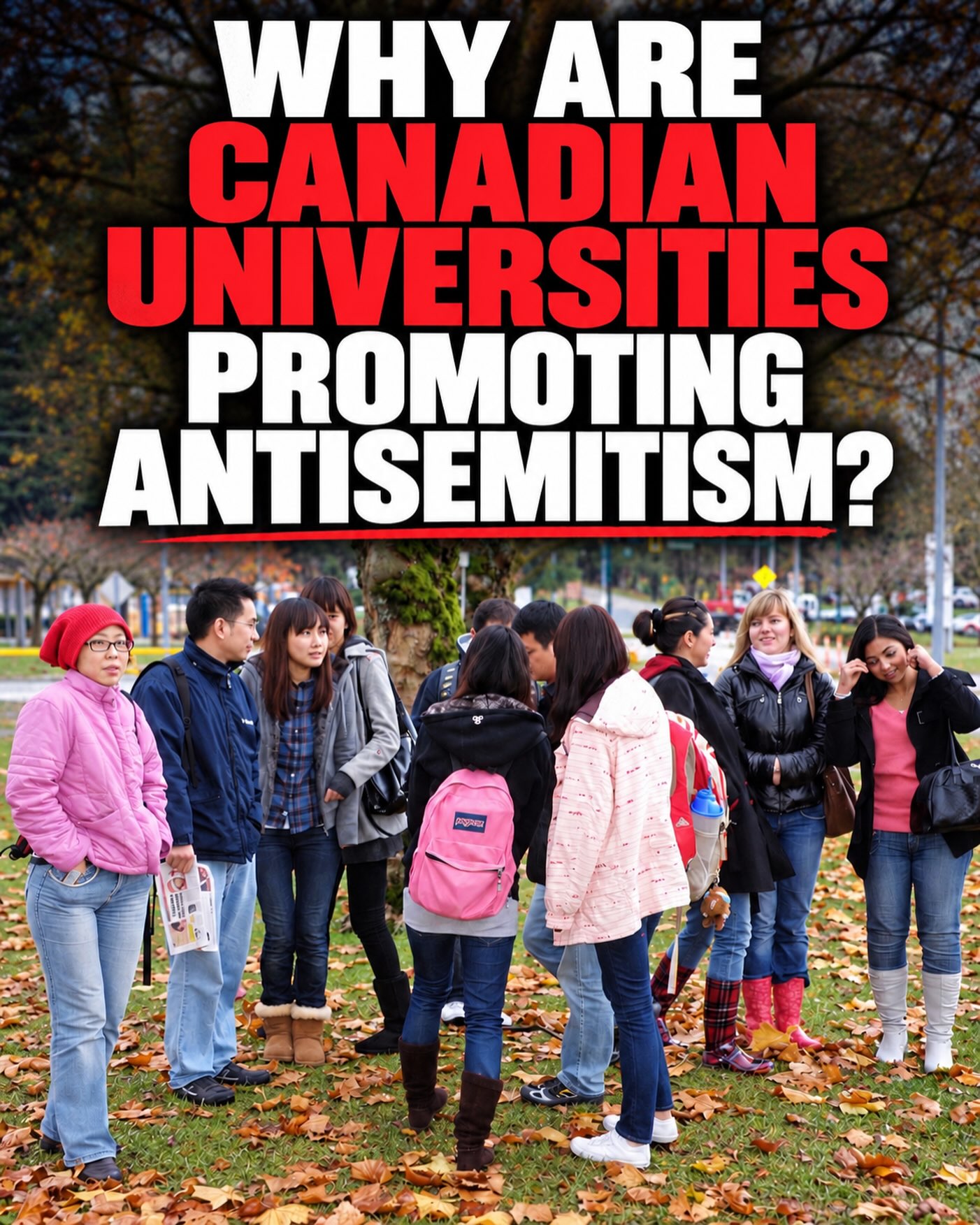
A bold viral question raises the stakes on Canadian campuses: Why would respected universities be accused of promoting antisemitism? The question hangs in the air on a campus filled with autumn leaves, where a group of students chat outdoors. When a shocking OCR text appears overlaid on the image, asking "WHY ARE CANADIAN UNIVERSITIES PROMOTING ANTISEMITISM?," the question is suddenly not just posed in a hypothetical context. The only information available to discern what the creator means to discuss is the question posed in large, bold, on-screen text.
A Potent Question and Its Silhouette
The caption of the video shows intent to spark a specific discussion. The question is everything. The creator used on-screen text to make sure there is no doubt about the statement posed, values the question over visual elements. There's no other content. Without visual context, the viewers rely heavily on the phrases of the question alone. However, there is more context to the visuals on the frame shown: students on a campus, surrounded by the leafy trees and buildings typical of a Canadian university. It is more than a question; it’s an urgent provocation asking for an answer. Although there is no transcript or comment details to analyze further, the question and visual context are enough to ask: who is behind this question? What is this meant to enlighten?Is it meant to be partisan? The rich visual context of the campus, with trees and buildings, suggests a university setting, but no campus is named.
Exponential power of the social question
The content creator is referencing a charged topic, antisemitism. This incendiary concept would be controversial on most university campuses. Its framing as a question of national scale, where "CANADIAN" universities are accepting of antisemitism, escalates the tension. What universities are meant, in this context, is left to the viewers. There is no cheat sheet, only the provocative question. The visual context—a student-filled campus—doubles the impact. The bold question challenges the campus atmosphere. While not naming particular institutions, it asks about all Canadian universities.
The feel of the charge
This question could be a cry for help, an invitation for articulate debate, or an incitement to anger. In the context of modern media habits, it could also be a call to search for it—searching for answers to this question easily could throw a web browser full of explanations and opinion. This is not a question meant to rest; students can cross-reference their schooling with the community where they grow. The experiences that students have should be measured against the example set in the question, which is asking for a rational response. The political implications of the question are tenuous: what does it mean to promote antisemitism?
University anti-antisemitism statements
Canadian universities have active policies to prevent antisemitism. Many programs have curricula that target racism and discrimination, so the portrayal of Canada’s universities as antisemitic is out of character.
Request for reform
Critics react negatively when seeing this disturbing question, many feel "Canadian" universities need reform.
The debate of free speech
To take issue with the question: many feel it's divisive, stirring up controversy without context. This is part of a larger question about free speech with heavy debate: universities must balance freedom of speech with an anti-harassment stance.
Practical Guidance for Students
If you find yourself involved because a classroom debated the question:
- Open Communication: Remember, not everyone comes in knowing about the topic. Ask specific questions to clarify the room's feeling on the benefit of having the discussion.
- Dig Deeper: If the question provokes a specific emotion, don't let it dictate your response.
- Stay Informed: Find credible media outlets or reports from activist organizations.
- Extend the conversation: To build on the conversation at hand, engage with other media, such as documenting your experience on social media. Finally, a conversation about antisemitism could lead to many different discussions.
Watch the Reel
Questions readers ask
What specific actions or policies by Canadian universities have led to accusations of promoting antisemitism?
The viral video doesn't specify any particular actions or policies, which leaves the accusation quite vague. It's important to note that many Canadian universities have policies in place to prevent antisemitism and promote inclusivity. The video's impact comes from its broad, provocative question rather than concrete examples.
Who created the viral video, and what might be their motives?
The article does not provide information about the creator of the video. The motives behind the video could range from raising awareness about a serious issue to provoking debate, or even stirring up controversy. The lack of additional context makes it difficult to determine the creator's intent.
What is the significance of the video being set on a Canadian university campus?
The campus setting is crucial because it directly implicates educational institutions in the debate about antisemitism. By using a generic campus scene, the video suggests that the issue is pervasive across Canadian universities, rather than isolated to specific institutions.
How have Canadian universities responded to the accusations raised by the video?
The article mentions that Canadian universities have active policies to prevent antisemitism and often include curricula that target racism and discrimination. However, it does not provide specific responses from universities to the viral video. It’s likely that many institutions would strongly deny such accusations and reiterate their commitment to inclusivity and anti-discrimination policies.
Is there a specific definition of 'promoting antisemitism' that the video is using?
The video does not provide a specific definition, leaving it open to interpretation. This ambiguity adds to the provocative nature of the question, as viewers may have different understandings of what it means for a university to 'promote antisemitism.' The lack of context makes the question even more charged and open to debate.
What kind of impact might this video have on students and the broader public?
The video could provoke a range of reactions, from sparking important discussions about antisemitism to inciting anger or confusion. It encourages viewers to reflect on their own experiences and the policies of their institutions, potentially leading to greater awareness and dialogue about the issue. However, it could also lead to misinterpretations and further polarization if not handled with care.
Related deep dives
Similar reads based on topic and creator.


Recent articles
Fresh deep dives from the latest Reels we unpacked.




Comments
Be the first to comment.