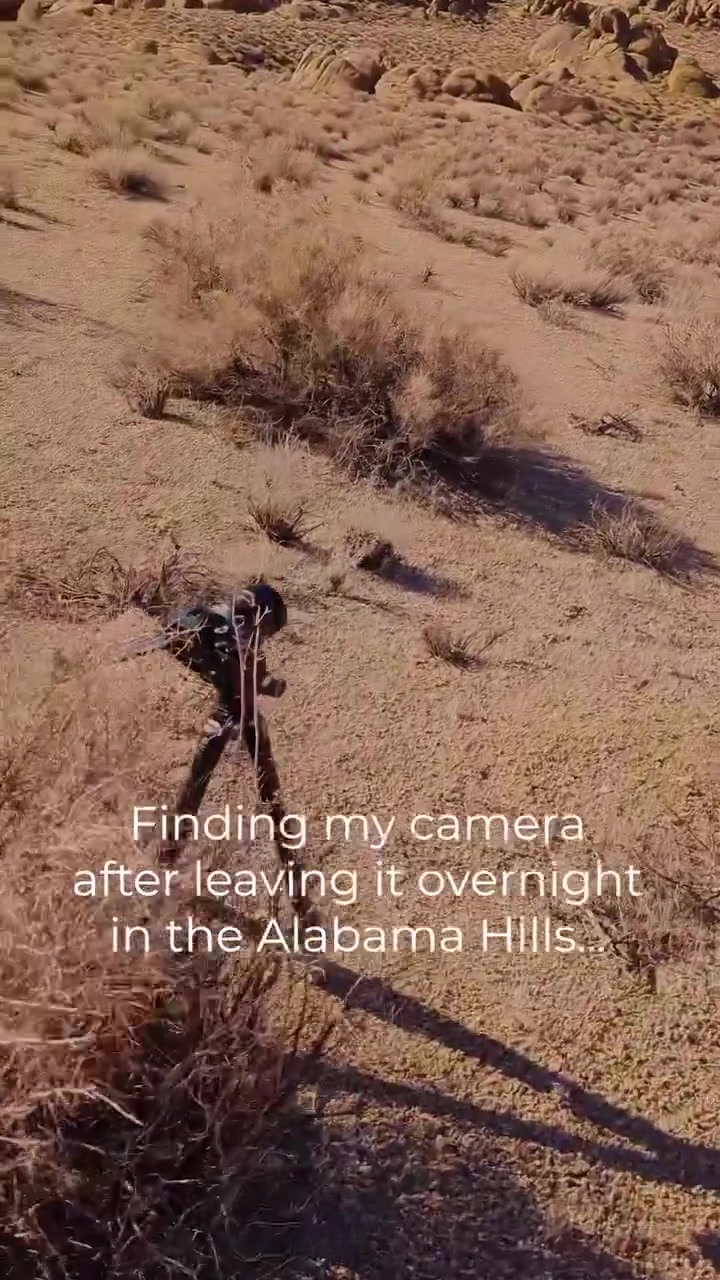
Alabama Hills: The Magic Hour in its Blue Hour The Alabama Hills are where staggering rock formations and sprawling desert meet the sky. In this timelapse, photographer Mike Abramyan captures the perfect marriage of that landscape and the ethereal light of the Blue Hour. This transition between the night and the day is more than a pass to see the changing hues of earth and sky.
Golden Hours in Grand Landscapes
Amateurs and pros alike prize photography's "golden hours" for its cinematic tones. But in landscape photography, the blue hour -- and the Alabama Hills -- take center stage. The place isn’t quite as famous as nearby Yosemite, but the Alabama Hills offer the biggest free trail system in the country. The area's rocks are made of granitic material that then eroded as the Sierra Nevada mountains rose. The structure of the Sierra Nevada Mountains, a key formation in the south eastern edge of California, acts as a scenic backdrop for the cloudslit sky. That Sierra Nevada backdrop isn't the only attraction here. In the heart of the Alabama Hills, rocks form a perfect backdrop for timelapse work.
Quality of Light
The greatest component of Alabama Hills are the tenebrous rocky structures. The boundaries and shapes formed by these rock formations provide an organic frame through which night can be viewed. The more subtle parts of the frame are critical to the High Sierra and infinite backdrop of the Mojave Desert. A rough contrast is found between the rocks on the ground and the sky behind. In this timelapse, the camera captures the blue hour where the sky is at a calm dull blue. This is contrasted with the sharp, dark edges of the rocks. The other key part is the star trails. This shot captures the trails for several hours, and the captured star trails in the timelapse come from several long-exposure photographs.
Techniques and Aesthetics
Timelapse Techniques
The transitions in the timelapse are deliberately smooth, with the sky changing from a deep blue to a bright, warm sunrise. Mike Abramyan captures a digital experience of the blue hour. The transition occurs over all of 13 frames, as the camera records over the course of 12.8 seconds. One important technique here is the smooth transition between the frames. This technique typically involves tapering in to a single, long exposure, and several shorter ones afterwards.
The Hidden Sierra
The Sierra Nevada Mountains are a dominant feature of the horizon. However, only the top portion is revealed here. The rest of the 400-mile mountain range is missing from the frame. This is a common feature of Alabama Hills photos - while the sky is the primary focus, the surrounding mountains are also captured.
The Colors of the Transition
When the Blue Hour begins, the transition from night to day brings out a subtle greyish white tone, and the sky turns a rich blue. This process begins slowly, with blue and grey forming, and then the sun peeks behind the mountains. When the Blue Hour ends, the color temperature of the frame changes. The grey and blue are replaced with a bright white. In the timelapse, this is condensed into a matter of frames. The result is a beaming sun with a bright white color temperature.
Blue Hour Praises
Mike Abramyan says of the blue hour, "Blue twilight is the period just before sunrise and just after sunset, when the sun is just below the horizon. During the blue hour, the sun creates a soft light that is a very beautiful blue." This soft light is what's seen in the timelapse, as the sun leaves a haze that settles on the hills.
Prepare for your Blue Hour
Planning a Blue Hour photoshoot in the Alabama Hills is straightforward. The latitude of the Alabama Hills makes it a great place to capture any star trails and blue hour shots. Here's how to do it.
- Best viewing: The blue hour and star trails are both best seen in the spring or autumn. Shortly after a new moon, when there is less moonlight and night sky reflections. The lack of moonlight makes for a stunning contrast between the rocks, mountains, and sky.
- Equipment: Use a camera with a tripod, a cable release, and a lens with a wide field of view. The tripod allows the camera to be stable during long exposures, the cable release reduces the risk of introducing unwanted vibrations, and the lens ensures that the scene is captured in wide-angle.
- Long Exposures: To get star trails, you'll need to do a bunch of long exposures, with intervals for the stars to move through the image. Each individual photo will need the shutter speed to be timed correctly for the stars to be sustained and trackable.
A Golden Spot for the Blue Hour
The Alabama Hills are a lonely place, where the deeps of the Mojave desert meet the sweep of the Sierra Nevada Mountains. This vastness sets the stage for the rupes that claim this place's name. But a camera can't stop there. The Blue Hour emerges from the sky and gives this place its character.
Watch the Reel
Related deep dives
Similar reads based on topic and creator.


Recent articles
Fresh deep dives from the latest Reels we unpacked.


Comments
Be the first to comment.