Critical Minerals in Data Centers
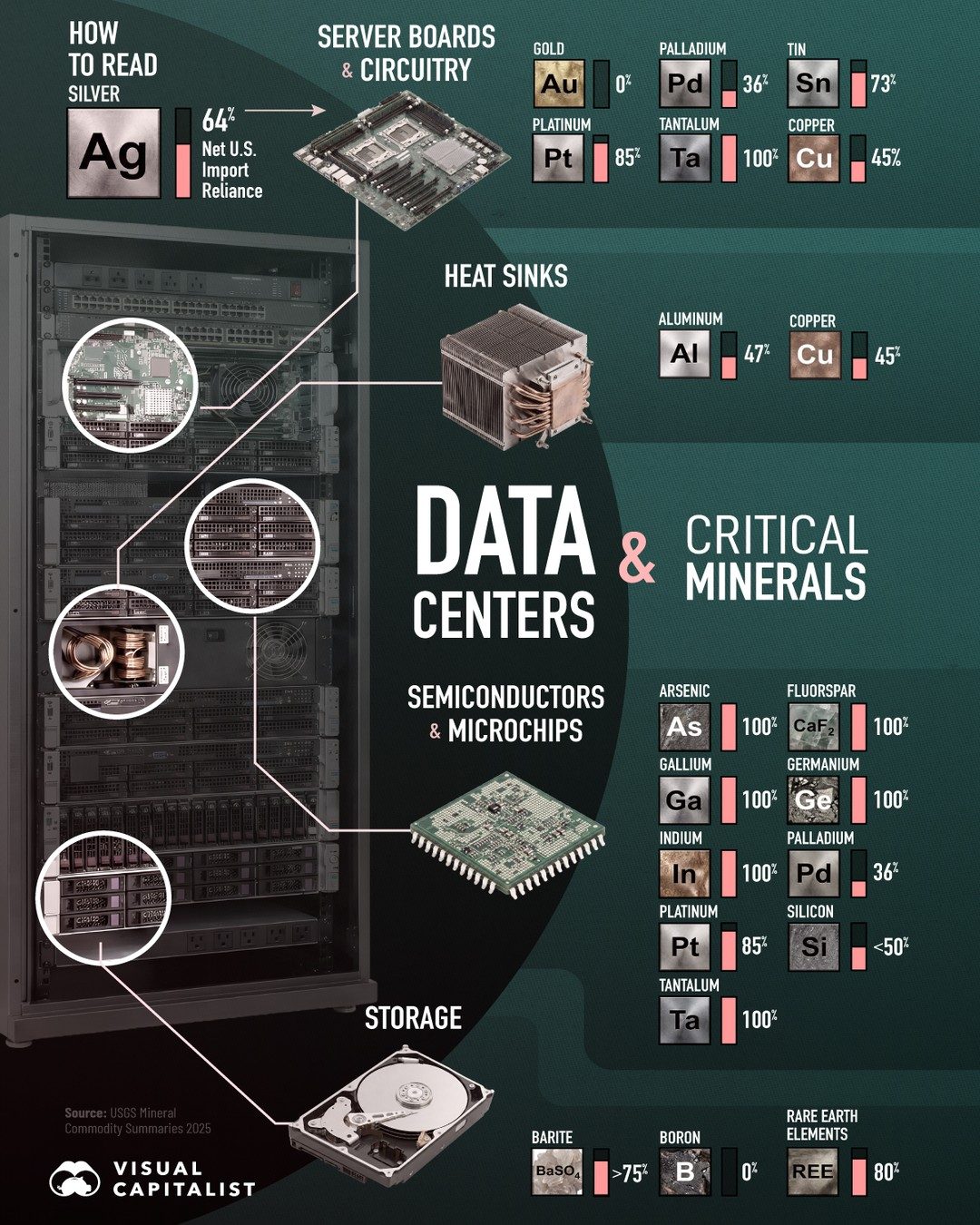
The AI boom relies heavily on a variety of critical minerals that power the infrastructure of data centers. These minerals are essential for everything from server boards and circuitry to cooling systems and storage components. However, many of these materials are imported, highlighting a significant dependency on foreign sources.
Context
Understanding the role of critical minerals in data centers is essential for grasping the complexity of the AI infrastructure. AI technologies require significant computational power, which is provided by data centers equipped with advanced server racks. These data centers, in turn, depend on a diverse range of minerals to function efficiently. The U.S. is particularly reliant on imports for several key materials used in AI semiconductors and data centers.
Main Discussion
The Role of Critical Minerals in Data Centers
Critical minerals play a pivotal role in the functioning of data centers. Key minerals such as gold, palladium, tin, and silver are essential for server boards and circuitry. For example, gold is used in circuitry due to its excellent conductivity and resistance to corrosion, while palladium and silver are crucial for various electronic components.
Import Reliance for Critical Minerals
The U.S. has a significant reliance on imported minerals for its data center infrastructure. According to data from the U.S. Geological Survey, the U.S. is 100% reliant on imports for certain minerals such as tantalum (Ta) and germanium (Ge). This dependency can pose risks to the supply chain, especially in times of global disruption.
Key Minerals and Their Applications
-
Server Boards and Circuitry
Server boards and circuitry require a variety of critical minerals. For instance, tin (Sn) and silver (Ag) are widely used in soldering processes. The U.S. import reliance for tin is around 73%, while for silver, it is 64%. Platinum (Pt) and palladium (Pd) are also crucial for their conductivity and resistance to corrosion.
-
Heat Sinks
Heat sinks are critical for cooling the server infrastructure. Materials like gallium (Ga), aluminum (Al), and copper (Cu) are commonly used in heat sinks. The U.S. import reliance for gallium is 47%, while for copper, it is 45%. These minerals help in efficiently dissipating heat, ensuring the smooth operation of data centers.
-
Semiconductors and Microchips
Semiconductors and microchips are the backbone of data centers. Minerals like arsenic (As), germanium (Ge), and indium (In) are essential for their production. The U.S. is 100% reliant on imports for germanium and indium, which are vital for the semiconducting properties of microchips.
-
Storage Components
Storage components in data centers require materials like barium sulfate (BaSO4) and boron (B). Barium sulfate is commonly used in ceramic insulation and other storage materials. The U.S. import reliance for barium sulfate is greater than 75%, indicating a significant dependency on foreign sources.
-
Other Essential Minerals
Rare earth elements (REE) play a crucial role in various technologies used in data centers. The U.S. import reliance for REE is around 80%, highlighting the importance of securing a stable supply of these minerals.
Practical Tips
For anyone involved in the data center industry or interested in the AI infrastructure, it is crucial to stay informed about the critical minerals used and their import dependencies. Here are some practical tips:
- Supply Chain Management: Understand the supply chain for critical minerals and monitor global trends that could affect their availability.
- Diversification: Explore opportunities to diversify the sources of critical minerals to reduce reliance on a single supplier.
- Innovation: Invest in research and development to find alternative materials or technologies that can reduce dependency on critical minerals.
Important Takeaways
- Data centers and AI infrastructure rely heavily on a variety of critical minerals.
- The U.S. is significantly dependent on imports for these minerals, particularly for tantalum, germanium, and indium.
- Key minerals like gold, palladium, tin, and silver are essential for server boards and circuitry.
- Heat sinks, semiconductors, and storage components also require critical minerals for their functioning.
- It is crucial to stay informed about the supply chain and explore opportunities for diversification and innovation.
Conclusion
The importance of critical minerals in data centers cannot be overstated. As the AI boom continues to grow, so does the demand for these essential materials. Understanding the role of these minerals and the U.S. dependency on imports is vital for ensuring the stability and efficiency of data center operations. By staying informed and proactive, the industry can navigate the challenges posed by the supply chain and continue to drive technological advancements.
Watch the Reel
Questions readers ask
Which critical minerals are most commonly used in AI data centers?
AI data centers utilize a range of critical minerals. Some of the most common include copper for circuitry, lithium for batteries, and rare earth elements like neodymium and dysprosium for magnets in cooling systems. Additionally, minerals like tungsten and gold are used in semiconductor components and heat sinks.
Why is the U.S. particularly reliant on imports for these minerals?
The U.S. has a limited domestic supply of many critical minerals essential for AI data centers. This scarcity drives the need for imports to meet the high demand for these materials in AI infrastructure. The global supply chain for these minerals is complex, and many countries have restricted exports, making the U.S. dependent on foreign sources.
What are the primary uses of critical minerals in data center infrastructure?
Critical minerals serve various purposes in data centers. They are used in server boards for circuitry, in cooling systems to manage heat, and in storage components to enhance data retention. Additionally, these minerals are crucial for semiconductor production, which is vital for the advanced processing capabilities required by AI technologies.
How does the dependency on imported minerals affect AI technology development?
The reliance on imported minerals can create supply chain vulnerabilities for AI technology development. Fluctuations in global mineral markets, geopolitical tensions, and export restrictions can disrupt the availability of these materials, potentially slowing down the advancement and deployment of AI technologies.
What minerals are essential for the cooling systems in AI data centers?
The cooling systems in AI data centers often rely on rare earth elements like neodymium and dysprosium for their powerful magnetic properties, which are used in cooling fans and other components. Additionally, copper is commonly used in heat sinks and other cooling mechanisms due to its excellent thermal conductivity.
What steps can be taken to reduce the dependency on imported minerals for AI data centers?
To reduce dependency on imports, efforts can be made to explore and develop domestic mineral resources. Investing in recycling technologies to reclaim minerals from old electronic devices and promoting innovation in material science for alternative solutions can also help. Collaboration with international partners to ensure stable supply chains is another strategic approach.
What role do critical minerals play in the storage components of AI data centers?
Critical minerals are essential for the storage components in AI data centers, as they enhance data retention and efficiency. For example, materials like cobalt and lithium are used in batteries that power backup systems, while other minerals like tungsten and gold are used in the semiconductors that enable reliable data storage and retrieval.
Related deep dives
Similar reads based on topic and creator.


Recent articles
Fresh deep dives from the latest Reels we unpacked.




Comments
Be the first to comment.