Air Pollution in Cities
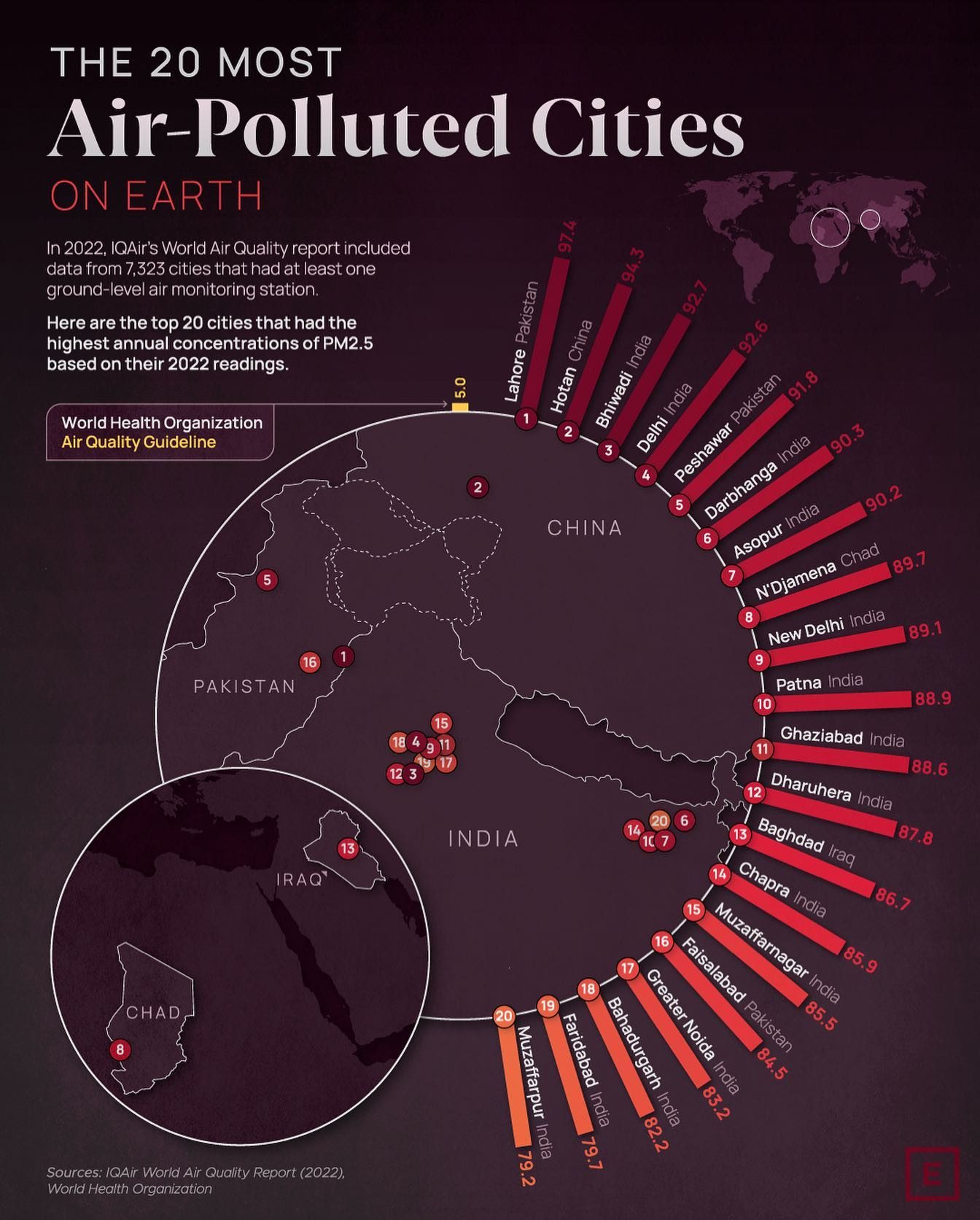
Air pollution is a critical global issue, with nearly the entire global population breathing air that exceeds safe quality limits. To understand the severity of this problem, let's delve into the data from the 2022 IQAir’s World Air Quality Report, which provides a stark visualization of the most air-polluted major cities in the world.
Why This Matters
Air pollution, particularly fine particulate matter known as PM2.5, poses significant health risks. Exposure to high levels of PM2.5 can lead to respiratory and cardiovascular diseases, as well as increased mortality rates. Understanding which cities are most affected can help inform policy decisions and public awareness campaigns aimed at mitigating this public health crisis.
Main Discussion
The 20 Most Air-Polluted Cities
According to the 2022 data, the most air-polluted cities are predominantly located in China, Pakistan, India, Iraq, and Chad. These regions have some of the highest annual concentrations of PM2.5, making them hotspots for air pollution concerns. The data highlights the urgent need for localized interventions to improve air quality in these areas.
PM2.5 Concentrations
PM2.5 refers to particulate matter that is 2.5 micrometers or smaller in diameter. These tiny particles can penetrate deep into the lungs and even enter the bloodstream, causing a range of health issues. The World Health Organization (WHO) has set air quality guidelines to help limit exposure to harmful levels of PM2.5. The 2022 data from IQAir shows that many cities far exceed these guidelines, underscoring the severity of the problem.
Regional Focus
China
China has some of the most polluted cities in the world. Industrial activity, vehicle emissions, and coal burning are significant contributors to the high PM2.5 levels. Cities like Beijing and Shanghai have made efforts to reduce pollution, but the data indicates that more comprehensive measures are needed to achieve significant improvements.
Pakistan
Pakistan also faces severe air pollution issues, with cities like Lahore and Karachi frequently ranking among the most polluted. The country's rapid urbanization and industrialization, along with inadequate waste management practices, contribute to the high PM2.5 concentrations. Public health initiatives and stricter environmental regulations are essential to address this problem.
India
India's air pollution crisis is well-documented, with cities like Delhi and Mumbai consistently ranking among the most polluted. The country's reliance on fossil fuels, vehicle emissions, and crop burning are major factors. Efforts to promote clean energy and improve urban planning are crucial to mitigating the health risks associated with air pollution.
Iraq
Iraq's air pollution is exacerbated by conflict and industrial activity. Cities like Baghdad and Mosul experience high levels of PM2.5, which can be attributed to dust storms, vehicle emissions, and industrial processes. Comprehensive air quality management strategies are necessary to protect public health.
Chad
Chad is the least urbanized of these countries, but it still faces significant air pollution challenges. Dust storms and biomass burning contribute to high PM2.5 levels. Improving air quality monitoring and implementing sustainable practices can help mitigate these issues.
Practical Tips
For Individuals
- Monitor Air Quality: Use reliable sources like IQAir’s World Air Quality Report to stay informed about air quality levels in your area.
- Use Air Purifiers: Consider investing in an air purifier, especially if you live in a highly polluted area.
- Limit Outdoor Activities: On days with high PM2.5 levels, minimize outdoor activities and avoid peak traffic hours.
- Wear Masks: Use masks designed to filter out PM2.5 particles when traveling in polluted areas.
For Communities
- Advocate for Policy Changes: Support local and national policies aimed at reducing air pollution, such as stricter emission standards and expanded public transit.
- Promote Clean Energy: Advocate for the adoption of clean energy sources and the phase-out of fossil fuels.
- Improve Urban Planning: Support initiatives that promote green spaces, better waste management, and sustainable urban development.
- Raise Awareness: Organize community events and campaigns to educate the public about the dangers of air pollution and the steps they can take to reduce it.
For Governments
- Enforce Emission Standards: Implement and enforce strict emission standards for industries and vehicles.
- Invest in Renewable Energy: Allocate resources to develop and promote renewable energy sources.
- Improve Public Transportation: Develop efficient and affordable public transportation systems to reduce vehicle emissions.
- Monitor and Report Air Quality: Establish comprehensive air quality monitoring systems and regularly report findings to the public.
Important Takeaways
- Nearly 99% of the global population breathes air that exceeds safe quality limits, as indicated by the World Health Organization.
- The most air-polluted cities are predominantly in China, Pakistan, India, Iraq, and Chad.
- High concentrations of PM2.5 pose severe health risks, including respiratory and cardiovascular diseases.
- Comprehensive measures, including stricter emission standards, increased use of renewable energy, and improved urban planning, are necessary to mitigate air pollution.
- Public awareness and advocacy are crucial in driving policy changes and individual actions to improve air quality.
Conclusion
Addressing air pollution in cities requires a multi-faceted approach involving individuals, communities, and governments. By understanding the data and taking proactive steps, we can work towards cleaner air and healthier lives. The 2022 IQAir’s World Air Quality Report serves as a critical tool in raising awareness and informing policy decisions to combat this global health crisis.
Watch the Reel
Questions readers ask
Which cities topped the list of most polluted cities in 2022?
The most polluted cities in 2022 were primarily located in countries such as China, Pakistan, India, Iraq, and Chad. These regions faced significant challenges with air quality, particularly concerning PM2.5 levels. Among these, cities such as Lahore in Pakistan, Hotan in China, and Delhi in India were notably high on the list.
What is the significance of PM2.5 in air pollution data?
PM2.5 refers to fine particulate matter that is 2.5 micrometers or smaller in diameter. These particles are particularly dangerous because they can penetrate deep into the lungs and even enter the bloodstream, leading to respiratory and cardiovascular diseases. Understanding PM2.5 levels is crucial for assessing the health risks associated with air pollution.
How does the IQAir World Air Quality Report help in understanding global air pollution?
The IQAir World Air Quality Report provides comprehensive data on air quality in major cities around the world. It uses an air quality index to rank cities based on their PM2.5 levels, offering a clear visualization of the most polluted areas. This report helps in identifying trends, tracking progress, and informing policy decisions to improve air quality.
What are the primary health risks associated with air pollution in these cities?
Exposure to high levels of air pollution, particularly PM2.5, can lead to a range of health issues, including respiratory diseases like asthma and bronchitis, as well as cardiovascular diseases such as heart disease and stroke. Long-term exposure can also increase mortality rates, making it a critical public health concern.
How can individuals and communities use this data to improve air quality?
By understanding the air quality data and the health risks associated with it, individuals and communities can take informed actions. This includes advocating for stronger environmental policies, reducing personal contributions to pollution, and participating in public awareness campaigns. Local governments can use this data to implement stricter emission standards and promote cleaner energy sources.
What steps can policymakers take to address air pollution in these cities?
Policymakers can utilize the data from reports like the IQAir World Air Quality Report to develop targeted interventions. This might include enforcing stricter emission standards, promoting renewable energy, improving public transportation, and encouraging industrial facilities to adopt cleaner technologies. Collaborating with international organizations can also bring additional resources and expertise to fight air pollution.
Are there any visual resources available to understand global air pollution trends?
Yes, there are several visual resources available, including the world air pollution map and air pollution infographics. These resources provide a visual representation of air quality data, making it easier to understand the distribution and severity of air pollution across different regions. They are invaluable for both public awareness and policy decision-making.
Related deep dives
Similar reads based on topic and creator.



Recent articles
Fresh deep dives from the latest Reels we unpacked.




Comments
Be the first to comment.