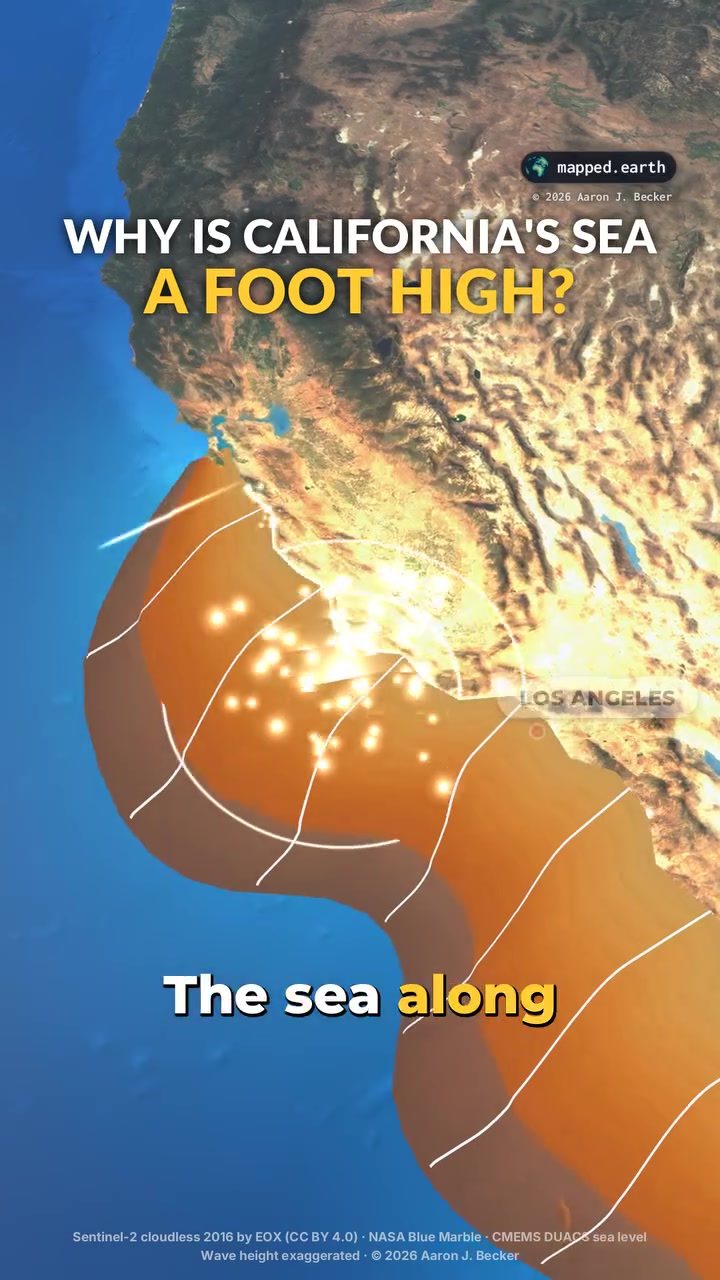
The Western Pacific Ocean Has Piled Up Afoot Of Water
The Pacific Ocean's western side has been experiencing a significant build-up of warm water, roughly a foot above normal levels this fall. This is explained by scientists as a Kelvin wave, a slow-moving bulge of water. It is a phenomenon that dominates California's Sea level, which is a part of a larger system of oceanic developments that contributes to changes in sea levels. The wave phenomenon—known as a Kelvin wave—is caused by the trade wind system steering the Pacific Ocean's movement. Trade winds, which blow towards the equator, push warm surface water towards Indonesia. This water piles up, reaching nearly 20.5 inches higher than the sea level off the coast of South America. During a strong El Niño this year, those trade winds weakened, causing the piled-up water to start moving east along the equator. Around 3 inch tall but over a thousand miles long, the bulge has traveled across the Pacific at a speed of 7 miles per hour.
Why California’s Sea Level is Rising
California's sea levels have been especially impacted by the Kelvin wave. When the wave hits South America, it splits, moving north past Mexico and up the coast toward California. This has caused sea levels to rise a foot in the region. Kelvin waves can significantly affect coastal areas. As the wave travels, higher sea levels allow tides and storm surge waves to reach farther up the beach, leading to increased flooding and erosion. These Kelvin waves are not isolated incidents. Six of these waves have been identified this year, and forecasters expect more to occur through February. According to on-screen OCR data, sea level has increased by 3 inches, which has significant implications. The wave's impact is part of a broader pattern, and understanding these phenomena is crucial for predicting and mitigating their effects on coastal communities. Kelley's formulation uses adaptable formalism, suggesting that sea level variations are fundamentally a product of these bulging waves. Researchers and forecasters need to monitor these waves and their impacts carefully. As the climate changes, El Niño events and other climate patterns may shift, causing more frequent and intense Kelvin waves. The rise in sea level is a powerful example of how global phenomena can have localized impact.
Watch the Reel
Related deep dives
Similar reads based on topic and creator.



Recent articles
Fresh deep dives from the latest Reels we unpacked.



Comments
Be the first to comment.