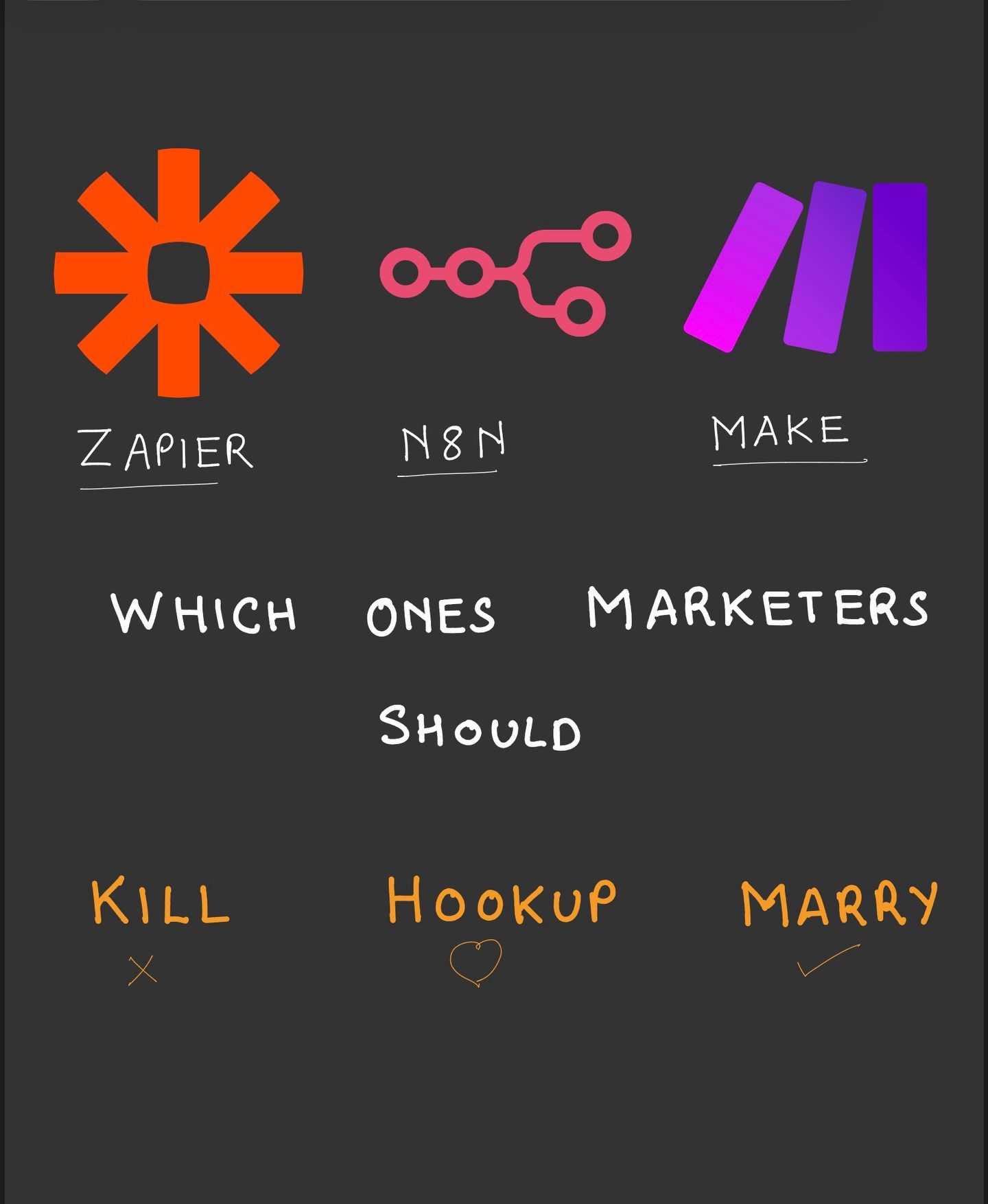
Marketing Automation: Zapier, Make, and n8n
Choosing the right marketing automation tool can be a daunting task, especially when comparing popular options like Zapier, Make, and n8n. While it is easy to get bogged down by feature lists, the key to making the right choice lies in understanding how well each tool fits your specific needs. This article dives into the unique strengths and weaknesses of Zapier, Make, and n8n, using a straightforward 'Kill, Hook, Marry' framework to help you decide which tool is best for various use cases.
Why This Matters
Marketing automation tools are essential for streamlining workflows, improving efficiency, and driving growth. However, not all tools are created equal, and what works for one business might not be suitable for another. Understanding the nuances of each tool can save you time, money, and frustration in the long run.
Zapier vs. Make vs. n8n: A Framework for Decision-Making
The 'Kill, Hook, Marry' framework is a simple yet effective way to evaluate marketing automation tools. 'Kill' refers to tools that are not suitable for a particular task, 'Hook' indicates tools that can work but may not be the best fit, and 'Marry' signifies tools that are ideal for the job.
Use Case 1: Form to Email List
For simple tasks like syncing data from a form to an email list, the best tool depends on the complexity of your workflow.
Kill: n8n
n8n is overkill for this task. It is designed for more complex workflows and building AI-driven processes, which is unnecessary for basic data syncing.
Hook: Make
Make can handle this task, but it might be paying for features you don't need. It is more powerful than necessary for simple data syncing.
Marry: Zapier
Zapier is built for this use case. It is straightforward and can set up the automation in just a few minutes.
Use Case 2: Lead Scoring
Lead scoring involves evaluating leads based on predefined criteria. This requires tools that can handle multi-condition routing effectively.
Kill: Zapier
Zapier struggles with complex conditional logic, making it less suitable for intricate lead scoring processes.
Hook: n8n
n8n has the power to handle lead scoring but feels clunky for routing tasks. It might require more effort to set up complex workflows.
Marry: Make
Make is designed for multi-condition routing. It excels at handling complex lead scoring criteria, making it the best choice for this task.
Use Case 3: AI Content Generation
Generating AI-driven content requires tools that support native AI integrations and can handle streaming data.
Kill: Zapier
Zapier lacks native AI integrations and has limited options for AI-driven content generation.
Hook: Make
Make offers AI blocks but they can be awkward to chain together, making the process less seamless.
Marry: n8n
n8n has native Claude/GPT nodes and is built for streaming data, making it the best choice for AI content generation.
Use Case 4: Real-Time Alerts
Real-time alerts require instant data processing and execution, making the tool's speed and reliability crucial.
Kill: Zapier
Zapier checks data every 15 minutes, which is too slow for real-time alerts. It is not designed to handle immediate responses.
Hook: n8n
n8n supports webhooks, but they are not optimized for real-time alerts. The tool has the capability but might require additional tweaking.
Marry: Make
Make offers instant webhook execution, making it the ideal choice for real-time alerts.
Use Case 5: Scaling to 500+ Automations
When scaling to a large number of automations, cost and performance become critical factors.
Kill: Zapier
Zapier can be cost-prohibitive for scaling to 500+ automations, with plans ranging from ₹15K to ₹25K per month. This can significantly impact your margins.
Hook: Make
Make is more affordable, with plans starting at ₹3K to ₹5K per month, but it can still be a significant expense for scaling.
Marry: n8n
n8n is the most cost-effective option for scaling, with a self-hosted version that costs between ₹500 and ₹1K. It offers unlimited automations, making it the best choice for scaling operations.
Practical Tips
When choosing the right marketing automation tool, consider the following tips:
- Define Your Workflow: Clearly outline the processes you need to automate. This will help you identify which tools are most suitable for your needs.
- Evaluate Costs: Consider the long-term costs of each tool, including setup, maintenance, and scalability.
- Test and Iterate: Don’t be afraid to test multiple tools. Sometimes, the best way to understand a tool's fit is to try it out in a real-world scenario.
- Seek Community Insights: Look for reviews and community feedback. Real-world experiences can provide valuable insights into a tool's strengths and weaknesses.
Important Takeaways
- Fit Over Features: The best tool is the one that fits your specific workflow, not the one with the most features.
- Cost and Efficiency: Consider both the cost and the efficiency of the tool in handling your tasks.
- Scalability: Think about how the tool will scale with your business. Some tools are better suited for smaller operations, while others can handle large-scale automation.
Conclusion
Choosing between Zapier, Make, and n8n comes down to understanding your specific needs and workflows. Zapier is ideal for simple tasks and real-time alerts, Make excels in complex routing and lead scoring, and n8n is the go-to for AI-driven content generation and scaling. By defining your decision logic and workflows, you can make an informed choice that aligns with your business goals.
Watch the Reel
Questions readers ask
What are the key differences between Zapier, Make, and n8n?
Zapier is known for its user-friendly interface and extensive app integrations, making it ideal for straightforward workflows. Make, formerly known as Integromat, offers a more robust and flexible platform for complex automation, with a strong emphasis on multi-step workflows. n8n, on the other hand, is an open-source tool that provides a high degree of customization and is particularly suited for users with technical skills who need to build complex workflows from scratch.
Which tool is best for beginners in marketing automation?
Zapier is generally considered the best choice for beginners due to its intuitive interface and pre-built templates. It offers a gentle learning curve, making it easier for new users to set up and manage their automation without needing advanced technical skills.
Can n8n be used for complex workflow automation?
Yes, n8n is highly capable of handling complex workflow automation. Its open-source nature allows for extensive customization, and it supports advanced features like error handling and conditional logic, making it a powerful tool for users who need to build intricate automation processes.
How does Make compare to Zapier in terms of workflow complexity?
Make is designed to handle more complex workflows than Zapier. It offers a wider range of advanced features, such as intricate branching logic, error handling, and advanced filtering options, making it a better choice for users who need to automate multi-step processes that require precise control and customization.
Which tool offers the most integrations with third-party apps?
Zapier boasts the largest number of integrations among the three tools, with over 3,000 apps available in its ecosystem. This makes it a versatile choice for users who need to connect various services and automate tasks across different platforms. Make and n8n also offer a significant number of integrations, but Zapier's extensive library sets it apart.
Is n8n a good choice for users who prefer open-source software?
Yes, n8n is an excellent choice for users who prefer open-source software. Being open-source, it allows for complete customization and transparency, enabling users to tailor the tool to their specific needs. Additionally, it provides a free, self-hosted version, making it a cost-effective solution for those who want to avoid subscription fees.
Which tool is best for lead scoring automation?
Both Zapier and Make can be used for lead scoring automation, but Make's advanced workflow capabilities make it a stronger candidate for this task. With its ability to handle complex logic and multi-step processes, Make can effectively manage and automate lead scoring based on various criteria and actions, providing a more comprehensive solution.
Related deep dives
Similar reads based on topic and creator.

Recent articles
Fresh deep dives from the latest Reels we unpacked.




Comments
Be the first to comment.