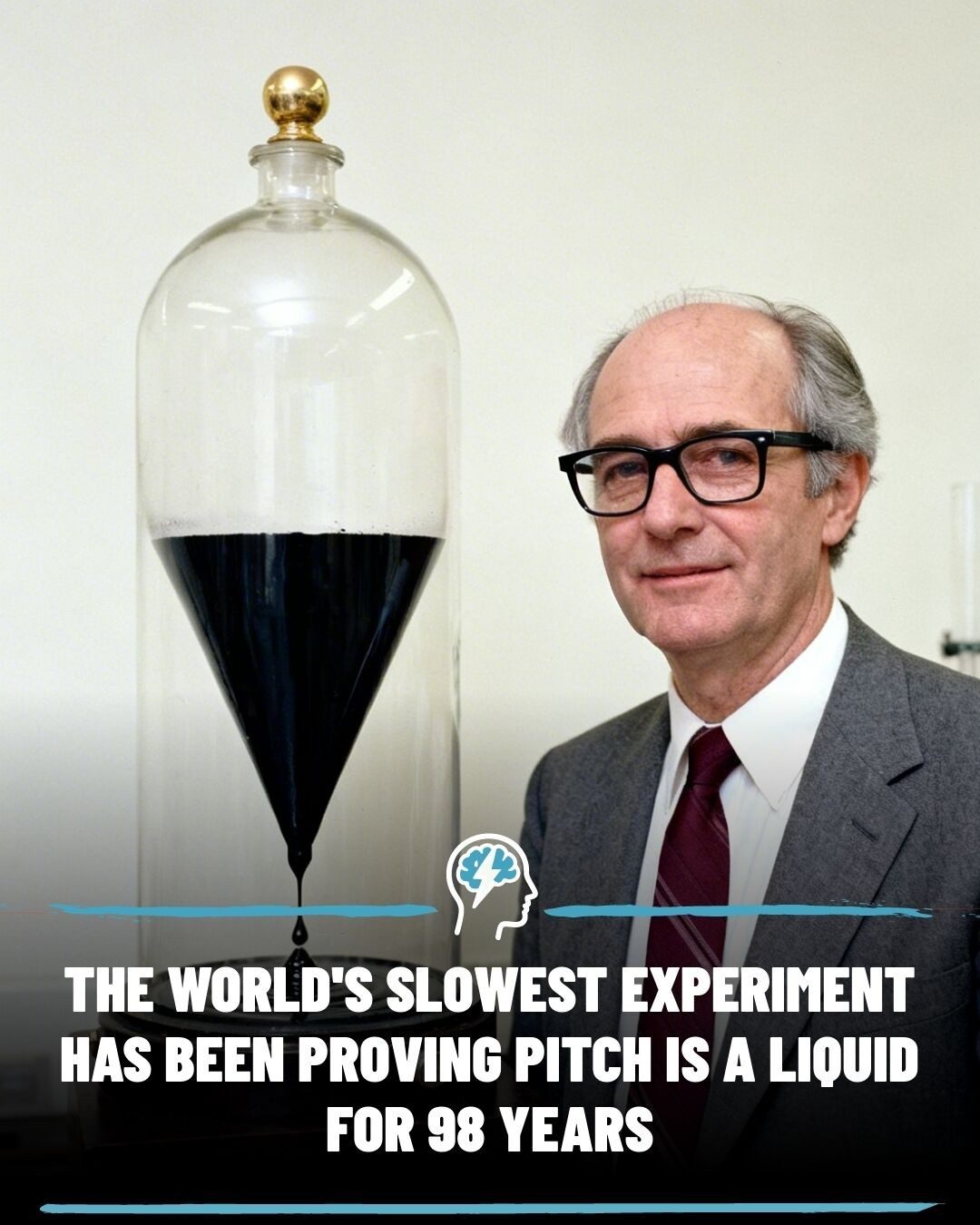
The Pitch Drop Experiment: The World's Slowest Experiment
The pitch drop experiment, initiated in 1927 by physicist Thomas Parnell at the University of Queensland, is one of the longest-running laboratory demonstrations in scientific history. This experiment aims to prove that pitch, a tar-like substance, is actually a liquid despite its solid appearance at room temperature.
Why This Matters
The pitch drop experiment has captured global attention due to its unprecedented longevity and the surprising behavior of pitch. This experiment challenges our everyday understanding of liquids and solids, demonstrating that what seems permanent can be in a state of slow transition when observed over an extended period.
The Pitch Drop Experiment: A Closer Look
The Origin and Setup
Thomas Parnell, a physicist at the University of Queensland, designed the pitch drop experiment to illustrate a counterintuitive property of pitch. Pitch, a black, tar-like substance, appears solid and can be shattered with a hammer. However, Parnell wanted to demonstrate that pitch, despite its solid appearance, exhibits the properties of a liquid over a very long time.
To conduct the experiment, Parnell heated a sample of pitch and poured it into a sealed funnel. He then allowed the pitch to settle for three years before cutting the stem of the funnel in 1930. This setup was designed to observe the flow of pitch over an extended period.
The Flow of Pitch
Pitch has an incredibly high viscosity—approximately 230 billion times more viscous than water. This high viscosity means that pitch flows extremely slowly, making it almost imperceptible to the human eye. The first drop from the funnel fell in 1938, eight years after the stem was cut. Since then, only nine drops have fallen, with each drop taking roughly a decade to form and release.
The Challenges of Observation
Despite decades of observation, no human being has ever witnessed a drop of pitch actually detach from the funnel in real time. Every recorded drop has either been missed due to timing, equipment failure, or the absence of an observer at the crucial moment. Video monitoring was only introduced in 2013, giving scientists their first real chance to capture the event.
Practical Tips for Understanding the Pitch Drop Experiment
Patience in Science
The pitch drop experiment teaches us that some of the most important scientific observations require immense patience. This experiment has been ongoing for nearly a century, and scientists continue to wait for the next drop. Observing phenomena on a timescale that far exceeds human perception is a testament to the dedication and persistence of scientists.
Expanding Our Timescale of Observation
This experiment encourages us to think beyond human timescales. What may seem permanent and unchanging to us might simply be moving at a pace too slow for us to perceive. By expanding our timeframe of observation, we can gain new insights into the behavior of materials and natural processes.
Important Takeaways
- Pitch is a Liquid: Despite its solid appearance, pitch is actually a liquid with an extremely high viscosity.
- Patience and Observation: The pitch drop experiment highlights the importance of patience and long-term observation in scientific research.
- Unexpected Behavior: Everyday materials can exhibit unexpected behaviors when observed over an extended period, challenging our everyday perceptions.
Conclusion
The pitch drop experiment is a fascinating demonstration of the properties of pitch and the value of long-term observation in scientific research. It reminds us that sometimes the most important scientific demonstrations are the ones that force us to think beyond human timescales. This experiment continues today in Brisbane, quietly waiting for the tenth drop to fall, a poignant reminder of the patience and dedication required in the pursuit of scientific understanding.
Watch the Reel
Questions readers ask
What is the pitch drop experiment?
The pitch drop experiment is a long-running demonstration started in 1927 by physicist Thomas Parnell at the University of Queensland. It involves observing the slow flow of pitch, a tar-like substance, to prove its liquidity despite its solid-like appearance at room temperature.
Why is the pitch drop experiment considered the world's slowest experiment?
The pitch drop experiment is considered the world's slowest because it has been running continuously since 1927, with only a handful of drops falling in nearly a century. This extraordinary slowness makes it the Guinness World Record holder for the longest-running laboratory experiment.
Who started the pitch drop experiment and where is it located?
The pitch drop experiment was started by Thomas Parnell, a physicist, at the University of Queensland in Brisbane, Australia. It has been continuously ongoing at this location since 1927.
How does the pitch drop experiment challenge our understanding of liquids and solids?
The experiment challenges our everyday understanding by showing that pitch, which appears solid, is actually a very viscous liquid. This demonstrates that substances can exist in states that defy our typical expectations of liquids and solids.
How many drops of pitch have fallen in the 98 years of the pitch drop experiment?
Since the experiment began in 1927, only a handful of drops have fallen. The exact number is around nine drops. The slow rate of the experiment has made it a fascinating subject for observation and study.
Can I view the pitch drop experiment in person and watch a drop fall?
Viewing the experiment in person can be challenging due to the rarity of the drops, but you can visit the University of Queensland in Brisbane to see the experiment setup. For those unable to visit, a live webcam is available to observe the experiment remotely, though the wait for the next drop could be years.
What is the significance of the pitch drop experiment in the history of scientific experiments?
The pitch drop experiment holds a unique place in scientific history as the world's longest-running laboratory experiment. It has captivated global attention and sparked interest in the behavior of substances over extended periods, contributing to our understanding of material sciences.
Related deep dives
Similar reads based on topic and creator.




Recent articles
Fresh deep dives from the latest Reels we unpacked.




Comments
Be the first to comment.