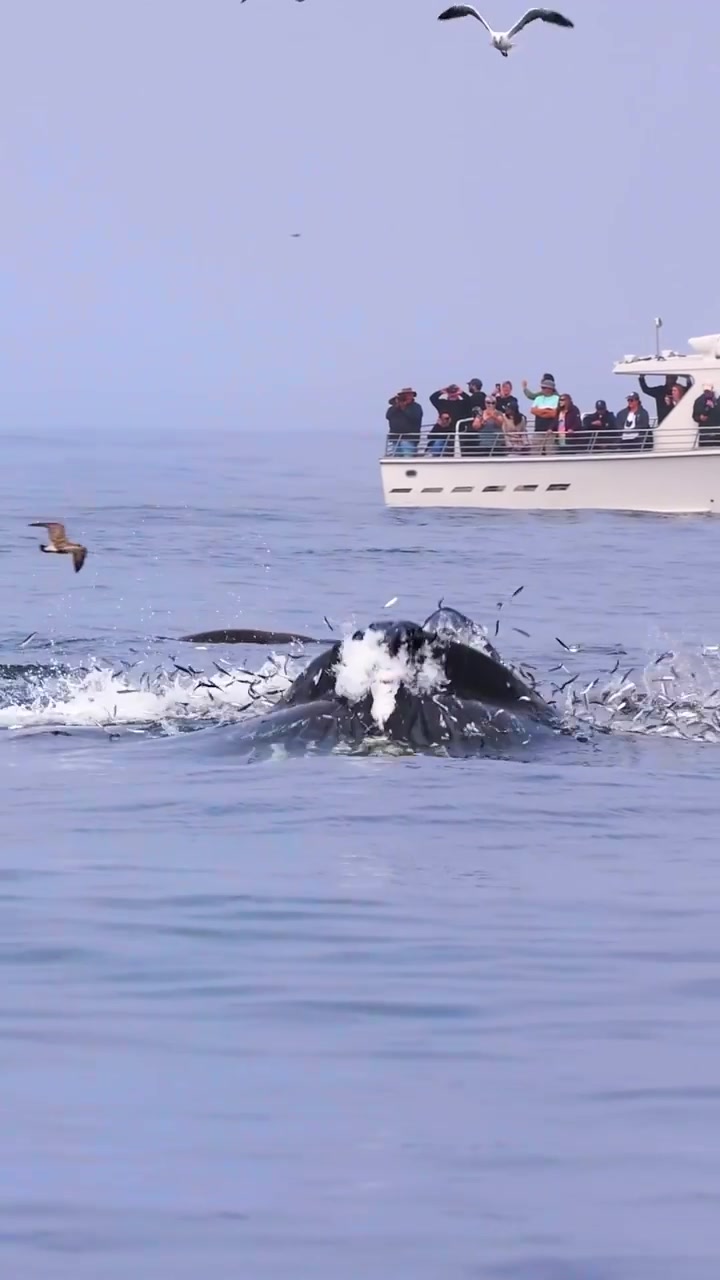
From a boat in the vast ocean, a single whale breached the water's surface and a splash echoed. In the video, the sheer scale of these marine mammals is on full display, as they leap out of the water with a display of raw power.
The Whale Breach
There are several types of whale movements in the water, that whalers and marine biologists have observed and catalogued over the years. Breaching is one of the most distinctive. Breaching is when a whale jumps out of the water and lands with a large splash. Breaching is distinctive in part because it’s very different from other movements and because it’s done by many types of whales, but especially by humpback whales. Breaching is not inevitable. Not all whale species breach, and if they do, it might not happen often. Breaching often involves lifting the entire body out of the water. Sailfishes display similar behaviour, but their jumps are more like leaps and are rarely so vertical.
The Role of Breaching in Marine Culture
Whales are a cultural icon and breaching is a signature whale behavior. Whales are also important to people, both culturally and economically. Whales have inspired countless stories, and have been portrayed in artistic media. Economically, whales are crucial for whale-watching tourism; tourists often flock to places where whales are known to swim. In whale migrations, humpback whales migrate a distance of about 1,200 miles. Humans are long committed to studying and preserving whales, whether in captivity or as the an environment that is home to whales. The video serves as a reminder of whale-watching as an experience.
An Epidemic of Breaching
Breaching is not well understood, but it has been documented in many ways. The ocean surfaces can have different sound qualities – whether from the cosmos, or from the ocean itself. There is ample scientific debate about whether whales breach for social communication, for predator avoidance, or simply for enjoyment. The most direct explanation is that whales breach to remove barnacles or other parasites from their skin. It is known that whales do not have to breathe while they are underwater. Whales may breach to get a better view, communicate, or remove parasites. The ocean surface is warmer and more populated than underwater, so whales may also breach to warm themselves or to attract mates. Researchers have observed that breaching can be a form of communication and social interaction. However, whales can also breach as a form of play. Repeated breaching, as seen in some whale groups, leaves the possibility that each breach can be a social communication event.
The Science Behind Breaching
When whales breach, they push their bodies against the resistance of the water, exerting a force that propels them out of the water. The energy that whales use in a breach is enough for them to jump around half of their body length out of the water, which, considering that the body of a whale is as heavy as 40 tons, is quite a feat.
Breaching from a Boat
Viewing a whale breach from the deck of a boat is a transformative experience. One does not need to imagine the power behind the force with which a whale breaches. One reason whale watching is so popular is that one can learn about the lives and behaviour of whales while getting a glimpse of their powerful movements. It's never guaranteed that you’ll get to see a whale breach, as the behavior is entirely up to the whale. THere are also other whale behaviors that are remarkable from the deck of a boat, such as tail slapping and spyhopping. Whales have very large tails, and these tails help them to propel through the water, so tail slapping is often used for communication.
The Phases of Whale Breaching
In the act of a whale breach, there are several phases.
- Ascent: The plunge is the whale breaking the surface of the water and propelling its body out of the water.
- Apex: After the whale's body emerges from the water, it reaches the apex, which is the highest point of the breach. The whale pushes off from the water, and at the apex, the whale is fully out of the water.
- Descent: The descent takes place when the whale falls back into the water.
Practical Considerations for Whale Watching
Whale watching is popular for many reasons. Whales are powerful, majestic, and enigmatic. Breaching is a signature whale behavior which is especially thrilling. Most whale-watching tours are organized around a good platform from which to watch. Getting to see a whale breach is a joyful memory that lasts a lifetime.
- Location Choosing: Whales are known to migrate, so the best locations for whale watching are places with whale migrations.
- Hiring a Guide: One is best advised to hire a guide or an expert if one wants to go whale watching. The best location for whale watching is off the coast of Maui, however, licenses to operate whale-watching tours are not issued in California and Massachusetts.
- Time: It is important to watch at the right time - in many places, whale watching is best in the spring and during the summer.
The Echo of Power
When whales breach, it is a demonstration of strength and grace. They push their massive bodies out of the water, often reaching much higher than their own body length. It is a remarkable sight that leaves one with a sense of awe.
Watch the Reel
Questions readers ask
What types of whales are most likely to breach?
Humpback whales are particularly known for breaching, but other whale species also exhibit this behavior. Breaching is a distinctive movement where whales jump out of the water and land with a large splash, making it a memorable sight for whale watchers.
Why do whales breach?
The reasons behind whale breaching are not fully understood, but there are several theories. Some believe whales breach to remove parasites, communicate with other whales, or even just for fun. It could also be a way to warm up or attract mates, as the ocean surface is warmer and more populated than underwater.
How high can a whale breach?
Whales can breach to around half of their body length out of the water. Given that some whales can weigh up to 40 tons, this is a remarkable display of power and energy.
Is breaching a common behavior among all whale species?
No, not all whale species breach, and even among those that do, it might not happen frequently. Breaching is more commonly observed in certain species like humpback whales, and it's a behavior that sets them apart from other marine animals like sailfish, which have a more horizontal leaping motion.
Can breaching be dangerous for whales?
Breaching itself is not typically dangerous for whales, as it is a natural behavior. However, repeated breaching could potentially lead to injury or exhaustion, especially if the whales are removing parasites or communicating with each other over long periods.
Why is whale breaching so captivating to watch?
Whale breaching is captivating because it’s a powerful and distinctive display of raw strength and agility. Seeing a whale leap out of the water and land with a splash is a breathtaking experience, especially from the deck of a boat, where the sheer scale and force of the movement are on full display.
How does breaching help whales communicate?
Breaching can be a form of communication and social interaction for whales. Researchers have observed that repeated breaching, as seen in some whale groups, could be a way for whales to signal to each other, especially when they are migrating or moving in groups.
Related deep dives
Similar reads based on topic and creator.




Recent articles
Fresh deep dives from the latest Reels we unpacked.




Comments
Be the first to comment.