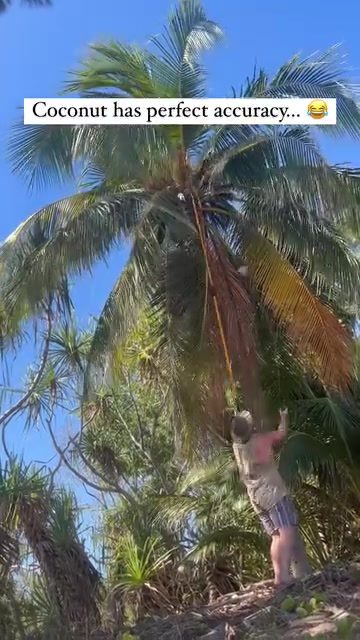
Falling Coconuts and Unexpected Physics
Coconuts falling from palm trees can be a common sight in tropical regions, but what happens when a person tries to catch one? The outcome is often humorous and unpredictable, as demonstrated in a recent video that went viral. Understanding the dynamics of falling coconuts and the physics involved can provide some insight into why catching one is far from easy.
Why this matters
Falling coconuts pose a significant risk to people and property in tropical areas. The coconut is a large, heavy fruit that can cause serious injuries if it hits someone. According to various studies, coconuts can reach terminal velocities of up to 50 miles per hour when falling from significant heights, making them extremely dangerous. Additionally, the unpredictable trajectory of a falling coconut adds to the challenge of catching one.
The dynamics of falling coconuts
The physics behind the fall
When a coconut falls from a palm tree, it experiences a constant acceleration due to gravity. The force of gravity pulls the coconut downward, causing it to accelerate at a rate of approximately 9.8 meters per second squared. As the coconut falls, it also experiences air resistance, which acts in the opposite direction of its motion and increases with speed. The coconut will eventually reach a terminal velocity where the force of air resistance equals the force of gravity, causing it to fall at a constant speed.
Unpredictable trajectories
The trajectory of a falling coconut is influenced by several factors, including the height from which it falls, the angle of the tree branch, and any external forces such as wind. These variables can cause the coconut to follow an unpredictable path, making it difficult to anticipate where it will land. This unpredictability is one of the main reasons why attempting to catch a falling coconut can be so challenging and dangerous.
The impact of the fall
When a coconut hits the ground, it can cause significant damage. The force of the impact is determined by the coconut's mass, the height from which it falls, and the angle at which it strikes the ground. The impact force can be calculated using the formula:
Impact Force = Mass * Acceleration
Where the acceleration is the change in velocity over time. For a coconut falling from a significant height, the impact force can be considerable, capable of causing injuries or property damage.
The challenge of catching a falling coconut
Timing and precision
Attempting to catch a falling coconut requires precise timing and coordination. The person must accurately predict the coconut's trajectory and be in the right position to catch it. Given the unpredictable nature of the coconut's fall, this is a nearly impossible task. The slightest miscalculation can result in the person missing the coconut or, as often seen, being knocked over by the force of the impact.
The role of physics
The physics of falling objects plays a crucial role in the difficulty of catching a coconut. The coconut's acceleration due to gravity, air resistance, and terminal velocity all contribute to its unpredictable trajectory. Additionally, the person attempting to catch the coconut must also account for their own physics, including their reaction time, coordination, and balance. The combination of these factors makes catching a falling coconut an extremely challenging task.
The role of balance
Maintaining balance while attempting to catch a falling coconut is essential. The person must lean out to reach the coconut, which can cause them to lose their center of gravity and fall. This is especially true when the coconut's trajectory is unpredictable, as the person may overcompensate and fall off balance. The video in question shows a person leaning out to catch a falling coconut, only to lose their balance and fall to the ground, illustrating the difficulty of this task.
Practical tips
Safety first
When dealing with falling coconuts, safety should always be the top priority. Always wear appropriate protective gear, such as a helmet and gloves, and avoid standing directly underneath a coconut tree. If a coconut is falling, try to move to a safe distance and let it fall to the ground.
Observing the environment
Pay attention to the surrounding environment, including the height of the coconut, the angle of the tree branch, and any external forces such as wind, before attempting to catch a coconut. This information can help you better predict the coconut's trajectory and avoid any unexpected outcomes.
Coordination and timing
If you must attempt to catch a falling coconut, ensure you have good coordination and timing. Practice your reaction time and coordination by catching other falling objects, such as balls or frisbees. This can help you improve your skills and better prepare you for catching a falling coconut.
Important takeaways
Falling coconuts pose a significant risk to people and property in tropical regions. The unpredictable trajectory of a falling coconut, combined with the physics of falling objects, makes catching one an extremely challenging task. Attempting to catch a falling coconut requires precise timing, coordination, and balance, and should only be attempted with proper safety measures in place.
Conclusion
While the video of a person attempting to catch a falling coconut and subsequently falling may be humorous, it also serves as a reminder of the unpredictable and dangerous nature of falling coconuts. Understanding the physics behind falling coconuts and the challenges of catching one can help us appreciate the risks involved and take the necessary precautions to stay safe.
Watch the Reel
Questions readers ask
Why are falling coconuts dangerous?
Falling coconuts can reach high velocities, up to 50 miles per hour, from significant heights. This makes them a substantial risk to people and property, as they can cause serious injuries upon impact.
What makes catching a falling coconut challenging?
Catching a falling coconut is challenging due to the unpredictable physics involved. Factors like gravity, air resistance, and the coconut's irregular shape make it difficult to anticipate its trajectory and speed.
What can be learned from the viral video featuring a falling coconut?
The viral video highlights the unpredictability of a coconut's fall, illustrating the complex interplay of physics that makes catching one so difficult. It also raises awareness about the potential dangers of falling coconuts in tropical regions.
How can one stay safe in areas with coconut trees?
To stay safe, avoid standing or walking directly beneath coconut trees, especially during windy conditions. Be aware of your surroundings and listen for falling coconuts. Additionally, consider wearing protective gear when in areas with a high risk of falling coconuts.
What is the role of gravity and air resistance in a falling coconut?
Gravity accelerates the coconut towards the ground, while air resistance works to slow its descent. The interaction of these forces, along with the coconut's shape and size, contributes to its unpredictable fall, making it difficult to catch.
Why are coconuts more dangerous than other falling fruits?
Coconuts are denser and heavier than many other fruits, allowing them to reach higher velocities during a fall. Their hard shell also makes them more likely to cause injury upon impact, unlike softer fruits that may simply bruise or split.
What should I do if I encounter a falling coconut?
If you encounter a falling coconut, the best course of action is to move away from the tree as quickly and safely as possible. Do not attempt to catch the coconut, as this can result in serious injury.
Related deep dives
Similar reads based on topic and creator.




Recent articles
Fresh deep dives from the latest Reels we unpacked.


Comments
Be the first to comment.