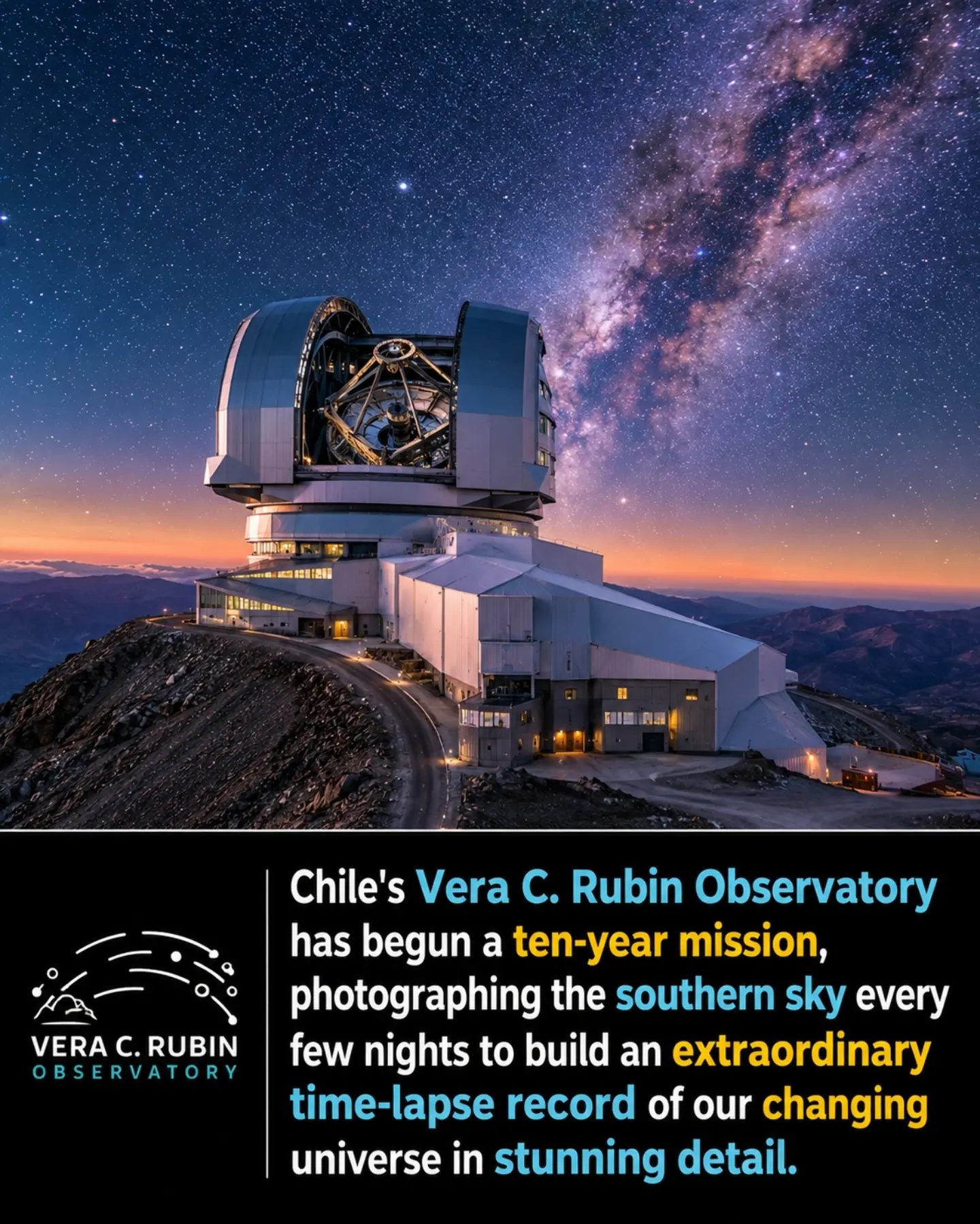
The Vera C. Rubin Observatory: Ten Years of Charting the Changing Universe
The Vera C. Rubin Observatory, nestled high in the Chilean Andes, has embarked on an ambitious ten-year mission. The observatory will photograph the southern sky every few nights, capturing a time-lapse record of our ever-changing universe. This extensive project aims to provide unprecedented insights into the cosmos, offering astronomers a detailed view of celestial objects and phenomena over time.
Why This Matters
The Vera C. Rubin Observatory's mission holds significant importance for astronomers and astrophysicists. The observatory's time-lapse record will enable scientists to study various astronomical events, including supernovae, asteroids, and distant galaxies, with unparalleled precision. This data will help researchers better understand the nature of dark matter and dark energy, two of the most mysterious components of our universe.
The Vera C. Rubin Observatory
The Vera C. Rubin Observatory is named after Vera C. Rubin, a pioneering astronomer known for her groundbreaking work on galaxy rotation rates. Her observations provided some of the first evidence for the existence of dark matter. The observatory continues her legacy by pushing the boundaries of astronomical research.
Location and Instrumentation
Located in the Cerro Pachón ridge of the Andes Mountains in northern Chile, the observatory benefits from clear skies and minimal light pollution. This ideal setting allows for optimal viewing conditions. The observatory is equipped with a state-of-the-art telescope and a high-resolution camera system that can capture vast segments of the sky in incredible detail.
The Legacy Survey of Space and Time (LSST)
One of the key components of the observatory's mission is the Legacy Survey of Space and Time (LSST). This survey aims to create a comprehensive map of the universe by photographing the southern sky every few nights. The LSST will generate an enormous dataset, allowing astronomers to track the movements and changes of celestial objects over a decade.
The Time-Lapse Record
The time-lapse record created by the Vera C. Rubin Observatory will be a treasure trove of information for astronomers. By observing the same regions of the sky repeatedly, scientists can detect changes and movements that would otherwise go unnoticed. This continuous monitoring is crucial for understanding various celestial phenomena.
Detecting Transient Events
One of the primary goals of the time-lapse record is to detect transient events, such as supernovae and asteroids. These events are relatively rare and often short-lived, making them difficult to study. The observatory's frequent observations increase the likelihood of capturing these events, providing valuable data for further research.
Mapping Dark Matter
The time-lapse record will also help map the distribution of dark matter in the universe. By observing the gravitational effects of dark matter on visible celestial objects, astronomers can infer its presence and distribution. This information is crucial for understanding the structure and evolution of the universe.
Studying Galaxy Evolution
The observatory's long-term observations will enable astronomers to study the evolution of galaxies over time. By tracking changes in galaxy structure, brightness, and composition, scientists can gain insights into how galaxies form, evolve, and interact with their surroundings.
Practical Tips for Aspiring Astrophotographers
While the Vera C. Rubin Observatory's mission is on a scale that most amateur astronomers can't achieve, there are still ways to get involved in astrophotography and contribute to scientific research. Here are some practical tips for aspiring astrophotographers:
Choose the Right Equipment
Investing in a good-quality telescope and camera is essential for astrophotography. A sturdy mount and tracking system are also crucial for capturing clear, detailed images of celestial objects.
Find the Right Location
Light pollution can significantly affect the quality of astrophotographs. Finding a dark sky location, such as a national park or a remote area, can greatly enhance the clarity and detail of your images.
Learn Image Processing Techniques
Post-processing your astrophotos can significantly enhance their quality. Using specialized software, such as Adobe Photoshop or GIMP, can help you bring out the details and colors in your images.
Join an Astronomy Club
Joining an astronomy club can provide access to expert advice, equipment, and observing opportunities. You can also share your experiences and learn from other enthusiasts.
Important Takeaways
The Vera C. Rubin Observatory's ten-year mission to create a time-lapse record of the changing universe is a monumental endeavor. This ambitious project will provide astronomers with unprecedented data, enabling them to study various celestial phenomena with unparalleled precision. The observatory's work will contribute to our understanding of dark matter, galaxy evolution, and the structure of the universe.
The observatory's location in the Chilean Andes, equipped with state-of-the-art technology, ensures optimal viewing conditions. The Legacy Survey of Space and Time (LSST) will generate an extensive dataset, allowing scientists to detect transient events, map dark matter, and study galaxy evolution.
Conclusion
The Vera C. Rubin Observatory's mission is a testament to human ingenuity and our insatiable curiosity about the cosmos. By continuously monitoring the southern sky, the observatory will provide invaluable data that will shape our understanding of the universe for years to come. The time-lapse record created by the observatory will be a legacy for future generations, inspiring new discoveries and advancements in astrophysics.
Watch the Reel
Questions readers ask
What is the primary goal of the Vera C. Rubin Observatory's decade-long mission?
The primary goal is to capture a detailed cosmic time-lapse of the southern sky by photographing it every few nights. This will allow astronomers to study the dynamic behaviors of various celestial objects and phenomena, such as supernovae, asteroids, and distant galaxies.
Why was the Vera C. Rubin Observatory built in the Chilean Andes?
The Chilean Andes were chosen for their clear skies and minimal light pollution, providing ideal conditions for astronomical observations. The high altitude also offers a thinner atmosphere, reducing atmospheric interference.
How will the observatory's data help in studying dark matter and dark energy?
By tracking the movements and behaviors of celestial objects, the observatory's data will help astronomers infer the presence and effects of dark matter and dark energy. This includes studying the gravitational lensing effects of dark matter and the acceleration of the universe's expansion due to dark energy.
What kind of astronomical events can be studied with the observatory's time-lapse data?
The time-lapse data will enable the study of various astronomical events, including the explosions of stars (supernovae), the orbits of asteroids and other small bodies, and the interactions between galaxies and other celestial objects.
How often will the Vera C. Rubin Observatory photograph the southern sky?
The observatory is designed to photograph the southern sky every few nights. This frequent imaging will allow for the creation of a high-resolution time-lapse record, revealing the changes and movements of celestial objects over time.
What advantages does the Vera C. Rubin Observatory offer for astronomical research?
The observatory offers a detailed, time-resolved view of the southern sky, allowing for the study of transient and variable phenomena, enhanced detection of rare and fleeting events and a deeper understanding of the universe's dynamics.
What are the expected outcomes of the observatory's mission for cosmic astronomy?
The mission aims to provide a comprehensive record of the southern sky's changes over a decade. This will likely lead to new discoveries in cosmic astronomy, including insights into the nature of dark matter and dark energy, the dynamics of galaxies, and the behavior of transient celestial events.
Related deep dives
Similar reads based on topic and creator.



Recent articles
Fresh deep dives from the latest Reels we unpacked.


Comments
Be the first to comment.