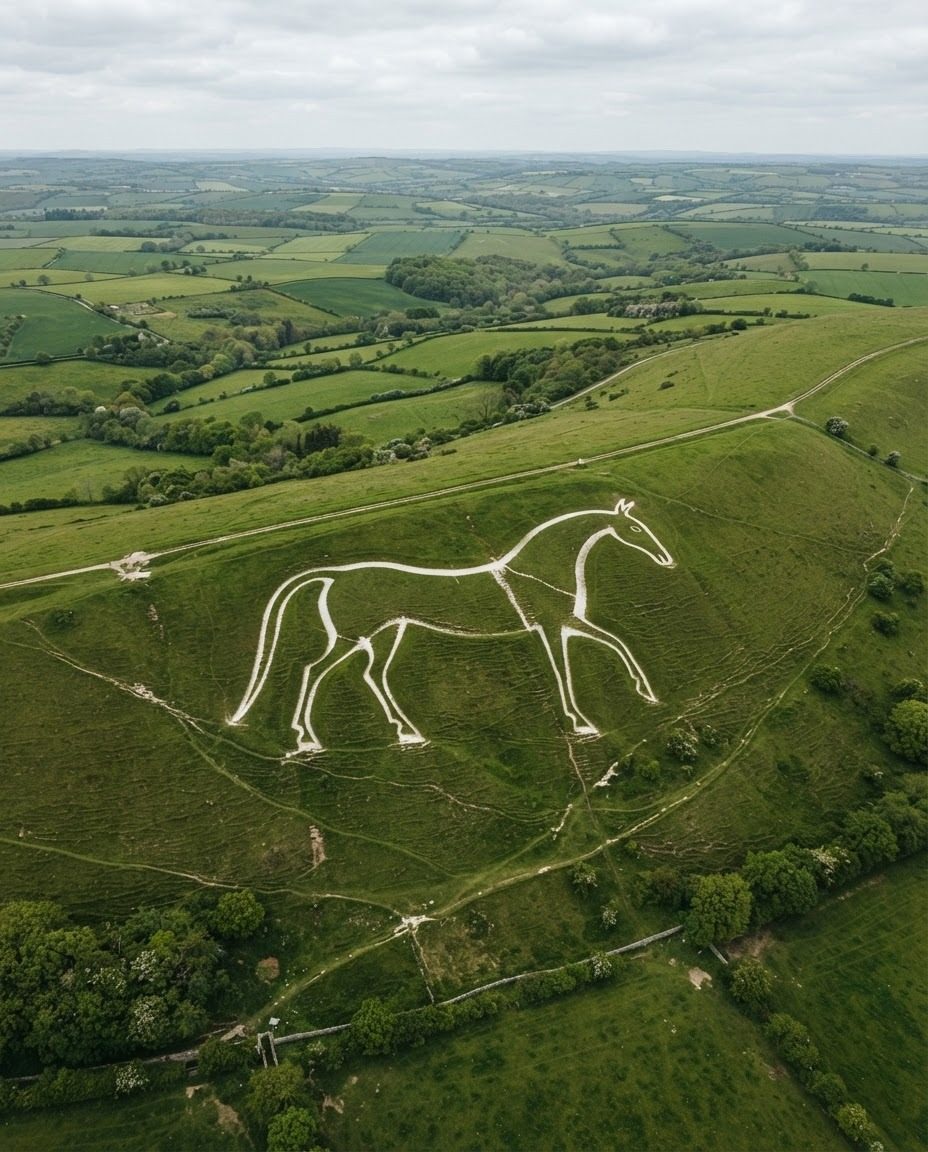
The Ubiquity of the Uffington White Horse
The aerial photograph of the Uffington White Horse is an eye-catching display of beauty and history. Located in Oxfordshire, England, the prehistoric chalk figure is carved into a hillside. The white-colored monument created from trampled chalk, with its regal pose and immense size, is visible from miles around. It is unique due to its striking appearance and apparent longevity. The Uffington White Horse is a significant example of prehistoric occupation and techniques. The exact date of its creation is ambiguous. Though some researchers propose it could date as far back as 1000 BCE. It could also be a much more local representation of the horse images popularized during the Anglo-Saxon era. The horse is depicted with its mouth open, rather than with bridle onto the hill. This is unlike other chalk figures, making it instantly recognizable and distinctive.
A Monument to Ancient British Art
The figure is a remarkable example of ancient British art. The stylistic analysis of the monument suggests it is a work of Celtic craftsmanship, as opposed to Anglo-Saxon or Roman. The artist's intentions remain unclear, but the horse is consistent with other Celtic styles found in artifacts and carvings from the time. It is thought to have held a signifying presence within the broader landscape. The presence of the horse is likely in tandem with the nearness of other Anglo-Saxon and Roman artifacts. The figure has been preserved for centuries, the scale only adding to the majesty of the creation. However, it was also recut in 1857, when antiquarians reshaped it, demonstrating the importance of the monument throughout several eras.
The Horse's Enduring Mystery
The specific meaning of the Uffington White Horse remains elusive, despite its notable presence in English folklore. Theories about its origins and purpose are varied; it could have served as a territorial marker, a religious symbol, or a monument to a local deity. Researchers note the commonality of horse figures in ancient cultures, often symbolizing power, strength, and mobility. However, the exact impetus behind this particular carving is still uncertain. Some appreciate the horse as an artifact of ancient land-based communities. Many had settled on or near the Ridgeway, Britain. A Neolithic path that runs through Oxfordshire and Wiltshire. The Uffington White Horse is part of a rich tapestry of ancient landmarks in Britain. It is a testament to the craftsmanship and artistic vision of prehistoric societies. The figure stands as a marker of British heritage and a symbol of enduring cultural significance.
Watch the Reel
Related deep dives
Similar reads based on topic and creator.




Recent articles
Fresh deep dives from the latest Reels we unpacked.




Comments
Be the first to comment.