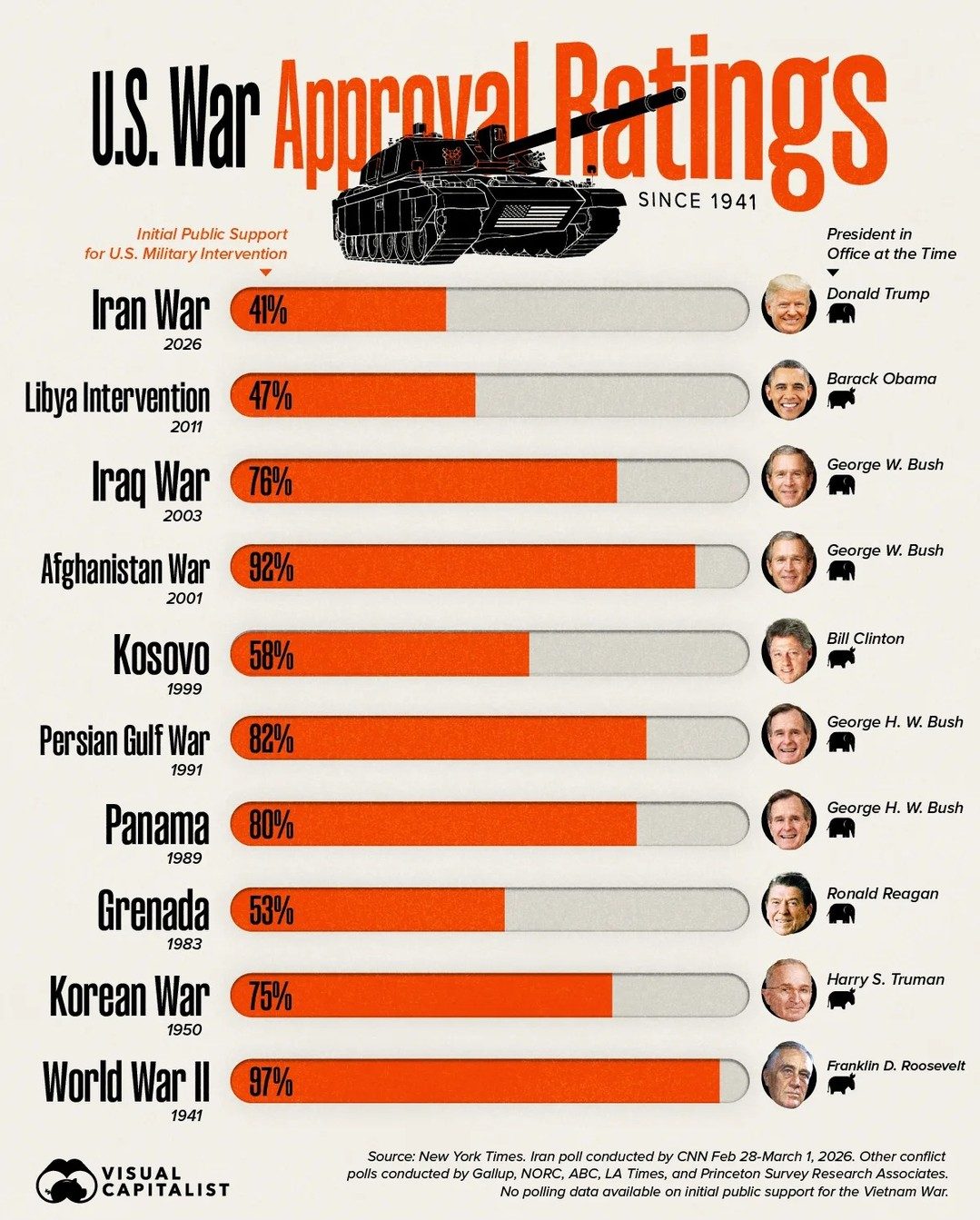
Public Approval of U.S. Military Interventions
Context / Why this matters
Public opinion plays a pivotal role in shaping the course of military engagements, influencing political decisions and societal attitudes. By examining the historical trends of U.S. public approval ratings for military interventions, we can gain deeper insights into the evolving sentiments and responses to conflicts since 1941.
Main discussion
Historical Overview
Since World War II, public support for U.S. military interventions has seen significant fluctuations. World War II marked the peak of public approval, with a staggering 97% of Americans supporting the war effort. This high level of support can be attributed to the global threat posed by the Axis powers and the unified national effort to combat it.
In contrast, more recent conflicts, such as the Iran war in 2026, show a stark decline in public support, with only 41% of Americans approving the intervention. This shift reflects a broader trend of diminishing public enthusiasm for military engagements, particularly in the post-9/11 era.
The Impact of Presidential Leadership
The president in office during a conflict significantly influences public opinion. For instance, during the Korean War, President Harry S. Truman enjoyed 75% support, while President George W. Bush saw 82% approval for the Afghanistan War.
George H. W. Bush’s leadership during the Persian Gulf War in 1991 also garnered high approval, with 82% of the public backing the intervention. Conversely, President Donald Trump's approval ratings for the Iran conflict in 2026 were notably low at 41%, reflecting a significant decline in public trust and support.
Trends and Anomalies
One notable trend is the steady decline in public support for military interventions since the early 2000s. While major crises can still drive short-term spikes in approval, such as the 76% support for the Iraq War in 2003, these spikes tend to fade more quickly than in previous decades.
The Kosovo conflict in 1999, for example, saw 58% public approval, which is relatively low compared to the high approval ratings for World War II and the Korean War. This suggests that public perception of necessary military interventions has become more nuanced and less uniform.
The Grenada intervention in 1983 also illustrates this shift, with 53% approval, which is modest compared to earlier conflicts. The Panama intervention in 1989 saw 80% approval, reflecting a specific geopolitical context that warranted higher public support.
Key Conflicts and Their Approval Ratings
World War II (1941)
World War II stands out as the conflict with the highest initial public approval, at 97%. The immediate and global threat posed by the Axis powers, combined with a unified national effort, fostered unprecedented public support.
Korean War (1950)
The Korean War, under President Harry S. Truman, had 75% public approval. This conflict, framed as a defensive measure against communist expansion, garnered substantial support despite the casualties.
Vietnam War
Ironically, the available data shows that there is no polling data available on initial public support for the Vietnam War, which is a significant gap in historical records.
Persian Gulf War (1991)
The Persian Gulf War, under President George H. W. Bush, had 82% public approval. This conflict, portrayed as a clear-cut mission to liberate Kuwait, enjoyed broad public support.
Kosovo (1999)
The Kosovo intervention, under President Bill Clinton, had 58% public approval. This conflict, which involved airstrikes and humanitarian intervention, was met with more measured support, reflecting evolving attitudes towards military engagements.
Afghanistan War (2001)
The Afghanistan War, under President George W. Bush, had 82% public approval. This conflict, seen as a response to the 9/11 attacks, initially enjoyed high support, although it later waned as the war dragged on.
Iraq War (2003)
The Iraq War, also under President George W. Bush, had 76% initial public approval. This conflict, framed as part of the War on Terror, initially had strong support, but it gradually eroded as the war became mired in controversy.
Libya Intervention (2011)
The Libya intervention, under President Barack Obama, had 47% public approval. This conflict, involving NATO airstrikes, saw more nuanced public support, reflecting the complexities of modern military engagements.
Iran War (2026)
The Iran War, under President Donald Trump, had 41% public approval. This conflict reflects the broader trend of declining public support for military interventions and the increasing skepticism towards prolonged conflicts.
Presidential Influence
The role of the president in shaping public opinion cannot be overstated. The leadership style, communication strategies, and overall political climate during a conflict significantly influence public approval ratings. For example, President George W. Bush's handling of the Afghanistan and Iraq Wars saw varying levels of support, highlighting the impact of leadership decisions on public sentiment.
Practical tips
For Policymakers
Understanding public opinion is critical for policymakers when deciding on military interventions. Regular polling and engagement with the public can help gauge sentiment and adjust strategies accordingly. Transparent communication and clear objectives can enhance public support and ensure sustained backing for military operations.
For the Public
Staying informed about ongoing conflicts and the rationale behind military interventions is essential. Engaging in informed discussions and seeking multiple perspectives can help form a balanced view. Public support for military engagements should be based on a comprehensive understanding of the geopolitical context and the potential outcomes.
Important takeaways
Declining Support
Public support for military interventions has been on a steady decline since the early 2000s. While major crises can still drive short-term spikes in approval, these spikes fade more quickly than in the past. This trend reflects a more nuanced and critical public attitude towards military engagements.
Presidential Influence
The president in office during a conflict significantly influences public opinion. Effective leadership, transparent communication, and clear objectives can enhance public support for military interventions. Conversely, lack of clarity and prolonged conflicts can erode public trust and support.
Historical Context
Examining historical trends provides valuable insights into public attitudes towards military interventions. The high approval ratings for World War II and the Korean War contrast sharply with the more modest support for recent conflicts, highlighting the evolving nature of public opinion.
Conclusion
Public approval ratings for U.S. military interventions reflect a complex interplay of historical context, geopolitical factors, and presidential leadership. As public sentiment continues to evolve, understanding these dynamics becomes increasingly important for policymakers and the public alike. By analyzing past trends and current attitudes, we can gain a deeper understanding of how public opinion shapes military engagements and vice versa.
Watch the Reel
Questions readers ask
What was the initial public support for wars like World War II in the U.S.?
The initial public support for World War II in the U.S. was extraordinarily high, with 97% of Americans supporting the war effort. This strong approval was driven by the significant global threat posed by the Axis powers and a unified national response.
How has public approval for U.S. military interventions varied since 1941?
Since 1941, public approval for U.S. military interventions has experienced notable fluctuations. There have been peaks, such as during World War II, and drops, particularly in more recent conflicts like the wars in Iraq and Afghanistan under George Bush.
What role does public opinion play in U.S. military engagements?
Public opinion significantly influences the course of U.S. military engagements. Political decisions and societal attitudes are shaped by public sentiment, impacting the strategies and outcomes of conflicts. For example, declining public support can lead to changes in military policies and withdrawal plans.
What was the public approval rate for the Iran war?
Public approval for the Iran war was notably lower than many previous conflicts. The approval ratings reflected societal attitudes and perceptions of threats, with public opinion playing a key role in shaping the government's approach to the conflict.
How does presidential leadership affect public support for wars?
Presidential leadership can significantly impact public support for wars. Effective communication and leadership can bolster public approval, while perceived missteps or lack of clear direction can lead to declining support. For instance, the approval ratings for the George Bush wars varied based on how the public perceived the handling of these conflicts.
What are some key factors that influence public opinion on military interventions?
Several factors influence public opinion on military interventions, including the perceived threat level, media coverage, and political leadership. Additionally, societal attitudes and historical context contribute to how the public views specific conflicts. For example, the initial high approval for World War II was driven by the clear and immediate global threat.
Where can I find historical data on U.S. public opinion on military conflicts?
Historical data on U.S. public opinion on military conflicts can be found through various sources such as public opinion polls, government archives, and academic research. Organizations like Gallup and Pew Research Center provide comprehensive polling data on war approval ratings over the years.
Related deep dives
Similar reads based on topic and creator.


Recent articles
Fresh deep dives from the latest Reels we unpacked.




Comments
Be the first to comment.