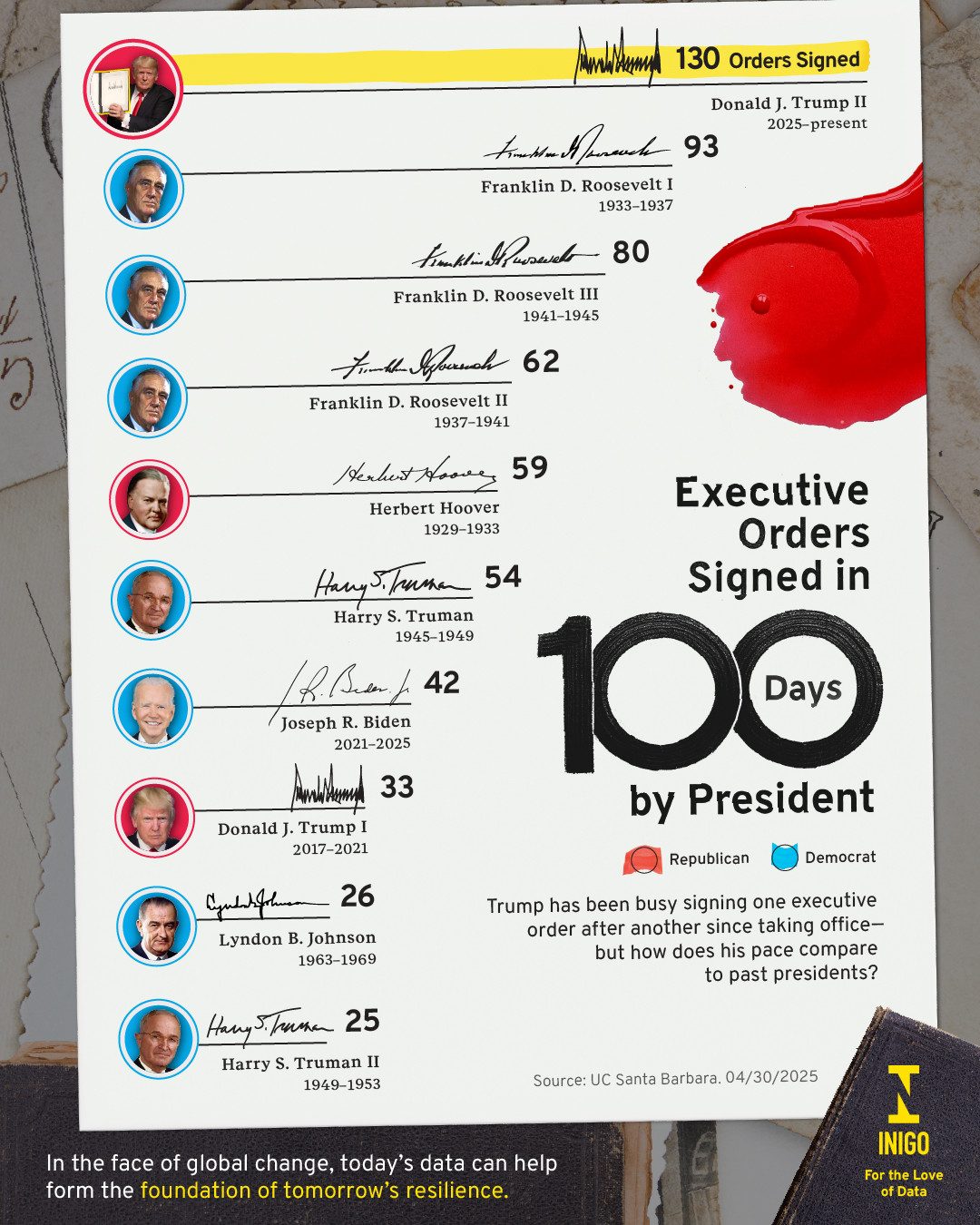
Presidential Executive Orders
Executive orders are directives issued by the President of the United States to manage operations within the federal government. These orders are an essential tool for presidential action and can cover a wide range of topics, from immigration and environmental policies to economic regulations and national security measures. Below, we explore the usage of executive orders by various presidents, highlighting the most prolific signers and comparing their actions to the broader historical context.
Why This Matters
Understanding the use of executive orders by U.S. presidents is crucial for grasping the dynamics of power and governance in the American political system. These orders can significantly impact policy without requiring congressional approval, making them a powerful tool for executive action. Analyzing the frequency and context of executive orders provides insights into presidential leadership styles, policy priorities, and the evolving role of the executive branch.
Main Discussion
Historical Context of Executive Orders
Executive orders have been used by every U.S. president, but their frequency and significance vary widely. Franklin D. Roosevelt stands out as the most prolific user of executive orders, having signed 130 during his first 100 days in office. This period was marked by the Great Depression and the need for swift economic reforms, which necessitated decisive executive action. Roosevelt's use of executive orders was instrumental in implementing the New Deal, a comprehensive set of programs aimed at stabilizing the economy and providing relief to Americans.
Notable Presidents and Their Executive Orders
-
Franklin D. Roosevelt (1933-1937 & 1941-1945)
- Orders Signed: 130 and 80 respectively.
- Context: Roosevelt's tenure was dominated by the Great Depression and World War II. His extensive use of executive orders reflects the urgency and scope of the challenges he faced. These orders facilitated rapid policymaking and implementation, from economic relief programs to military mobilization.
-
Herbert Hoover (1929-1933)
- Orders Signed: 59
- Context: Hoover's term was also marked by the early stages of the Great Depression. His use of executive orders, though fewer than Roosevelt's, was still significant in addressing the economic crisis through various relief and recovery measures.
-
Harry S. Truman (1945-1949 & 1949-1953)
- Orders Signed: 54 and 25 respectively.
- Context: Truman's presidency spanned the end of World War II and the onset of the Cold War. His executive orders covered a range of issues, from military reorganization to the establishment of the Central Intelligence Agency (CIA) in 1947.
-
Joseph R. Biden (2021-2025)
- Orders Signed: 42
- Context: Biden's early days as president have been marked by a focus on addressing the COVID-19 pandemic and reversing some of his predecessor's policies. His executive orders have covered issues such as environmental regulations, healthcare, and immigration.
Comparison of Republican and Democrat Presidents
The use of executive orders by Republican and Democrat presidents reveals interesting patterns. On one hand, Republican presidents like Herbert Hoover and Donald J. Trump, while prolific, have often used them to roll back regulations and implement conservative policies. Herbert Hoover’s executive orders were critical in addressing the early stages of the Great Depression, while Trump's 33 orders in his first term focused on issues like immigration, healthcare, and environmental regulations. On the other hand, Democrat presidents, including Roosevelt and Biden, have used executive orders to implement progressive policies, particularly in economic and social reforms.
Donald J. Trump and Executive Orders
Donald J. Trump's presidency stands out as one of the most active in terms of executive orders, particularly in his first 100 days, during which he signed 143. His use of executive orders was more than double that of many previous presidents, reflecting his aggressive approach to policy implementation. Trump's orders covered a wide range of topics, including immigration, healthcare, and environmental regulations. His pace of signing orders was notable, though not unprecedented, and reflects a strategy of using executive powers to achieve policy goals amid a divided government.
Practical Tips
For those interested in understanding and analyzing executive orders, consider the following tips:
- Review Historical Data: Utilize resources like those provided by UC Santa Barbara, which compile data on executive orders signed by various presidents.
- Contextual Analysis: Look at the broader context, including the political climate, economic conditions, and major events during a president’s term. This context helps explain the frequency and purpose of executive orders.
- Policy Impact: Evaluate the long-term impact of executive orders on policy and governance. Some orders have had lasting effects, while others were reversed or modified by subsequent administrations.
- Comparative Analysis: Compare the use of executive orders by different presidents to identify trends and patterns, such as the differences between Republican and Democrat presidents.
Important Takeaways
- Executive orders are a powerful tool for presidential action, allowing for swift policy implementation without congressional approval.
- Historical context plays a crucial role in understanding why and how presidents use these orders.
- Trend analysis reveals that presidents like Roosevelt and Trump have been particularly prolific in issuing executive orders, reflecting their aggressive policy agendas.
- Partisan differences exist in the types of policies addressed by executive orders, with Republicans often focusing on deregulation and Democrats on implementing progressive policies.
Conclusion
Executive orders are a fundamental aspect of the U.S. presidential system, offering a direct means for implementing policy and navigating political challenges. From the Great Depression to the COVID-19 pandemic, these orders have been pivotal in shaping the nation's response to crises and implementing key policy initiatives. Whether you're a political enthusiast, a student of history, or someone interested in governance, understanding the role and impact of executive orders provides a deeper appreciation for the complexities of American politics.
Watch the Reel
Questions readers ask
How many executive orders did Donald Trump sign during his first 100 days in office?
Donald Trump signed 19 executive orders in his first 100 days. This number is significantly lower than Franklin D. Roosevelt, who signed 130 during the same period.
What are some of the key differences between executive orders and legislation?
Executive orders are issued by the president and do not require congressional approval, while legislation must be passed by both the House and Senate and signed by the president. Executive orders have the force of law but can be more easily reversed by future presidents. They are often used to implement existing laws or to set policy direction within the executive branch.
Which presidents have signed the most executive orders?
The presidents who have signed the most executive orders are Franklin D. Roosevelt with 3,721, followed by Harry S. Truman with 907, and Woodrow Wilson with 1,803. These numbers reflect the significant use of executive orders by some presidents to implement their policy agendas.
How do Trump's executive orders compare to those of other presidents?
Trump issued a total of 220 executive orders during his presidency. This number is relatively low compared to other presidents, such as FDR. However, the impact of these orders varied widely, affecting policies on immigration, environmental regulations, and economic measures.
Can executive orders be challenged or overturned?
Yes, executive orders can be challenged in court and may be overturned if deemed unconstitutional or if they exceed the president's authority. They can also be revoked by future presidents, making them a subject of ongoing legal and political debate.
What are the most common topics addressed by presidential executive orders?
Executive orders cover a wide range of topics, but some of the most common include national security, immigration, environmental regulations, and economic policies. These orders are used to manage federal operations and implement policy changes without needing congressional approval.
Related deep dives
Similar reads based on topic and creator.


Recent articles
Fresh deep dives from the latest Reels we unpacked.




Comments
Be the first to comment.